

Is Tirzepatide Safe? A Doctor-Led Guide to Weight Loss Safety in 2026
The question isn't whether tirzepatide works. The real question is whether it's safe for you. And if you've spent any time searching online, you've likely encountered a confusing mix of clinical trial data, alarming forum posts, and grey-market products that make answering that question feel almost impossible.
That anxiety is completely understandable. Concerns about nausea, long-term thyroid effects, and the growing number of unregulated versions being sold online are legitimate things to think through before starting any new treatment. You're right to ask hard questions.
So, is tirzepatide safe? The honest clinical answer is that safety isn't just a property of the medication itself. It's a product of how it's prescribed, monitored, and adjusted over time. This guide cuts through the noise to give you a clear picture of what the evidence actually shows, what risks are real versus overstated, and why physician supervision changes the equation entirely. You'll come away knowing exactly what to look for in a safe program, how to tell FDA-approved treatments apart from unverified alternatives, and what steps genuinely reduce your risk from day one.
Key Takeaways
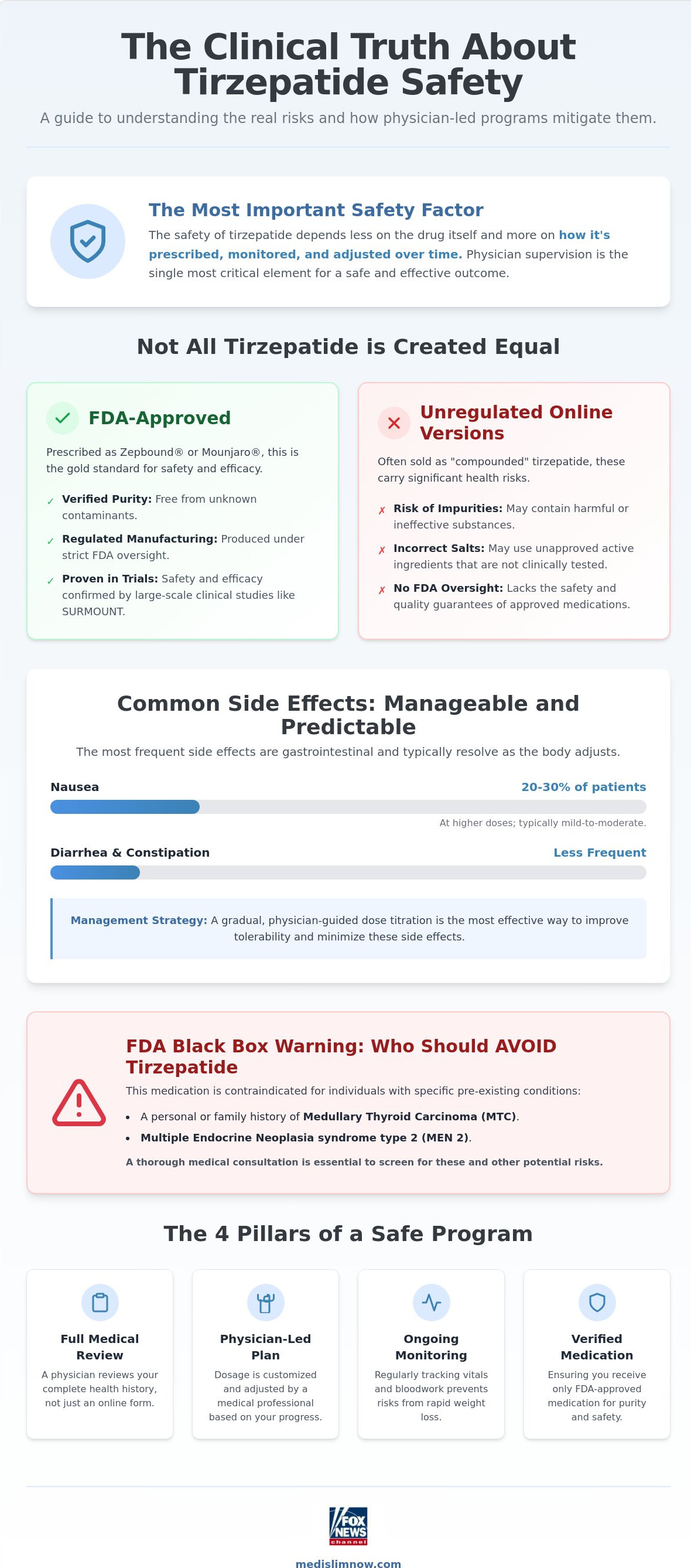
- Is tirzepatide safe? The answer depends less on the drug itself and more on how it's prescribed, monitored, and adjusted — which is why physician supervision is the single most important safety factor.
- Not all tirzepatide is equal: compounded versions sold online can contain incorrect salts or impurities that FDA-approved formulations do not, and knowing the difference could protect your health.
- Common side effects like nausea and digestive discomfort are real but manageable — and clinical data shows most patients tolerate tirzepatide well when doses are increased gradually under medical guidance.
- Losing weight too quickly carries its own risks, including nutritional deficiencies, which is why structured programs that monitor vitals and bloodwork matter as much as the medication itself.
- Before starting treatment, a comprehensive medical consultation — including a full health history review — is the step that separates a safe program from a risky one.
Understanding Tirzepatide Safety: FDA Approval and Clinical Data
Tirzepatide is a dual GIP (glucose-dependent insulinotropic polypeptide) and GLP-1 (glucagon-like peptide-1) receptor agonist. In plain terms, it activates two separate hormonal pathways that regulate blood sugar, appetite, and fat storage simultaneously. That dual mechanism is what sets it apart from earlier weight loss medications, and it's central to understanding tirzepatide's pharmacology and approval history.
The FDA approved tirzepatide under two distinct indications. Mounjaro received approval for type 2 diabetes management in May 2022. Zepbound followed in November 2023, approved specifically for chronic weight management in adults with obesity or weight-related conditions. These aren't the same approval applied to two uses. Each went through its own clinical review process, with separate trial data evaluated for safety and efficacy in each target population.
That distinction matters for patients. When physicians prescribe tirzepatide for weight loss, they're working from a specific evidence base built around that indication, not extrapolating from diabetes data. The SURMOUNT trial program, which supported Zepbound's approval, enrolled thousands of participants and tracked outcomes over extended periods, providing regulators with a detailed picture of how the medication performs and what risks it carries in a weight management context.
Asking is tirzepatide safe is the right question. But "safe" has a precise clinical meaning: the benefits demonstrably outweigh the risks for a defined population, under defined conditions. FDA approval confirms that threshold has been met. It doesn't mean risk-free. It means the evidence supports use when the right patients are selected and the medication is properly managed.
The Dual-Action Advantage
Targeting two hormonal pathways rather than one gives physicians more flexibility in managing both dosage and tolerability. GIP activation, in particular, appears to moderate some of the gastrointestinal effects associated with GLP-1 agonists alone, which may explain why many patients report a smoother adjustment period. Dual-action mechanisms represent the next generation of weight loss safety, offering a more balanced physiological response than single-pathway predecessors. To understand exactly how this works in practice, how does tirzepatide work breaks down the science in detail.
Who Should Avoid Tirzepatide?
Certain contraindications are firm. Tirzepatide is not appropriate for anyone with a personal or family history of medullary thyroid carcinoma (MTC), a specific type of thyroid cancer. It's also contraindicated in patients with Multiple Endocrine Neoplasia syndrome type 2 (MEN 2), a genetic condition that significantly elevates MTC risk. These aren't theoretical concerns; they're the basis of a black box warning on the label.
Other individual factors, including certain pancreatic conditions and specific medication interactions, also require careful review before starting treatment. A thorough medical consultation is the only reliable way to identify and clear these risks. No online questionnaire substitutes for a physician reviewing your complete health history.
Common Side Effects vs. Rare Risks: What the Data Shows
Side effect lists can be genuinely alarming when you read them without context. Every possible adverse event gets equal billing, which makes a mild, temporary bout of nausea look as serious as a rare surgical complication. That framing doesn't serve patients well. Understanding is tirzepatide safe requires separating what's common and manageable from what's genuinely rare and serious.
The SURMOUNT trials, which formed the clinical backbone of Zepbound's FDA approval, documented gastrointestinal effects as the most frequently reported side effects. Nausea was the most common, reported by roughly 20 to 30 percent of participants at higher doses. Diarrhea and constipation appeared less frequently. These numbers sound significant until you factor in a critical detail: the vast majority of these episodes were mild to moderate in severity, and most resolved as the body adjusted to the medication. They weren't reasons to stop treatment. They were expected responses during a defined adjustment window.
The more serious categories, pancreatitis and gallbladder disease, appear in the prescribing literature as risks to monitor. They're real, but their incidence in clinical trials was low. Reviewing the clinical safety profile and contraindications of tirzepatide from NCBI confirms that these events were uncommon in trial populations and that patients with relevant risk factors were identified and managed before they became problems. That's exactly the role physician oversight plays.
Managing Gastrointestinal Comfort
Timing and dose progression matter more than most patients realize. The "slow and low" titration approach, starting at a minimal dose and increasing gradually over weeks, is the single most effective strategy for reducing GI discomfort. Smaller, more frequent meals reduce gastric load. Staying well-hydrated supports digestion. Avoiding high-fat or heavily processed foods during the early weeks makes a measurable difference. For a detailed breakdown of how dosing and outcomes connect in practice, tirzepatide for weight loss covers the clinical picture comprehensively.
The Truth About 'Stomach Paralysis' Rumors
Gastroparesis, a condition where the stomach empties too slowly, has circulated widely online as a feared consequence of GLP-1 class medications. It's worth being precise here. Clinically significant gastroparesis is extremely rare in tirzepatide trial data. What some patients experience is a temporary slowing of gastric motility, which is actually part of how the medication reduces appetite. That's a mechanism, not a malfunction.
The difference between an internet forum post and a clinical trial involving thousands of monitored patients is the difference between an anecdote and evidence. Physician monitoring catches early signs of digestive slowing and adjusts the treatment plan before minor discomfort becomes a clinical concern. That's not a theoretical benefit; it's what structured medical supervision is designed to do. If you're weighing your options, a physician-supervised weight loss consultation is the most direct way to assess your individual risk profile before starting treatment.
Safety Myth-Busting: Compounded Drugs and Online 'Red Flags'
Here's a myth worth dismantling directly: not all tirzepatide is the same. The version your physician prescribes through a licensed, regulated program and the vial that arrives in a padded envelope after a quick online checkout are not equivalent products. They may share a name. They don't share the same safety profile.
Compounded tirzepatide exists in a fundamentally different regulatory category from FDA-approved Zepbound. Compounded preparations are not reviewed or approved by the FDA for safety, efficacy, or quality before they reach patients. That's not a technicality. It means no independent verification that the active ingredient is correctly identified, that the salt form is appropriate, or that the product is free from contaminants. The FDA approval of tirzepatide for chronic weight management applies specifically to Zepbound, manufactured under strict quality controls. A compounded version carries none of those assurances.
In 2025 and into 2026, the FDA moved to restrict compounded tirzepatide as Zepbound's shortage status was resolved, citing ongoing concerns about the grey market for GLP-1 class medications. Patients ordering from unverified online sources may be receiving products with incorrect dosing concentrations, unverified purity, or substituted salt forms that behave differently in the body. A deep discount on a weight loss injection isn't a bargain. It's a signal that something in the supply chain has been cut.
How to Spot a Dangerous Online Pharmacy
Certain red flags are consistent and recognizable. Watch for any of these before placing an order:
- No prescription or physician screening required. Legitimate tirzepatide programs require a medical evaluation before dispensing. A site that skips this step is operating outside safe prescribing standards.
- No licensed physician available for follow-up. If you can't reach a doctor after starting treatment, you have no clinical safety net.
- Medication arriving in unlabelled or damaged packaging. Proper pharmaceutical products include clear labelling, lot numbers, and storage instructions. Anything less suggests an uncontrolled supply chain.
- Prices that seem implausibly low. Legitimate compounding pharmacies operate under regulatory oversight that has real costs. Prices far below market norms typically reflect corners being cut somewhere that matters.
Why Clinic-Based Care Is the Gold Standard
Physician-supervised programs like those offered at Medi Slim in the Richmond area operate through what's known as a closed-loop pharmacy system. Medication is sourced from verified, licensed pharmacies, dispensed under physician oversight, and administered as part of a monitored treatment plan. There's no ambiguity about what's in the vial or where it came from.
That structure also means patients aren't navigating injections alone. Self-administering any injectable medication without proper guidance introduces unnecessary risk, from incorrect injection technique to missed early warning signs. A step-by-step patient guide developed within a clinical program gives patients the specific, practical knowledge they need before their first dose. That's a meaningful difference from a PDF downloaded alongside an unverified product.
Asking is tirzepatide safe only makes sense when you're talking about verified tirzepatide. The source of your medication is part of the safety equation, not a secondary concern.
Clinical Oversight: The Secret to Safe Weight Loss
Weight loss is a physiological transformation, not just a change in appearance. When you lose weight rapidly, your body undergoes significant metabolic shifts that require professional monitoring to remain beneficial. Asking is tirzepatide safe involves looking past the medication itself and focusing on the clinical framework surrounding its use. Without a doctor's eye, rapid weight loss can lead to unintended consequences like nutritional deficiencies or electrolyte imbalances that go unnoticed until they cause symptoms.
The Medi Slim approach treats weight loss as a managed medical process. This includes regular monitoring of vitals and periodic blood work to ensure your internal health keeps pace with your external progress. By tracking markers for kidney function, liver health, and nutrient levels, physicians can adjust your protocol in real time. This personalized dosing ensures you receive the minimum effective dose needed for results while maximizing your safety profile. It transforms the experience from a trial-and-error effort into a precise medical strategy.
Styku 3D Scanning: Monitoring Health Beyond Weight
The number on a traditional scale is a blunt instrument. It cannot distinguish between the fat you want to lose and the lean muscle mass you need to keep. Preserving muscle is a critical safety metric because muscle drives your resting metabolic rate and supports long-term health. If you lose too much muscle during your journey, your metabolism may slow down, making weight maintenance much harder later on.
We use Styku 3D Body Composition Analysis to provide a clear picture of exactly what you are losing. These scans allow us to verify that your weight loss is coming from adipose tissue rather than vital lean mass. It provides a level of data that helps us fine-tune your nutrition and activity levels throughout the program. For a deeper look at why this technology is essential, see our guide on tracking tirzepatide results with styku.
The Value of Local Richmond Access
Safety is also about accessibility. National telehealth platforms often feel faceless, leaving patients to navigate side effects or concerns through chatbots or delayed email chains. There is a measurable safety benefit to having a physical clinic in Glen Allen or Midlothian where you can speak with a medical team in person. If you have a question about a symptom or need a dose adjustment, you aren't waiting on a national queue.
Local, physician-led care reduces the anxiety that often accompanies medical weight loss. Knowing that a licensed professional in your own community is overseeing your health history and current progress provides a level of security that digital-only platforms cannot match. If you are ready to move forward with a program designed for your specific health profile, schedule a medical weight loss consultation at one of our Richmond area locations today.
Your Safety Checklist: Getting Started with Tirzepatide
Safety isn't a one-time approval; it's an ongoing protocol. When patients ask is tirzepatide safe, they're often looking for a green light to begin. However, the highest level of safety is achieved through a structured, step-by-step entry into the program. Following a clinical checklist ensures that your health history, current physiology, and future progress are all aligned before your first dose.
- Step 1: Schedule a comprehensive medical consultation. This is the most critical step. A licensed physician must evaluate your BMI, metabolic health, and weight loss goals to determine if you are a candidate for treatment.
- Step 2: Share your full medical history. Be transparent about any history of pancreatitis, kidney issues, or gallbladder disease. Your doctor needs this data to assess your individual risk profile accurately.
- Step 3: Establish a baseline with a Styku 3D body scan. Knowing your starting fat percentage and muscle mass allows your medical team to monitor your health beyond just the number on the scale.
- Step 4: Start at the lowest dose. Clinical protocols begin with a minimal dose to assess your body's tolerance. This "titration" phase is designed to minimize gastrointestinal discomfort while your system adjusts.
- Step 5: Maintain a direct line of communication. Safety requires a feedback loop. You should have a clear way to report symptoms and ask questions as your dose increases over time.
Preparing for Your First Consultation
Your first visit is a two-way conversation. To get the most out of your appointment, bring a complete list of all current medications, vitamins, and supplements. Some substances can interact with how your body processes GLP-1 medications, so nothing is too small to mention. We encourage our Richmond patients to adopt a safety-first mindset. Don't hesitate to ask your doctor specific questions, such as:
- How will we monitor my kidney function during treatment?
- What is the specific plan if I experience persistent nausea?
- Based on my health history, what are my specific risk factors?
Having these answers helps replace anxiety with a clear, manageable plan. It moves the conversation from general concerns to your specific health reality.
Conclusion: Moving Forward with Confidence
The clinical evidence and real-world data from 2025 and 2026 support a clear conclusion. Tirzepatide is a safe, revolutionary tool for chronic weight management when it's used within a supervised medical framework. The risks that dominate internet headlines are largely manageable or avoidable when you have a physician monitoring your progress and verifying the source of your medication.
You don't have to navigate this journey alone or guess which online sources are reliable. By choosing a local, physician-led program, you ensure that your transformation is supported by clinical expertise and advanced monitoring technology. If you're ready to take the first step toward a healthier version of yourself, schedule your safety consultation at Medi Slim today. Our team is here to provide the professional oversight and personalized care you need to reach your goals safely.
Start Your Transformation with Professional Confidence
The clinical evidence is clear: when managed by medical professionals, tirzepatide is a reliable and transformative tool for chronic weight management. You've seen that the answer to is tirzepatide safe depends heavily on the quality of your medication and the depth of your clinical monitoring. By avoiding unregulated online sources and choosing a program that prioritizes your unique health profile, you can significantly reduce the risk of side effects and nutritional gaps.
At Medi Slim, we don't just provide a prescription. We provide continuous oversight through physician check-ins and advanced Styku 3D Body Composition Analysis to ensure you're losing fat while protecting vital muscle mass. With local clinics in Henrico, Midlothian, and Mechanicsville, your medical team is always accessible to answer questions and adjust your plan in real time. You deserve a weight loss journey that is as safe as it is effective.
Book Your Physician-Supervised Tirzepatide Consultation in Richmond and take the first step toward a healthier future today. We're ready to partner with you every step of the way.
Frequently Asked Questions
Is tirzepatide safer than semaglutide for weight loss?
Both medications are clinically validated and FDA-approved for weight management. Tirzepatide utilizes a dual-action mechanism that targets two hormonal pathways, which some studies suggest may offer better gastrointestinal tolerability for certain patients. Neither drug is universally "safer," as the best choice depends entirely on your individual medical history and how your body responds to the initial titration phase.
Can tirzepatide cause long-term thyroid problems?
Current clinical data shows a potential risk for medullary thyroid carcinoma (MTC) in animal studies, which is why a black box warning exists. While no definitive link has been established in humans, we prioritize your health by screening for a personal or family history of thyroid cancer. This rigorous screening process is essential to determine if tirzepatide is safe for your specific genetic profile.
What should I do if I experience severe nausea on tirzepatide?
You should contact your medical team immediately if nausea becomes persistent or prevents you from staying hydrated. Do not attempt to skip or change your doses without professional guidance. Your physician can provide anti-nausea strategies or adjust your titration schedule to help your system adapt. Maintaining adequate fluid intake and eating smaller, frequent meals can often mitigate these symptoms during the adjustment period.
Is it safe to buy tirzepatide from an online compounding pharmacy?
Buying from unverified online sources is generally considered risky because these products lack the rigorous FDA oversight applied to brand-name medications. Unregulated compounded versions may contain incorrect salt forms or hidden impurities. To ensure your tirzepatide is safe, it's vital to source medication through a licensed clinical program that uses verified, regulated pharmacies and provides direct physician oversight.
How does medical supervision make tirzepatide safer?
Supervision transforms weight loss from a self-guided experiment into a monitored medical process. At Medi Slim, we use regular blood work and Styku 3D scans to track your metabolic health and muscle preservation. This allows us to catch early signs of dehydration or nutritional gaps before they become serious issues. Professional oversight ensures your dosage is always optimized for both safety and results.
Can I take tirzepatide if I have a history of kidney disease?
Patients with a history of kidney disease require extra caution and frequent monitoring. Because gastrointestinal side effects can lead to dehydration, there is a risk of worsening renal function if fluids aren't managed correctly. While it's not strictly prohibited for all cases, you must have a physician review your latest lab results to determine if the medication is appropriate for your current stage of kidney health.
What are the most common long-term side effects of tirzepatide?
The most common side effects documented in long-term studies remain gastrointestinal, including nausea, constipation, and diarrhea. Most of these issues are transient and occur primarily when increasing your dose. While long-term data collection is ongoing, current clinical evidence hasn't revealed significant new safety concerns in patients who have used the medication for several years under proper medical guidance.
Is tirzepatide safe for women planning to become pregnant?
Tirzepatide is not recommended for women who are pregnant or planning to conceive in the near future. The current clinical recommendation is to discontinue the medication at least two months before trying to become pregnant to ensure it is completely out of your system. If you discover you're pregnant while on the program, you should contact your doctor immediately to pause your treatment.