

Short Pump Weight Loss Doctor: Choosing Medical Care
What should you look for in a Short Pump weight loss doctor when your health history, treatment options, and ongoing support all matter? Choosing medical care means more than finding a plan or asking about medication. It helps to understand how recommendations are made, what professional oversight involves, and how progress will be reviewed.
A medical weight loss consultation can turn questions about your goals and health into a personalized discussion. At Medi Slim, physician-supervised consultations support treatment decisions, with prescription-based Semaglutide and Tirzepatide among the available options. Styku 3D body composition analysis can also track changes in fat and muscle, adding context beyond scale readings alone.
This article explains what to look for in a medical weight loss provider, how supervised treatment differs from self-directed plans, and what to discuss at an initial consultation. It also covers Medi Slim’s Richmond-area care for people in Short Pump and nearby communities, including Henrico, Mechanicsville, Midlothian, and Glen Allen.
Key Takeaways
- Medical weight management uses your health profile to inform care, making professional support a practical option rather than a test of willpower.
- Assess a Short Pump weight loss doctor by looking at clinical oversight, personalized planning, progress tracking, and follow-up.
- Compare self-directed efforts, general wellness support, and physician-supervised care to understand how oversight and treatment decisions differ.
- Prepare for your consultation by gathering your health history, current medication details, goals, and questions.
- Medi Slim’s consultations, prescription treatment options, and Styku body composition analysis support medically supervised weight management in the Richmond area.
Choosing a Short Pump Weight Loss Doctor: What Medical Care Should Include
Seeking help with weight management is a practical health decision, not a personal failing. If self-directed diets or general wellness advice haven’t met your needs, clinician-guided care can take your health history, goals, and circumstances into account. A useful first step is understanding how medical care differs from general advice.
Medical weight management is clinician-guided care that uses an individual’s health profile to inform a plan and its review. General weight-loss advice may offer broad habits or strategies, but it may not account for your medications, health conditions, or other factors relevant to treatment. For background on the wider topic, see this Weight loss overview.
When a medical weight loss doctor may be worth considering
A consultation may be useful when repeated self-directed efforts haven’t suited your needs or when you want guidance that takes your health into account. That doesn’t mean everyone seeking weight loss needs prescription medication. A clinician’s role is to assess whether medical treatment is appropriate and discuss options in context, rather than assume one approach suits everyone.
Your health history helps shape that assessment. Current medications, existing health concerns, previous approaches, and your goals can all inform the conversation. For example, a plan that sounds suitable in general may need to be reconsidered in light of someone’s individual health profile. A medical consultation helps make those distinctions before treatment decisions are made.
What Short Pump-area patients should expect from clinical oversight
Clinical oversight should involve more than choosing a target weight or discussing medication. Expect a clinician to review your goals and relevant health history, consider whether a proposed treatment is suitable, and explain how the decision relates to your circumstances. The assessment should guide the plan. Medication is one possible option, not an automatic step.
Ask how progress will be reviewed and what information can help guide those discussions. The scale is one measure, but body composition can add context. Medi Slim offers Styku 3D body composition analysis to track changes in fat and muscle as part of progress monitoring. These measurements can help you discuss changes beyond a single number, without treating any one measure as the whole picture.
For people searching from Short Pump, Medi Slim provides physician-supervised medical weight loss consultations in the Richmond area. The important distinction is that treatment decisions are individualized and based on professional assessment. A thoughtful process helps you understand the reasoning behind your care, whether or not prescription treatment is appropriate.
How to Evaluate a Short Pump Weight Loss Doctor Before Choosing Care
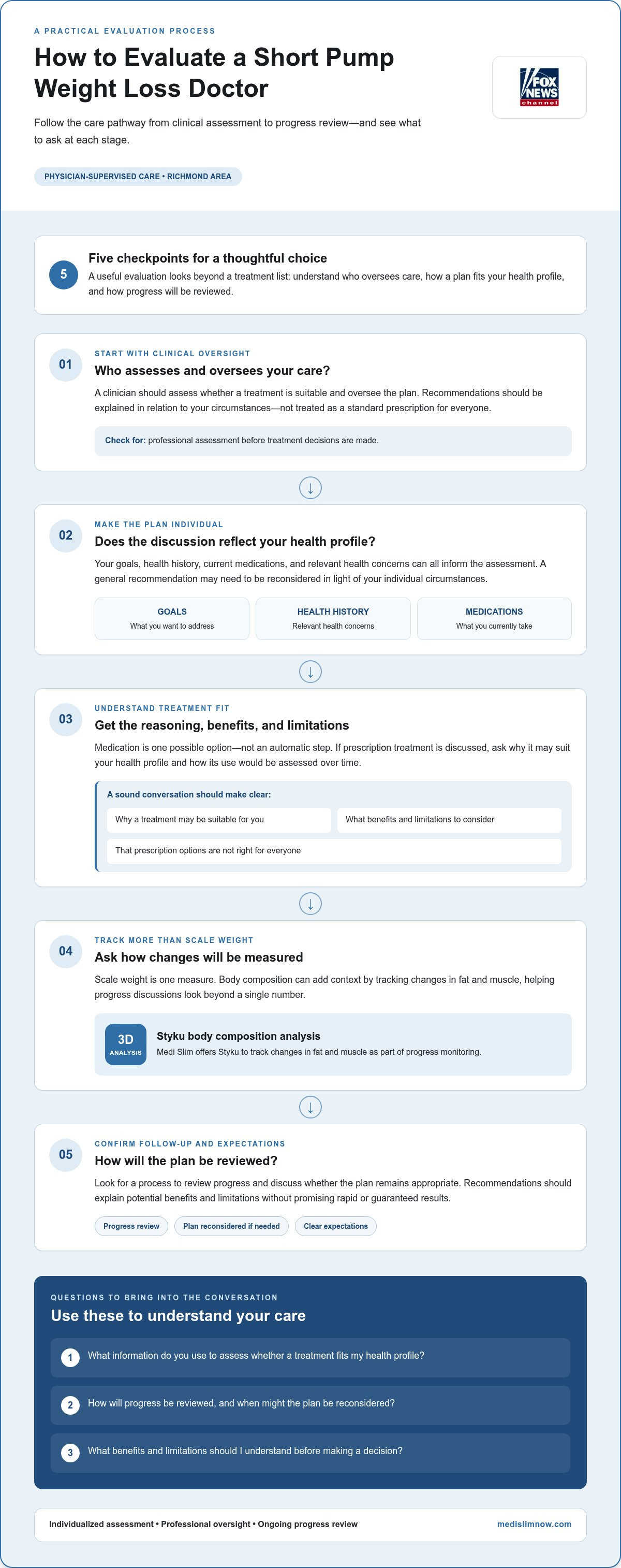
A helpful evaluation looks beyond a list of treatments. You should be able to understand who oversees care, how the plan relates to your health profile, and what progress reviews may involve. These details distinguish physician-supervised medical weight management from general wellness support, which may offer useful habits but not individualized clinical assessment or prescription decisions.
Use this checklist to guide your comparison:
- Clinical supervision: Is a clinician involved in assessing treatment suitability and overseeing the plan?
- Individualized planning: Does the discussion consider your goals, health history, and current medications rather than rely on a standard recommendation?
- Progress tracking: How will changes be reviewed, and are measurements used beyond scale weight?
- Follow-up: Is there a process for reviewing progress and discussing whether the plan remains appropriate?
- Clear expectations: Are potential benefits and limitations discussed without promises of rapid or guaranteed results?
A treatment recommendation should connect clearly to your circumstances. If medication is discussed, ask why it may be suitable for you and how its use would be assessed over time. Prescription options aren’t right for everyone, and a consultation should support an informed decision rather than assume a particular treatment is necessary. For an overview of prescription approaches, explore this prescription weight loss medication guide.
Questions that help you assess treatment fit
Bring practical questions to the conversation. Ask how your goals and health history inform the assessment, what factors affect treatment suitability, and what progress reviews may involve. Share your current medications and relevant health information so the clinician can consider them when discussing options. You can also ask how the plan might be reviewed if your needs or progress change.
- What information do you use to assess whether a treatment fits my health profile?
- How will progress be reviewed, and when might the plan be reconsidered?
- What benefits and limitations should I understand before making a decision?
Direct answers help you understand the recommendation and how it relates to your individual assessment. A Short Pump weight loss doctor should connect the discussion to your circumstances, not just to a general promise or a single number on the scale.
Why progress tracking should be broader than the scale
Body weight can be a useful measure, but it doesn’t describe every change in body composition. Tracking changes in fat and muscle can add context when you review progress with a clinician. Medi Slim offers Styku 3D body composition analysis for this purpose. Learn how Styku progress tracking with Semaglutide can complement scale readings in a progress discussion.
If you’re considering supervised care, a medical weight loss consultation can help you discuss your goals, health information, and appropriate treatment options with a clinician.
Comparing Medical Weight Loss Options Near Short Pump
Weight loss approaches differ in the kind of guidance they provide. Self-directed efforts offer flexibility, while general wellness support may provide broad advice or accountability. Physician-supervised medical weight management adds a clinical assessment to help determine whether treatment is appropriate for your health profile. The right fit depends on the support you need, not on a promise that one method works for everyone.
| Approach | Oversight and personalization | Prescription decisions | Progress measurement |
|---|---|---|---|
| Self-directed efforts | You choose and manage your approach independently. | No clinician-led medication assessment is built in. | You choose what to track, which may include weight or personal goals. |
| General wellness support | May provide broad guidance or encouragement, depending on the service. | Prescription suitability isn’t typically the focus of general wellness advice. | Tracking methods vary and may follow general goals. |
| Physician-supervised care | A clinician assesses your circumstances and informs an individualized plan. | A prescribing clinician considers whether medication is suitable. | Progress information can support reviews and discussion of the plan. |
What physician-supervised care adds to a weight loss plan
Medical oversight connects treatment choices to an assessment rather than a generic recommendation. A consultation can take your health information and goals into account, while progress measurements and follow-up discussions provide context for reviewing the plan. That structure can help you understand why an option is being considered, what its limitations are, and what information may guide later decisions. Medication doesn’t replace clinician guidance, and no plan can guarantee a specific result.
For Short Pump residents comparing local options, a Short Pump weight loss doctor should be able to explain how clinical assessment, treatment decisions, and follow-up relate to one another. Medi Slim provides physician-supervised consultations for individualized medical weight management in the Richmond area, including for people in Henrico, Mechanicsville, Midlothian, and Glen Allen.
How prescription options fit into an individualized plan
Prescription medication is one possible part of medical weight management, not a universal starting point. Medi Slim offers Semaglutide and Tirzepatide as prescription options when clinically appropriate. The prescribing clinician determines suitability based on individual circumstances. A medication name alone can’t establish that it’s the right fit for you. A useful discussion covers why an option is being considered and how your care will be reviewed.
For medication-specific context, read about Semaglutide weight loss care in Richmond and Tirzepatide weight loss treatment. If you’re ready to explore how supervised care relates to your goals, a medical weight loss consultation can help you take an informed next step.
Preparing for a Weight Loss Consultation Near Short Pump
A little preparation can make your first conversation clearer and more useful. You don’t need to arrive with a perfect plan. Bring information that helps a clinician understand your health, priorities, and previous experiences. The discussion can then help identify a personalized path without assuming that a particular treatment or result is right for everyone.
Information to bring to your first discussion
Before meeting with a Short Pump weight loss doctor, take a few minutes to gather key details. A short written summary can help you remember important points and leave more time for questions.
- List your current medications. Include prescription medicines and other products you take, along with any relevant changes you’ve made.
- Summarize relevant health history. Note health concerns, past evaluations, and other details you think may matter to the conversation.
- Describe previous weight management approaches. Include what you tried, what felt manageable, and what didn’t meet your needs. This helps explain your experience without judging it.
- Set realistic goals and priorities. Think about what you hope to address and which concerns matter most. You can discuss and refine your goals with the clinician.
- Write down questions. Ask about treatment suitability, how progress may be reviewed, and what follow-up could involve. Share new concerns or changes openly during the discussion.
Quick preparation checklist: health history, current medications, past approaches, personal goals, and questions for the clinician. This summary helps organize the visit, but it doesn’t determine which treatment is appropriate.
How to assess whether the care approach feels right
Notice how the clinician explains the assessment and recommendations. You should be able to understand how your health information relates to the options under discussion, including the potential limitations of a proposed approach. Respectful communication matters too. You should feel able to raise concerns, ask for clarification, and discuss what matters to you without pressure.
Before beginning a plan, make sure you understand how follow-up works and what information may be used to review progress. If body composition tracking is part of the discussion, ask how those measurements add context to a progress review. It’s reasonable to take time to consider what you’ve heard and speak up if an explanation isn’t clear.
Preparing your notes can help you use a medical weight loss consultation for a focused, informed conversation about next steps. To learn more about Medi Slim’s physician-supervised approach, explore Medi Slim medical weight loss.
Medi Slim: Physician-Supervised Weight Loss Care for Short Pump-Area Patients
If you’re looking for a Short Pump weight loss doctor, consider how the care process brings assessment, treatment options, and progress tracking together. Medi Slim provides physician-supervised medical weight loss consultations for people exploring non-surgical weight management. The consultation is an opportunity to discuss your goals and health circumstances and consider what kind of care may be appropriate for you.
What Medi Slim brings to a medically supervised weight loss journey
Medi Slim connects medical weight loss consultations with individualized treatment planning. Semaglutide and Tirzepatide are prescription-based options offered through the practice when clinically appropriate. Whether either is suitable depends on an assessment by the prescribing clinician. The medication itself doesn’t determine what your care should look like.
Progress information can add another useful part to the conversation. Medi Slim offers Styku 3D body composition analysis to track changes in fat and muscle. Alongside scale readings, this can provide additional context when discussing progress. Measurements are information to consider, not a promise of a particular outcome or a substitute for clinical judgment.
Together, consultation, prescription options, and body composition tracking support a medically supervised approach. The clinician’s assessment guides decisions, while progress information can inform discussions over time. This keeps the focus on your circumstances rather than treating one medication or measurement as the right answer for everyone.
A practical next step for Short Pump-area readers
Medi Slim serves the broader Richmond-area community, including people in Short Pump, Henrico, Mechanicsville, Midlothian, and Glen Allen, with physician-supervised consultations and non-surgical medical weight management. The program brings consultation, prescription options, and progress tracking into the care discussion. Consider whether a clinician-guided conversation fits the questions and goals you’ve identified.
Before taking a next step, think about what you’d like to discuss: your health priorities, treatment suitability, and how progress may be followed. You don’t need to arrive with a preferred medication or a fixed plan. A consultation considers your circumstances and discusses an appropriate path without assuming eligibility or promising results.
Explore Medi Slim and take the next step.
Take a Confident Next Step Toward Medical Care
Choosing a Short Pump weight loss doctor is ultimately about finding care that helps you make informed decisions in a way that fits your health needs. You don’t have to settle every question before moving forward. A first conversation can clarify what matters to you and whether a medically supervised approach feels like a practical fit.
Give yourself room to consider the information, ask for clarification, and decide at your own pace. The next step doesn’t need to be a commitment to a particular treatment. It can simply be an opportunity to explore your options with professional guidance.
Explore Medi Slim’s approach to medical weight loss and consider whether a consultation aligns with your goals: Explore Medi Slim medical weight loss care.
A clear, thoughtful conversation can help you move forward with greater confidence, one decision at a time.
Frequently Asked Questions
Is a weight loss doctor different from a dietitian?
Yes. A weight loss doctor can review your health history and assess whether medical treatment may be appropriate, while a dietitian focuses on nutrition guidance and food-related goals. Their roles may complement each other, but they aren’t interchangeable. For example, a clinician may address medical treatment decisions while a dietitian helps with meal-planning questions. Ask who handles prescribing, medical monitoring, and nutrition support in the care model you’re considering.
Do I need a referral to see a weight loss doctor near Short Pump?
Referral requirements can depend on the practice and your insurance plan. A referral requirement and eligibility for a specific treatment are separate questions. If you’re searching for a Short Pump weight loss doctor, keep both in mind as you plan your care. This can also help people around Richmond, Henrico, Mechanicsville, Midlothian, and Glen Allen consider their next step.
How much does medical weight loss care cost?
Costs vary based on the services involved, clinical visits, treatment plan, and any insurance coverage that applies. When reviewing costs, consider what the amount includes, such as consultation, follow-up care, or medication, rather than relying on one advertised figure. A consultation with Medi Slim is an opportunity to discuss your needs and the care involved. Understanding the details of a proposed plan can help you assess its financial scope before deciding whether it suits you.
Can a weight loss doctor prescribe medication during the first visit?
Possibly, but a prescription isn’t automatic or guaranteed at an initial visit. The clinician first considers your health history, goals, current medications, and whether a treatment is appropriate for your circumstances. The assessment and next steps vary by individual. Bring an up-to-date medication list and be ready to discuss relevant health information. Don’t start prescription weight loss medication without guidance from a qualified medical professional, even if someone else has used it successfully.
How long does it take to see progress with medical weight loss?
There’s no single timeline that applies to everyone. Progress can depend on health factors, the care plan, and how your body responds over time. At follow-up, a clinician can help interpret changes and discuss whether the plan remains appropriate. Avoid using another person’s experience or a fixed target date as a forecast for your own results. Ongoing discussion about progress can help keep expectations grounded and decisions focused on your individual care.
What should I bring to a weight loss consultation?
Bring your current medication list, relevant health information, and a brief account of approaches you’ve tried. It can also help to note your priorities and questions, such as what informs treatment decisions or how follow-up is handled. If something has changed since you booked, mention it during the conversation. These notes help the clinician understand your situation, but they don’t determine a particular treatment or guarantee an outcome.