

Why Am I Not Losing Weight on Semaglutide? Common Reasons and Next Steps
If you’re asking, “why am I not losing weight on semaglutide,” an unchanged scale can feel discouraging. It doesn’t necessarily mean the medication has stopped working. Treatment timing, your prescribed dose progression, missed doses, daily routines, and changes in body composition can all affect what you see.
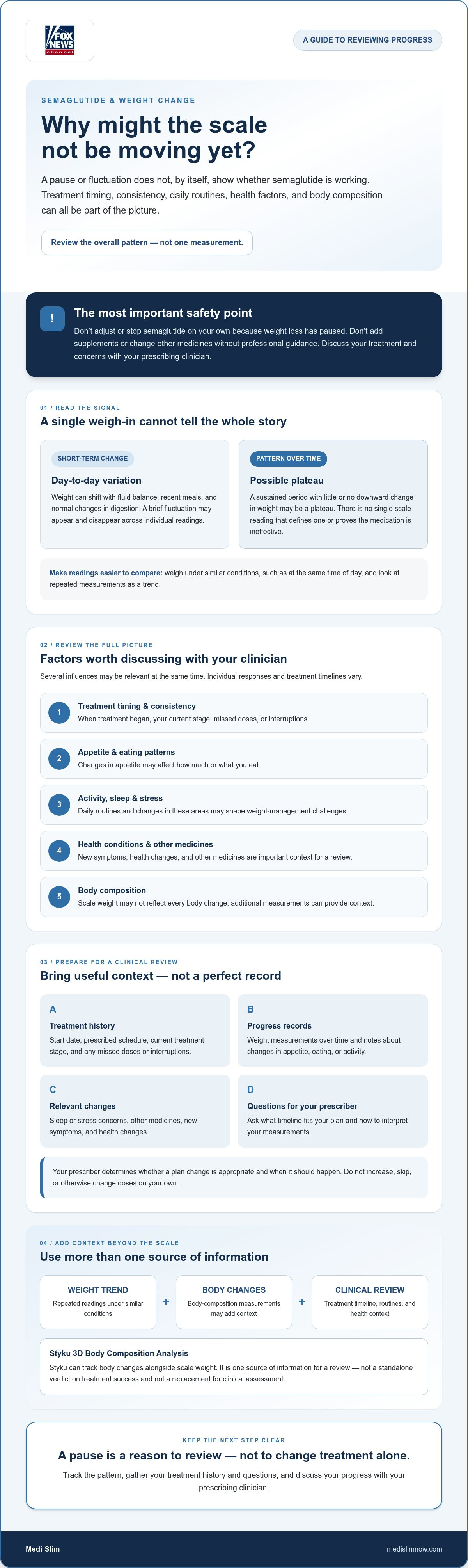
Don’t adjust or stop your medication on your own because weight loss has paused. Progress varies, and the scale may not reflect every change. Your prescribing clinician can review your treatment timeline, how you’re taking semaglutide, and other factors that may be relevant.
This article covers common reasons for limited or stalled progress, what to bring to a clinical review, and how to track changes. Body-composition measurements, including Styku 3D analysis, can provide context alongside scale readings. The next step is to discuss your situation with your prescribing clinician, rather than judging your progress by one measurement.
Key Takeaways
- If you’re wondering “why am I not losing weight on semaglutide,” review your overall treatment history before concluding it isn’t working.
- Consider your prescribed schedule, eating patterns, activity, sleep, health conditions, and other medicines when reviewing progress.
- Look at weight trends over time. A brief fluctuation or plateau alone can’t establish whether semaglutide is effective for you.
- Before contacting your prescriber, gather your treatment history, progress records, and questions. Don’t change or stop medication or add supplements without professional guidance.
- A medical weight-loss consultation can help review your concerns and progress measures. Styku 3D body-composition analysis may add context beyond scale readings.
Why might you not be losing weight on semaglutide yet?
Limited progress early in treatment can be frustrating, especially if you expected the scale to move quickly. But a single weigh-in, or even a short period without a change, can’t show on its own whether semaglutide is working. Individual responses and treatment timelines vary. If you’re asking, “why am I not losing weight on semaglutide,” consider how long you’ve been taking it, your current stage of treatment, and the overall pattern in your measurements.
Semaglutide is used for different medical purposes, and its effects and potential side effects are part of a broader treatment picture. For a general overview of the medication, see Semaglutide. Your clinician can assess your progress in the context of your treatment plan, rather than comparing it with someone else’s experience.
Is it too early to judge semaglutide results?
Your treatment plan may include clinician-directed dose escalation, so you could still be in an early or changing stage of treatment. Make a note of when you started, whether you’ve taken doses as prescribed, and what stage your clinician planned for you to be at now. Ask your prescriber what timeline is appropriate for your individual plan. Don’t increase, skip, or otherwise change doses on your own.
Can the scale miss changes in body composition?
Yes. Day-to-day weight can shift with fluid balance, recent meals, and normal changes in digestion. Weighing under similar conditions, such as at the same time of day, makes readings easier to compare. Look at the trend across repeated measurements rather than focusing on one result. Body-composition tracking may add context, but it doesn’t replace clinical assessment.
A possible weight-loss plateau is a sustained period with little or no downward change in weight, while day-to-day variation is a normal fluctuation that may appear and disappear across individual readings. There’s no single scale reading that defines a plateau or proves the medication is ineffective. Keep a consistent record and discuss a persistent pattern with your clinician.
If the scale is hard to interpret, other measurements may help round out the picture. Styku 3D Body Composition Analysis, available through Medi Slim, can track body changes alongside scale weight. It’s one source of information for a review, not a standalone verdict on treatment success. A medical weight-loss consultation can help you discuss your timeline, measurements, and concerns with physician-supervised care in the Richmond area.
What factors can affect weight loss while taking semaglutide?
If you’re wondering, “why am I not losing weight on semaglutide,” there may be several factors to review. Slower progress doesn’t mean you’ve failed or lack willpower. Individual response depends on multiple clinical and lifestyle factors. Treatment consistency, appetite, eating patterns, activity, sleep, health conditions, and other medicines may all be relevant. Your clinician can help consider how these factors fit together.
How can treatment stage and consistency influence progress?
Review when you began treatment and whether you’ve missed doses or had interruptions. If you’re still in a clinician-directed stage of your plan, your response now may differ from what you and your prescriber expect later. Don’t change the dose or schedule yourself. Your prescriber should determine whether a plan change is appropriate and when it should happen.
Bring a clear treatment history to your review. Note when you started, any interruptions, and questions about the instructions you were given. This can help your clinician consider consistency alongside other possible influences, rather than making assumptions based on the scale alone.
What else should you review with your clinician?
Daily habits can influence progress, but they’re only part of the picture. Changes in appetite may affect how much or what you eat. Activity, sleep, and stress can also shape routines and make weight management more challenging. Describe what your days generally look like; you don’t need to present a perfect record.
Also mention other medicines, new symptoms, or changes in your health. Some medical conditions and medications can affect weight or complicate progress, so your clinician needs the full context to assess your situation. Don’t stop or change another medicine without guidance from the clinician responsible for it.
- When treatment began and any missed doses or interruptions
- Changes in appetite, eating patterns, or activity
- Sleep or stress concerns
- Other medicines and relevant health changes
Weight trends can also change over the course of treatment. A Vanderbilt University School of Medicine article describes distinct stages of weight loss, maintenance, and regain. This is a reminder that progress isn’t always a straight line, but it can’t determine what’s happening in your individual case. For a clearer explanation of how the medication relates to appetite and fullness, read “How Does Semaglutide Work? The Science of Satiety,” if available in this article series.
If you’d like a clinician to review your treatment history and concerns, learn about Medi Slim’s medical weight-loss consultations in the Richmond area.
Is a plateau a sign semaglutide is not working?
Not necessarily. A plateau can be frustrating, but it doesn’t prove that semaglutide has stopped helping or that your treatment is ineffective. Short-term scale changes may reflect normal variation, while a longer period with little change is a pattern to review with your clinician. One measurement can’t answer the question “why am I not losing weight on semaglutide.”
How can you tell a fluctuation from a longer-term stall?
Compare measurements taken under similar conditions and look at the overall trend instead of reacting to a single weigh-in. Schedule changes, illness, and fluid shifts may affect an individual reading. Note relevant circumstances alongside your measurements, then ask your clinician to interpret the pattern in the context of your treatment history. There isn’t one universal time period or scale change that defines a plateau for everyone.
| What you notice | What it may suggest | What to review |
|---|---|---|
| A brief rise or fall | Short-term variation, not necessarily a lasting change | Measurement conditions and recent schedule, health, or fluid changes |
| Little change across repeated measurements | A possible longer-term stall worth discussing | Your treatment timeline, consistency, and progress trend with your clinician |
| Clothes fit differently despite a similar scale reading | The scale may not reflect every change in body composition | Other progress measures and clinical context |
Clothing fit and body-composition measurements can add context to scale weight, though neither can determine on its own whether your medication is working. Keep measurements consistent and share the full picture with your prescriber instead of making treatment decisions based on one sign.
What can a Styku 3D body scan add?
A Styku 3D body scan offers another way to observe body changes alongside weight and other measures. It doesn’t diagnose a condition or guarantee a particular result, and it should be interpreted as part of a broader clinical review. Medi Slim uses Styku scans to monitor medical weight-loss progress. For more on tracking progress, see Tracking Semaglutide Results with Styku, if available in this article series.
Bring your measurement history and any changes you’ve noticed to a medical weight-loss consultation. A clinician can consider these details alongside your treatment plan and help determine what, if anything, should be reviewed next.
What should you do if semaglutide is not helping your weight loss?
If you’re still concerned about “why am I not losing weight on semaglutide,” organize the details before deciding what to do next. A clear record can help your prescriber assess your progress and determine whether anything in your plan needs review. Don’t change, stop, increase, or supplement your medication without professional guidance.
What information should you bring to a medical review?
Before your appointment, gather the details that can make the discussion more useful. Include your treatment start date, prescribed schedule, any missed doses or interruptions, and questions about how to follow your plan. Bring weight measurements taken consistently over time and body-composition measurements, if available. You don’t need a perfect record; a practical summary is a good starting point.
- Write down other medicines or supplements you take.
- Note relevant health changes, new symptoms, or side effects, including when they began.
- List concerns about appetite, eating patterns, activity, sleep, or your treatment routine.
- Prepare questions about what progress to expect and when your plan should be reviewed.
Be candid about what has been manageable and what hasn’t. This information isn’t a test of effort. It helps your clinician understand the circumstances around your progress and discuss appropriate next steps.
When should you contact your prescriber?
Contact the prescribing clinician if concerns about progress persist, you’re finding the treatment schedule difficult to follow, or you have questions about a dose or side effect. You don’t need to wait for a particular number on the scale to ask for guidance. Your prescriber can review your treatment history and advise whether further assessment is appropriate.
Seek urgent medical care for severe symptoms. Examples include trouble breathing or swelling of the face or throat, which can signal a serious allergic reaction, or severe, persistent abdominal pain. These symptoms need prompt medical assessment and shouldn’t be managed by changing your medication on your own. For emergency symptoms, use local emergency services rather than waiting for a routine appointment.
For non-urgent concerns, a medical weight-loss consultation can give you an opportunity to review your progress and questions with a clinician. Medi Slim offers physician-supervised semaglutide and tirzepatide programs in the Richmond area, including Richmond, Henrico, Mechanicsville, Midlothian, and Glen Allen. Discuss your weight-loss care with Medi Slim to explore whether a consultation fits your needs.
How can medical weight-loss support help you reassess semaglutide progress?
If your progress is unclear, a medical review can put the numbers in context. Instead of focusing on one weigh-in, you and the clinician can consider your treatment history, changes over time, how you’re tolerating the medication, and what concerns you most. This can help address “why am I not losing weight on semaglutide” without assuming the medication has failed or that you’ve done something wrong.
What may a personalized medical review consider?
A consultation may include a discussion of your current treatment plan, when you began, how consistently you’ve been able to follow it, and what response or side effects you’ve noticed. Relevant health history, other medicines, and progress measures can add important context. Bring the questions and records you have, even if they’re incomplete.
Treatment decisions should be made with your clinician, based on an individual assessment. A consultation doesn’t determine in advance whether a particular medication or plan is appropriate, and results can’t be guaranteed. Don’t change, stop, or add medication on your own while waiting for a review.
How does Medi Slim support weight-loss progress tracking?
Medi Slim offers personalized medical weight-loss consultations and physician-supervised programs that include prescribed semaglutide and tirzepatide. A consultation gives you an opportunity to discuss your treatment history and concerns and consider what information may be useful to monitor. The clinician can review your situation and explain potential next steps based on your individual needs.
Scale weight is only one measure. Medi Slim also offers Styku 3D Body Composition Analysis, which can complement weight readings by helping track body changes over time. It’s a monitoring tool, not a diagnosis or a promise of a particular outcome. Your clinician can help interpret scan information alongside your health history, treatment experience, and other progress measures.
For readers in Richmond, Henrico, Mechanicsville, Midlothian, and Glen Allen, a medical weight-loss consultation with Medi Slim can be a practical way to discuss stalled or uncertain progress with physician-supervised support. Consider asking about an assessment if you’d like to review your plan and explore which progress measures may be relevant for you.
Take the next step with a clearer progress picture
If you’re asking, “why am I not losing weight on semaglutide,” remember that a stalled scale doesn’t tell the whole story. Treatment stage, consistency, health factors, and everyday routines can all shape progress. A brief fluctuation is different from a sustained pattern, so record measurements consistently and bring your questions to the prescribing clinician.
Don’t change, stop, or add medication without professional guidance. A personalized medical weight-loss consultation can review your treatment history, response, and concerns. Medi Slim offers physician-supervised semaglutide and tirzepatide treatment, along with Styku 3D body-composition analysis to complement scale readings and help track body changes.
For readers in Richmond, Henrico, Mechanicsville, Midlothian, and Glen Allen, a clinician-led review can help clarify what information matters and what next steps may be appropriate for you. Talk with Medi Slim about physician-supervised weight-loss care. With professional guidance and a fuller picture of your progress, you can approach your next steps with greater clarity.
Frequently Asked Questions
Why am I not losing weight on semaglutide after a month?
A month may be too early to judge your individual response, especially if you’re following a clinician-directed treatment plan that includes dose escalation. Weight can fluctuate, and appetite or eating patterns may not change at the same pace for everyone. If you’re asking “why am I not losing weight on semaglutide,” review your treatment start date and measurements over time with your prescriber instead of drawing conclusions from one weigh-in.
How long does it take to lose weight on semaglutide?
There isn’t one timeline that applies to everyone. Your response may depend on your treatment stage, consistency, health history, and other individual factors. Some treatment plans involve clinician-directed dose changes over time, so progress early in treatment may not reflect your longer-term response. Track weight consistently and ask your prescriber what to expect for your specific plan. Don’t compare your pace with another person’s or assume a particular outcome is guaranteed.
Can semaglutide stop working for weight loss?
A pause in weight change doesn’t necessarily mean semaglutide has stopped working. Weight may fluctuate, and progress can change over time. A sustained stall is a reason to review your treatment history, consistency, measurements, and other health or lifestyle factors with your clinician. A plateau alone can’t establish whether the medication is effective for you. Don’t stop or change your medication based on the scale without discussing it with your prescriber.
What should I do if semaglutide is not suppressing my appetite?
Tell your prescribing clinician that your appetite hasn’t changed as you expected. Note when you started treatment, whether you’ve missed doses or had interruptions, and any appetite changes or side effects you’ve noticed. Appetite response varies, and this information can help your clinician assess your situation. Don’t take extra medication or alter your prescribed schedule to try to increase appetite effects. Ask your prescriber what the next appropriate step is.
Should I increase my semaglutide dose if I am not losing weight?
No. Don’t increase your dose on your own. The prescribing clinician should decide whether a dose or treatment-plan change is appropriate, based on your treatment stage, response, tolerability, and health history. Contact them to discuss your progress and questions about your prescribed schedule. If you’re having difficulty following the plan or experiencing side effects, mention that too. Avoid stopping, changing, or supplementing semaglutide without professional guidance.
Can I be losing fat without the scale changing on semaglutide?
It’s possible for scale weight to stay similar while body composition changes, but the scale alone can’t confirm fat loss. Fluid shifts and other normal variation can also affect individual readings. Track weight consistently and consider other context, such as how clothing fits. Styku 3D Body Composition Analysis can add another measure to progress discussions, but it doesn’t replace clinical assessment or guarantee a particular result.
When should I talk to my doctor about semaglutide weight loss?
Contact your prescribing clinician if concerns persist, appetite or side effects are troubling you, or you’re having difficulty following your treatment plan. Bring your treatment dates, missed doses, weight trends, symptoms, and a list of other medicines. Seek urgent medical care for severe or rapidly worsening symptoms. If you’re in Richmond, Henrico, Mechanicsville, Midlothian, or Glen Allen, Medi Slim offers medical weight-loss consultations and physician-supervised treatment options to discuss with a clinician.