

Board-Certified Weight Loss Doctors and Obesity Care
The title “weight-loss doctor” alone doesn’t tell you what training a clinician has. If you’re asking what a board-certified weight loss doctor is, it’s a physician who has completed obesity-specific education and passed the American Board of Obesity Medicine (ABOM) certification exam. ABOM certification is a specialty credential, separate from a medical license.
When choosing weight-management care, it makes sense to look for clear qualifications. Obesity medicine clinicians assess factors that affect weight and health, then use evidence-based approaches to shape care around each person’s needs. Certification can indicate specialized physician training, but it is only one part of evaluating care.
This article explains what obesity medicine clinicians do, how ABOM certification differs from licensure, and what to consider when comparing specialists, med spas, and online clinics. It also covers how medical weight-loss care may involve consultations, treatment planning, and progress monitoring, so you can decide what support may fit your situation.
Key Takeaways
- Understand how obesity medicine clinicians assess weight-related health and build care plans around individual needs.
- Learn why a medical license and obesity medicine board certification represent different qualifications.
- Compare in-person specialists, med spas, and online clinics by looking at clinical oversight and how care is delivered.
- See what ABOM certification involves and how specialized education can inform a clinician’s approach.
- Use a provider’s training, practice setting, and treatment options to decide what kind of support may suit you.
What Is an Obesity Medicine Clinician?
An obesity medicine clinician has specialized training to evaluate and treat obesity and related health conditions. Care may combine medical assessment, lifestyle strategies, medication, and ongoing monitoring.
Physician Expertise and Care Teams
An obesity medicine physician considers biological, genetic, environmental, social, and behavioral factors that can affect weight. The clinician reviews weight history and related concerns, then develops an individualized plan rather than treating weight as a simple matter of willpower. Obesity medicine clinicians may include physicians, nurse practitioners, and physician assistants with specialized training.
Care may also involve nutrition professionals, exercise physiologists, psychologists, or bariatric surgeons. Each brings a different perspective: nutrition support can address eating patterns, while behavioral care can help with habits and psychological factors. Look for an approach that considers both weight and related health needs, with coordination across disciplines when appropriate.
Medical Evaluation and Health Testing
Evaluation starts with your health history, previous weight-loss attempts, medications, daily routines, and any symptoms or conditions that affect treatment choices. The clinician also considers whether medical problems contribute to weight changes or are worsened by obesity. This context helps shape a plan around your physical limitations and practical needs.
Testing depends on the clinical picture. Medical weight-management evaluations can include blood tests to check blood sugar and cholesterol and assess liver and thyroid function. Results may identify health concerns that shape treatment. Bring a current medication list and relevant medical records to make the discussion more useful.
Treatment may pair nutrition changes, physical activity, and behavioral strategies with medication when appropriate. A clinician can help set realistic habits, assess how they fit your life, and monitor progress over time. Because obesity is a chronic relapsing disease, care may also address maintaining changes and responding to weight regain.
A board-certified obesity medicine physician focuses on medical treatment of obesity, while a bariatric surgeon performs weight-loss surgery. An endocrinologist focuses on hormone and metabolic conditions, which can overlap with weight concerns. These clinicians may work together, but their training and primary clinical focus differ.
Without insurance, a weight-loss doctor visit’s price depends on the clinician, practice setting, and whether testing or follow-up is included. The amount is provided after a quote request.
In the United States, insurance coverage depends on your plan, network, and the services involved. Office visits, laboratory tests, and prescription medications may be handled differently, so review your benefits and cost-sharing terms. Coverage may not be fully covered and varies by provider.
Prescription weight-loss medications can involve side effects, drug interactions, or treatment that does not suit a person’s health profile. Medically supervised care includes reviewing health history and current medications, selecting an appropriate approach, and monitoring response so concerns can be addressed.
Choosing a program based on licensure and practice setting
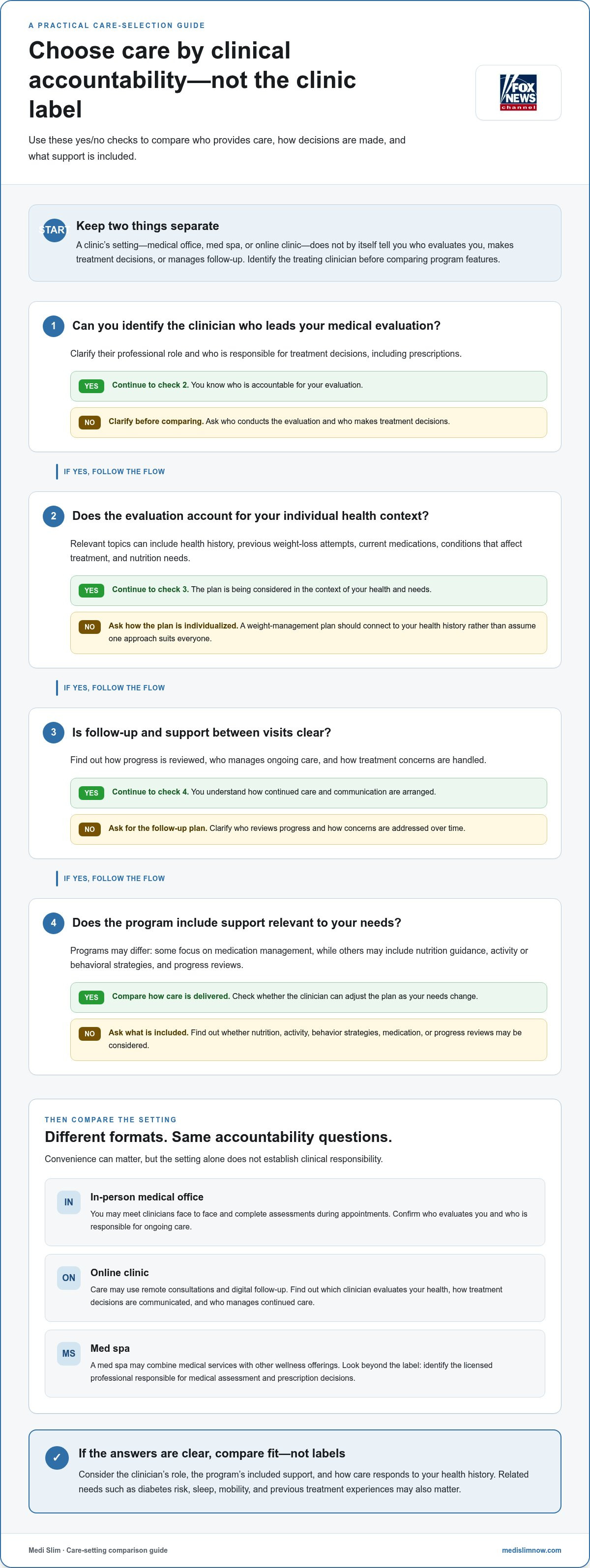
Separate a clinician’s qualifications from the clinic’s setting. A medical office, med spa, or online clinic may organize appointments differently, but the setting alone does not tell you who evaluates you, makes treatment decisions, or manages follow-up. Identify the treating clinician and their professional role before comparing program features.
Before choosing a weight-loss doctor, ask: Who conducts the medical evaluation and oversees treatment? How does the program account for conditions such as diabetes, current medications, and nutrition needs? What follow-up is included, and how are concerns handled between visits?
In an in-person office, you may meet clinicians face to face and complete assessments during appointments. An online clinic may use remote consultations and digital follow-up. In either setting, find out which clinician evaluates your health, who is responsible for ongoing care, and how treatment decisions are communicated. Convenience matters, but it should not obscure clinical accountability.
A med spa may combine medical services with other wellness offerings. Look beyond the label: identify the licensed professional responsible for your medical assessment and prescription decisions. A weight-management program should connect its treatment plan to your health history, rather than presenting the same approach as suitable for everyone. This is especially important when chronic conditions or other medications affect care choices.
Compare what each program includes. One may focus on medication management, while another may offer nutrition guidance, behavioral support, or regular progress reviews. Ask how the clinician adjusts the plan as your needs change. A program focused on weight should also consider related issues such as diabetes risk, sleep, mobility, and previous treatment experiences.
- Who provides care? Identify the clinician’s professional role and who leads your evaluation.
- What happens at the first visit? Ask whether the discussion covers health history, previous weight-loss attempts, and current medications.
- How is follow-up arranged? Clarify how progress and treatment concerns are reviewed over time.
- What does the plan include? Find out whether nutrition, activity, behavior strategies, or medication may be considered.
Use the answers to compare the care process, not just the location or appointment format. A medical weight loss consultation can be a practical starting point for discussing your history, goals, and medically supervised options.
A clear follow-up schedule can help you judge how care continues after the first visit. Cleveland Clinic says patients in its medical weight management program check in with providers every month. The Obesity Care Provider Database includes obesity doctors, nurse practitioners, physician assistants, dietitians, and bariatric surgeons. A clinic’s weight-loss treatment options include prescription medications, structured nutrition programs, behavioral coaching, and surgical consultation when appropriate. Ask which of these are relevant to your care and who coordinates them.
The page estimates that medical weight-loss practices can generate $300,000 to $500,000 or more in annual revenue. When comparing programs, clarify what any fee covers, including follow-up and the services in your treatment plan.
ABOM certification and specialized education
The American Board of Obesity Medicine (ABOM) certifies physicians who complete obesity-specific education and pass its certification exam. An ABOM Diplomate has completed at least 60 hours of obesity-focused education and passed the examination. The question “What is a board-certified weight loss doctor?” is best answered by distinguishing this added credential from a physician’s underlying medical training.
The ABOM exam contains 200 questions and is computer-based at Prometric testing centers. Its subject matter reflects obesity medicine practice, including factors that affect weight and evidence-based treatment approaches. Passing the exam is one requirement for certification, not a medical license or a replacement for a physician’s original specialty training.
To understand what a board-certified weight loss doctor is, look for the ABOM Diplomate credential, often written as DABOM after a physician’s name. Confirm the credential through the American Board of Obesity Medicine, and distinguish it from other training or professional memberships.
Specialized education matters because medical school may provide limited preparation in nutrition and weight management. Most physicians receive only a few hours of this training during medical school. ABOM certification adds structured obesity-specific education and an examination focused on clinical knowledge. It can help you assess a physician’s focused preparation, while their experience and care approach remain relevant.
Other professional education has different requirements. Fellows of the Obesity Medicine Association (OMA) have completed at least 75 hours of advanced training in obesity medicine. That fellowship distinction is not the same credential as ABOM board certification. A physician may have additional education through other routes, so understand which organization awarded each credential and what it represents.
The certification pathway takes sustained preparation. The ABOM certification process typically takes 8 to 14 months from application to certification, while most candidates spend 6 to 12 months studying for the exam. These are separate measures: the first covers the overall process, and the second describes exam preparation. Obesity medicine fellowships typically provide 1 to 2 years of full-time clinical training.
ABOM was established in 2011. Certification also involves continuing professional development: physicians must recertify every 10 years and meet ongoing CME requirements. This distinguishes an earned examination credential from education that continues throughout a physician’s career.
Use credentials as one part of your selection process. Ask whether the physician is ABOM-certified, what obesity medicine education they completed, and how that training informs your care. For example, a physician may coordinate medication and lifestyle treatment with other healthcare providers. Surgical care involves a different clinical role.
Certification and prescribing authority
ABOM certification and prescribing authority describe different qualifications. Certification shows that a physician completed obesity-specific education and passed the American Board of Obesity Medicine exam. Prescribing authority comes from a clinician’s professional license and applicable scope of practice. A physician can hold a medical license without ABOM certification, and ABOM certification does not replace that license.
In the United States, any licensed prescriber can legally prescribe FDA-approved GLP-1 medications. That legal authority is not limited to physicians with obesity medicine board certification. It also doesn’t mean every prescriber offers obesity care or that medication is appropriate for every patient. The clinician still assesses health history, current treatment, and weight-related concerns before making a prescribing decision.
For example, a patient considering a GLP-1 medication can discuss previous weight-management efforts, existing conditions, and other medications during an evaluation. These details help the prescriber consider the treatment in the context of the person’s health. Obesity medicine physicians are trained to assess obesity as a chronic disease and use evidence-based approaches, including medication, nutrition, physical activity, and behavioral strategies.
Certification can help when comparing clinicians, but it answers a different question from licensure. ABOM indicates specialized education in obesity medicine. Licensure establishes a professional’s authority to practise within their role. Neither credential alone explains the full care process, including how the clinician evaluates you, explains options, and monitors medication use.
When reviewing a prescriber’s qualifications, separate these points:
- Professional license: Identifies the clinician’s licensed role and prescribing authority.
- Obesity medicine certification: Shows whether a physician holds ABOM certification.
- Treatment assessment: Clarifies how health history and existing conditions inform medication decisions.
- Ongoing monitoring: Explains how the clinician follows medication use and reviews the treatment plan.
Ask who makes prescribing decisions and provides follow-up. In an online clinic, identify the licensed clinician responsible for evaluating your case. In a medical office, clarify whether the clinician you meet also manages prescriptions. These steps make accountability clearer in any setting.
Bariatric surgery follows a separate treatment pathway from prescription medication. Obesity medicine physicians can help assess whether patients may benefit from medication or bariatric surgery, monitor medication use, and provide care before or after surgery. Their role differs from a bariatric surgeon’s surgical role. Understanding this distinction helps you connect each decision to the right type of clinical expertise.
Which medical specialties offer board certification in obesity medicine?
Obesity medicine has its own board certification through the American Board of Obesity Medicine (ABOM). It is an additional credential for physicians, not a replacement for their original medical specialty. A physician may therefore have a primary specialty and separate certification in obesity medicine.
This distinction matters because the ABOM credential identifies specialized preparation in obesity care, not a particular primary specialty. The certification focuses on weight regulation and obesity treatment. It does not replace fields such as internal medicine, endocrinology, or surgery. Instead, physicians bring their existing medical background to assessing and managing obesity.
ABOM certification is specifically for physicians. The wider field of obesity care also includes healthcare providers such as nurse practitioners and physician assistants, who may have specialized training. Their professional qualifications differ from a physician’s ABOM Diplomate credential. When reviewing a clinician’s profile, look for the exact qualification and awarding organization rather than treating every obesity-care title as the same certification.
A practical way to understand a physician’s credentials is to separate three items: their primary specialty, any additional specialty certifications, and obesity medicine board certification. For example, a physician may have expertise in another medical field and also hold ABOM certification. The additional credential signals focused obesity medicine education, while the primary specialty describes another area of medical practice.
- ABOM certification: A physician-level board credential in obesity medicine.
- Primary specialty: The physician’s underlying medical discipline and training.
- Other obesity-care roles: Healthcare providers may have relevant training without holding the physician-only ABOM credential.
Do not assume a title alone identifies the training behind it. Look for “Diplomate of the American Board of Obesity Medicine” or “DABOM,” then distinguish it from other board certifications and professional memberships. The ABOM credential indicates that a physician completed the required education and passed its obesity medicine certification exam.
For your care decision, match the clinician’s credentials to the support you need. A physician with ABOM certification brings specialized obesity medicine knowledge to evaluation and treatment planning. A bariatric surgeon’s role centers on surgical care, while other specialists address their respective areas of medicine. These roles may complement one another in multidisciplinary care, but their credentials describe different training and responsibilities.
Obesity medicine board certification requires physicians to complete additional training and an examination in weight regulation and treatment. In practice, obesity medicine physicians can create individualized weight-loss plans that account for medical problems, psychological factors, functional difficulties, and physical limitations. They may also monitor and help manage conditions associated with obesity, including diabetes, hypertension, obstructive sleep apnea, and depression.
Their role can extend across stages of care: obesity medicine physicians can provide routine postoperative follow-up and refer patients to surgeons when indicated. Northwestern University Feinberg School of Medicine and Northwestern Memorial Hospital developed a comprehensive obesity care program in 1998. The obesity medicine market is projected to exceed $50 billion by 2030, highlighting the field’s expanding profile.
Medi Slim: Semaglutide
Medi Slim offers medical weight-loss consultations for people exploring clinician-guided treatment options. If you’re in Richmond, Henrico, Mechanicsville, Midlothian, or Glen Allen, a consultation can help you discuss your health history, goals, and options such as Semaglutide and Tirzepatide.
Styku 3D Body Composition Analysis can help track changes in body composition, including fat loss and muscle gain. This gives you and your clinician additional context for discussing progress and possible next steps during care.
If you’re ready to discuss medically supervised weight management, visit medislimnow.com to connect with Medi Slim.
Take the Next Step Toward Personalized Care
Choosing weight-management support is a personal health decision, not just a search for a particular title. If you’re considering what a board-certified weight loss doctor can bring to your care, consider how clinical training, your health history, and your priorities fit together. A clear conversation can turn general questions into useful topics for a medical consultation.
Think about what you want to address first, such as previous treatment experiences, health goals, or questions about medically supervised options. Bringing those priorities to a consultation can guide a focused discussion and clarify a suitable next step.
Contact Medi Slim to discuss care and explore a thoughtful starting point for your weight-management journey. You can move forward at a pace that feels informed and grounded.
Frequently Asked Questions
What Is an ABOM Diplomate?
An ABOM Diplomate is a physician who has completed at least 60 hours of obesity-specific education and passed the ABOM certification exam. The designation often appears as DABOM after the physician’s name. For patients, it identifies additional training in obesity medicine. It doesn’t identify the physician’s primary specialty or replace the medical license required to practise. Read the credential alongside the clinician’s role and care setting.
What is the American Board of Obesity Medicine (ABOM) certification?
ABOM certification is a physician credential recognizing specialized education and successful completion of the obesity medicine certification exam. The exam has 200 questions and is computer-based at Prometric testing centers. Certification is distinct from a state medical license: it reflects focused obesity medicine preparation, while licensure establishes authority to practise. If a physician lists several credentials, ABOM or DABOM refers specifically to obesity medicine, not automatically to surgical or endocrinology certification.
What treatments can a board-certified weight loss doctor provide?
A board-certified physician can develop a weight-management plan using nutrition, physical activity, behavioral strategies, and prescription medication. Care may include reviewing your health history and monitoring medication use. Some treatment plans also involve referral for surgical consultation when appropriate. Bariatric surgery is a separate intervention performed by a surgeon, and an obesity medicine credential does not mean every physician provides surgery. The clinician’s role and practice setting determine which treatments they deliver directly.