

How to Increase Muscle Mass While Losing Fat: The Science of Body Recomposition in 2026
What if the number on your bathroom scale is actually sabotaging your progress? Most people assume that weight loss is a simple matter of eating less, but this often leads to losing precious muscle tissue instead of fat. You've likely experienced the frustration of seeing the weight drop while your body still lacks the definition you expected. It's a common fear that being in a calorie deficit means sacrificing the strength you've worked so hard to build. Understanding how to increase muscle mass while losing fat is the key to breaking this cycle and achieving a truly athletic physique.
We're here to show you exactly how to leverage medical and physiological strategies to build lean tissue while shedding fat. This guide explores the science of body recomposition, ensuring your journey prioritizes strength and metabolic health over a temporary number on the scale. We'll preview the role of precise protein thresholds, the biological signals of resistance training, and the clinical advantage of physician-supervised programs. By the end, you'll have a clear, scientific roadmap to achieve a toned physique that is supported by clinical validation and advanced tracking tools.
Key Takeaways
- Understand why the standard scale is an unreliable metric for progress and how body recomposition offers a more accurate view of your health transformation.
- Master the specific nutritional strategies, such as the "Protein First" rule, to learn how to increase muscle mass while losing fat effectively.
- Recognize resistance training as the primary biological signal for muscle preservation, ensuring your body prioritizes fat loss without sacrificing strength.
- Evaluate the role of medical weight loss programs, including Semaglutide and Tirzepatide, in optimizing your metabolism and protecting lean tissue.
- Implement Styku 3D Body Composition Analysis to gain a clear, scientific validation of your body’s changing shape and muscle density.
Understanding Body Recomposition: Why the Scale is a Poor Metric for Progress
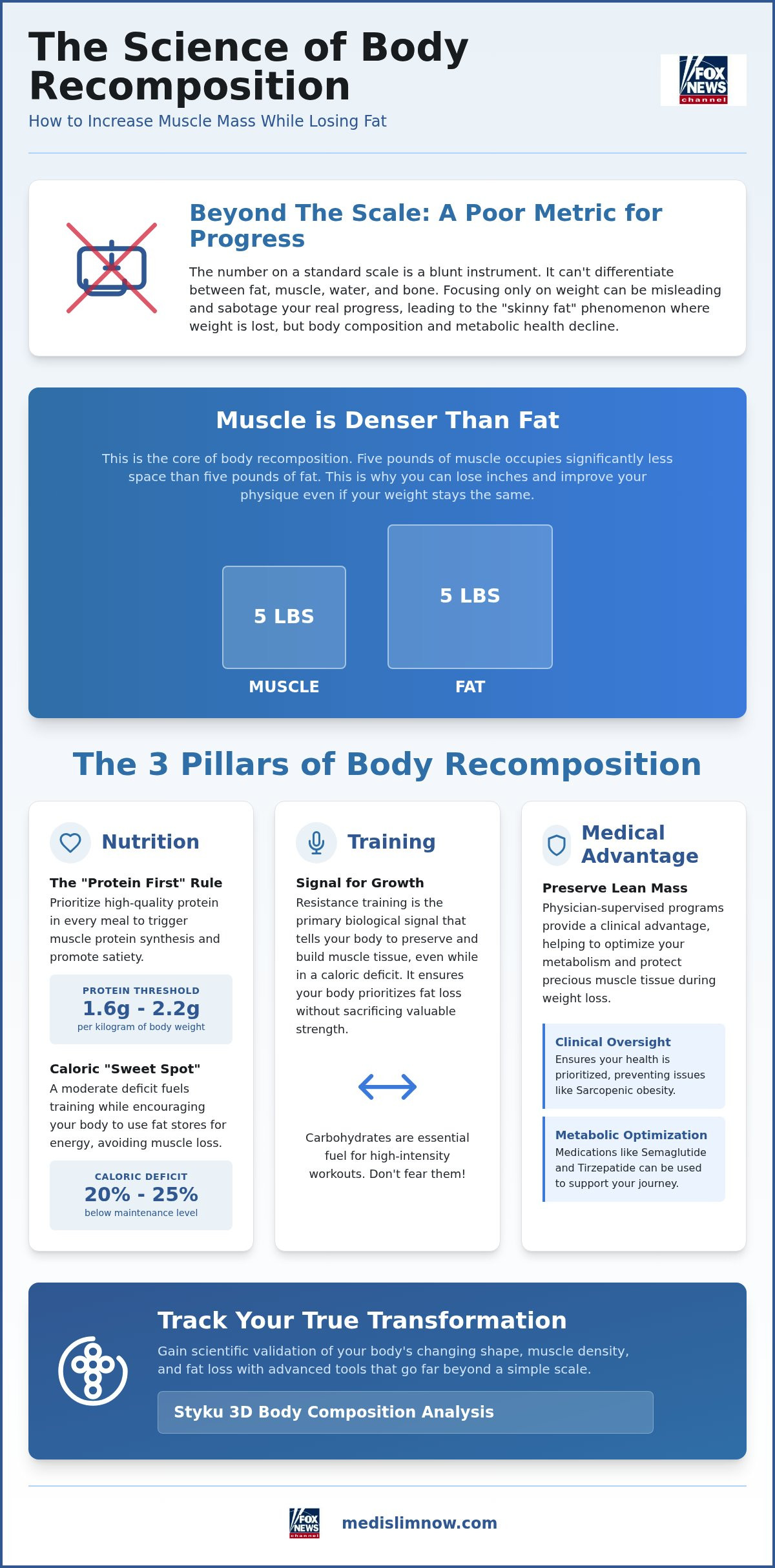
Body recomposition is the clinical process of simultaneously increasing lean muscle mass while decreasing adipose tissue. Unlike traditional dieting, which focuses solely on reducing total body weight, recomposition prioritizes your physical structure and metabolic health. You may find that your clothes fit better and your strength improves even if the number on the scale remains unchanged. This shift occurs because muscle is significantly denser than fat, occupying less space while providing more functional value.
The standard bathroom scale is a blunt instrument. It fails to differentiate between water retention, bone density, fat, and muscle. If you lose five pounds of muscle but gain five pounds of fat, the scale suggests you are "on track," yet your metabolic health has actually declined. This often leads to the "skinny fat" phenomenon, where an individual reaches a lower weight but retains a high body fat percentage and a soft appearance. Understanding how to increase muscle mass while losing fat requires moving beyond these simple metrics and focusing on what your weight is actually composed of.
The Biological Limits of Bulking and Cutting
Traditional fitness advice often suggests alternating between "bulking" and "cutting" phases. While this works for professional athletes, it's often inefficient for the general public. Modern science shows that most people can achieve both goals at once through a structured approach. Beginners often experience a "newbie gain" window where rapid recomposition is possible, but even experienced trainees can see progress with professional oversight. This supervised strategy is the most effective way to learn how to increase muscle mass while losing fat without the hormonal fluctuations caused by extreme dietary cycles.
Metabolic Health and Muscle Mass
Muscle tissue is your body's primary engine for glucose management. By maintaining higher levels of lean mass, you improve your insulin sensitivity and create a larger "sink" for blood sugar. This metabolic advantage is why preserving muscle prevents the rebound weight gain so common in calorie-restricted diets. Without enough muscle, your resting metabolic rate drops, making it harder to maintain your results long-term. Sarcopenic obesity is a clinical condition characterized by the simultaneous loss of skeletal muscle and an increase in body fat, a risk that increases significantly when weight loss is unmanaged and unsupervised.
The Nutritional Blueprint: Protein Satiety and Caloric Management
Nutrition is the primary lever that determines whether your body burns its own muscle or its stored fat. To master how to increase muscle mass while losing fat, you must move beyond simple calorie counting. You need a structured plan that prioritizes satiety and muscle protein synthesis (MPS). We recommend the "Protein First" rule: every meal should lead with a high-quality protein source to trigger the biological signals for muscle growth.
A common mistake is cutting calories too aggressively. We suggest a caloric deficit of 20 to 25 percent below your maintenance level. This range is the metabolic "sweet spot" for recomposition. It provides enough energy to fuel intense training while forcing your body to utilize adipose tissue for its remaining energy requirements. If you go deeper into a deficit, you risk triggering a starvation response that prioritizes muscle wasting over fat loss.
The Protein Threshold for Recomposition
Clinical standards for 2026 suggest a protein intake of 1.6g to 2.2g per kilogram of body weight for active adults. High protein intake has a significant thermic effect of food (TEF). This means your body burns more energy just to digest protein compared to fats or carbohydrates. While animal proteins offer a complete amino acid profile, you can achieve the same results with plant-based sources by combining them to ensure you receive all essential nutrients. This high-protein approach is essential for anyone learning how to increase muscle mass while losing fat effectively.
Managing Carbohydrates and Fats for Energy
You shouldn't fear carbohydrates. They are the primary fuel for high-intensity resistance training. Without them, your performance in the gym will suffer, and your body may look to muscle tissue for energy. Similarly, healthy fats are vital for hormonal health. They support the production of testosterone and growth hormone, both of which are necessary for lean tissue maintenance. Avoid "crash dieting," as it spikes cortisol. This muscle-wasting hormone can halt your progress and negatively impact your metabolic rate.
Nutrient timing and recovery also play a role in your success. Consuming protein and carbohydrates around your resistance training sessions maximizes your body's ability to repair tissue. Hydration and micronutrients like magnesium and zinc further support this process by ensuring cellular function remains optimal. If you are unsure how to balance these factors, a medical weight loss consultation can provide the professional oversight needed to tailor these variables to your specific metabolic profile.
Resistance Training: Signalling Growth in a Deficit
Resistance training is the primary biological signal that tells your body to preserve muscle tissue while in a calorie deficit. Without this stimulus, your body may look to its own muscle for energy. This is why many traditional dieters end up with a "soft" appearance despite losing weight. When you understand how to increase muscle mass while losing fat, you realize that lifting weights is not optional; it's the foundation of your transformation.
We prioritize a specific hierarchy for successful body recomposition. Many people mistakenly put cardio at the top of their list, but this often leads to burnout and muscle loss. Instead, your weekly routine should focus on the following order of importance:
- Resistance Training: The essential growth signal for lean tissue.
- Nutrition: Providing the necessary protein and fuel for repair.
- NEAT: Daily movement that burns fat without adding systemic stress.
- Cardio: A supplemental tool for cardiovascular health.
The Principle of Progressive Overload
To prevent muscle atrophy, you must consistently challenge your muscles. Tracking your "Volume Load," which is calculated as Weight x Reps x Sets, provides a measurable metric of your success. If this number increases over time, you're likely building or maintaining muscle despite your calorie deficit. Compound movements like squats, deadlifts, and presses are particularly effective. They engage multiple muscle groups and trigger a more robust hormonal response compared to isolation exercises.
Why Excessive Cardio Can Sabotage Muscle Gain
High-impact cardio can sometimes work against your goals. This is known as the "interference effect," where excessive steady-state cardio blunts the molecular signals required for muscle growth. We recommend prioritizing Low-Intensity Steady State (LISS) and NEAT over high-intensity interval training (HIIT) during a recomposition phase. Walking 10,000 steps daily supports fat loss by increasing your energy expenditure without placing excessive stress on your muscle tissue or recovery capacity.
Muscle doesn't grow in the gym; it grows while you sleep. Recovery is the final piece of the puzzle. You should aim for seven to nine hours of quality sleep to ensure your hormonal profile remains optimized for tissue repair. This resting period allows your body to process the biological signals you've sent during training, turning your efforts into visible muscle gains and metabolic strength.
The Medical Advantage: Preserving Lean Mass with Clinical Oversight
Medical supervision provides a critical safeguard against the "muscle dump" often seen in rapid, unmonitored weight loss. While traditional dieting can lead to a significant loss of lean tissue, clinical oversight ensures your body prioritizes fat stores. Using semaglutide for weight loss allows for targeted visceral fat reduction while sparing the muscle you've worked to build. This medical intervention, combined with the resistance training and protein strategies discussed earlier, is the most effective way to master how to increase muscle mass while losing fat.
The introduction of tirzepatide for weight loss has further advanced this field. As a dual-agonist, it provides metabolic regulation that helps maintain a higher metabolic rate during your transformation. When you use weight loss medication under professional guidance, the focus shifts from simply losing weight to optimizing your internal environment. This approach provides the biological support necessary to maintain lean tissue even while your body is in a caloric deficit.
Preventing Muscle Loss on GLP-1 Medications
You may have heard concerns about "Ozempic face" or muscle wasting on GLP-1 medications. These issues aren't caused by the drug itself but rather by severe malnutrition and inadequate protein intake during rapid weight loss. Physician-led dosing adjustments ensure you lose fat at a sustainable rate that doesn't overwhelm your body's recovery systems. Clinical monitoring also tracks electrolyte balance and kidney health, ensuring the process remains safe and effective as you learn how to increase muscle mass while losing fat.
Hormonal Optimization in Medical Weight Loss
Stabilizing your blood sugar levels is essential to prevent muscle catabolism. When your insulin levels are managed, your body is less likely to break down muscle tissue for glucose. This medical approach also reduces systemic inflammation, which can improve joint health and allow you to train harder in the gym. Every individual responds differently to treatment. Scheduling a medical weight loss consultation in Richmond is the first step toward a plan tailored to your specific body goals.
If you're ready to protect your strength while achieving your aesthetic goals, you can book your consultation today to begin a professionally managed recomposition program.
Tracking Success: Implementing Your Transformation in Central Virginia
Visual proof is essential for maintaining motivation during a body recomposition journey. When your goal is to change your physical structure, the standard scale often fails to reflect your hard work. By tracking semaglutide results with Styku, you gain access to a precise 3D map of your muscle gains and fat loss. This technology allows you to see the tangible results of your efforts, providing the scientific validation necessary to stay committed to your long-term health.
The Medi Slim process is designed for logistical ease. It begins with an initial consultation at our Henrico location, where we assess your metabolic health and baseline metrics. From there, you'll move to your first 3D scan. This baseline scan is the starting point for a 12-week recomposition roadmap. Whether you're a resident in Midlothian or Glen Allen, this structured timeline helps you understand exactly how to increase muscle mass while losing fat through a professionally managed program.
3D Body Scanning vs. The Bathroom Scale
The traditional BMI scale is an outdated metric that doesn't account for body composition. In contrast, tracking tirzepatide results with Styku reveals critical data like inch loss, even when your total weight remains the same. The scanner measures changes in the cross-sectional area of your arms, legs, and torso. These visuals help you identify improvements in posture and muscle symmetry that a simple number could never capture. It's the most effective way to prove you're mastering how to increase muscle mass while losing fat.
Getting Started at Medi Slim Wellness
During your first visit to our Richmond-area clinics, you'll meet with a supportive medical expert who understands your unique challenges. We don't believe in one-size-fits-all solutions. Instead, we create a personalized plan that balances medication, nutrition, and resistance training. This integrated approach ensures your journey is safe, streamlined, and effective. You can take the first step toward your new physique right now. Schedule your 3D body composition analysis at Medi Slim today.
Master Your Metabolic Transformation
Mastering the science of how to increase muscle mass while losing fat is no longer a matter of guesswork or simple willpower. You've learned that successful body recomposition requires a precise balance of high-protein nutrition, resistance training, and clinical oversight. By moving away from the standard scale and focusing on metabolic health, you ensure that your transformation is both visible and sustainable for years to come.
At Medi Slim, we provide the professional guidance needed to navigate this process safely and effectively. Our physician-supervised programs utilize advanced tools like Styku 3D Body Composition Analysis to prove your progress beyond a simple number. We serve the Richmond, Henrico, and Midlothian communities with a commitment to clinical excellence, transparency, and personalized care. You don't have to navigate this journey alone.
Ready to transform your physique and improve your metabolic vitality? Book Your Medical Weight Loss Consultation in Richmond today. It's time to build a stronger, healthier version of yourself with a plan that prioritizes your lean tissue and your future.
Frequently Asked Questions
Can I gain muscle and lose fat at the same time if I am over 40?
Yes, you can achieve body recomposition after age 40. While hormonal shifts make lean mass maintenance more challenging, the fundamental principles of resistance training and high protein intake remain effective. Our programs in Richmond focus on preserving skeletal muscle to combat age-related decline. By using medical oversight to optimize your metabolism, you can successfully learn how to increase muscle mass while losing fat even as you age, ensuring long-term strength and metabolic health.
How much protein do I really need to eat to prevent muscle loss while on Semaglutide?
Clinical standards for 2026 recommend consuming between 1.6g and 2.2g of protein per kilogram of body weight. When using Semaglutide, your appetite decreases, making it vital to prioritize protein at every meal. This "Protein First" approach triggers muscle protein synthesis and protects your lean tissue from being used as energy. Our Henrico clinic staff helps you calculate these specific thresholds to ensure your weight loss journey focuses on fat reduction rather than muscle depletion.
Is it better to do cardio or weights first for body recomposition?
You should prioritize resistance training before cardio in your workout sessions. Lifting weights while your energy stores are highest ensures you can provide the strongest biological signal for muscle growth. If you perform intense cardio first, you may lack the strength to challenge your muscles effectively. For residents in Midlothian looking to master how to increase muscle mass while losing fat, we recommend focusing on heavy compound movements followed by low-intensity walking for optimal recovery.
How often should I get a Styku 3D body scan to see muscle growth?
We recommend scheduling a Styku 3D body scan every four to six weeks. This timeframe is sufficient to capture meaningful changes in your physical structure while avoiding the daily fluctuations caused by water retention or inflammation. These scans provide a 3D map of your progress, showing inch loss and muscle symmetry improvements that a bathroom scale cannot detect. Consistent tracking at our Richmond-area clinics provides the scientific validation needed to stay motivated during your transformation.
Will Tirzepatide make me lose muscle if I don’t exercise?
Losing weight rapidly on Tirzepatide without resistance training increases the risk of muscle wasting. The medication is a powerful tool for fat loss, but your body needs a reason to keep its muscle tissue. Without the stimulus of exercise, your body may break down lean mass for energy. Our physician-supervised programs in Glen Allen integrate medication with a structured lifting plan to ensure your weight loss is healthy and prioritizes your metabolic rate and strength.
What is the best calorie deficit for gaining muscle while losing fat?
The optimal calorie deficit for body recomposition is a 20 to 25 percent reduction below your maintenance level. This sweet spot provides enough energy to fuel intense resistance training while forcing your body to utilize stored adipose tissue for the remaining energy needs. If your deficit is too aggressive, your body may enter a muscle-wasting state. Our medical consultations in Mechanicsville help you determine your exact caloric needs to ensure you are building tissue while shedding fat.
Are there weight loss clinics in Richmond that specialize in body composition?
Medi Slim is a specialized medical weight loss clinic serving the Richmond, Henrico, and Midlothian areas. We focus specifically on body composition rather than just a lower number on the scale. Our programs utilize physician-supervised Semaglutide and Tirzepatide treatments combined with Styku 3D scans. This medical approach ensures that our patients lose body fat while protecting their lean muscle mass, providing a comprehensive solution for those seeking a toned, athletic physique in Central Virginia.
How long does it take to see visible results from body recomposition?
Visible results from body recomposition typically take 8 to 12 weeks of consistent effort. While internal metabolic changes occur immediately, physical changes like improved muscle definition and significant inch loss require time. Using 3D scanning at our Richmond clinics allows you to see these changes earlier than you might in a mirror. A structured 90-day roadmap ensures you stay on track to achieve a leaner, stronger body while maintaining your metabolic health and long-term vitality.