

Weight Loss Medication Guide: Understanding Prescription Options in 2026
What if your struggle with weight isn't a failure of willpower, but a biological hurdle that requires a clinical solution? It is exhausting to follow every diet and exercise plan only to see the same numbers on the scale. You aren't alone in feeling frustrated by the cycle of temporary results and the constant fear of a rapid weight rebound. Many people find that traditional methods simply don't address the underlying metabolic signals that drive hunger and fat storage.
Modern weight loss medication provides a scientific bridge to help you finally overcome these plateaus. This guide explores the safety and effectiveness of the latest prescription options, including recent 2026 developments like Wegovy HD and the once-daily oral medication Foundayo. You'll discover how these tools work to improve your metabolic health markers and help you achieve sustainable results. We will clarify the differences between Semaglutide and Tirzepatide while outlining the medical eligibility requirements for a supervised program. By the end, you'll have a clear understanding of how to manage your health journey with professional oversight and precision body composition tracking.
Key Takeaways
- Understand how modern weight loss medication has evolved from simple stimulants to advanced hormone-based therapies that help regulate your metabolism.
- Compare the latest 2026 FDA-approved options, including injectable and oral versions of Semaglutide and Tirzepatide, to find the right fit for your health profile.
- Learn why a standard scale is an incomplete metric and how precision body tracking ensures you are losing fat while preserving vital muscle.
- Gain practical insights into managing common side effects through professional clinical protocols to maintain your comfort and momentum.
- Discover why local, physician-supervised care in Central Virginia offers a safer and more personalized alternative to online-only platforms.
What is Weight Loss Medication? The Science of Metabolic Management
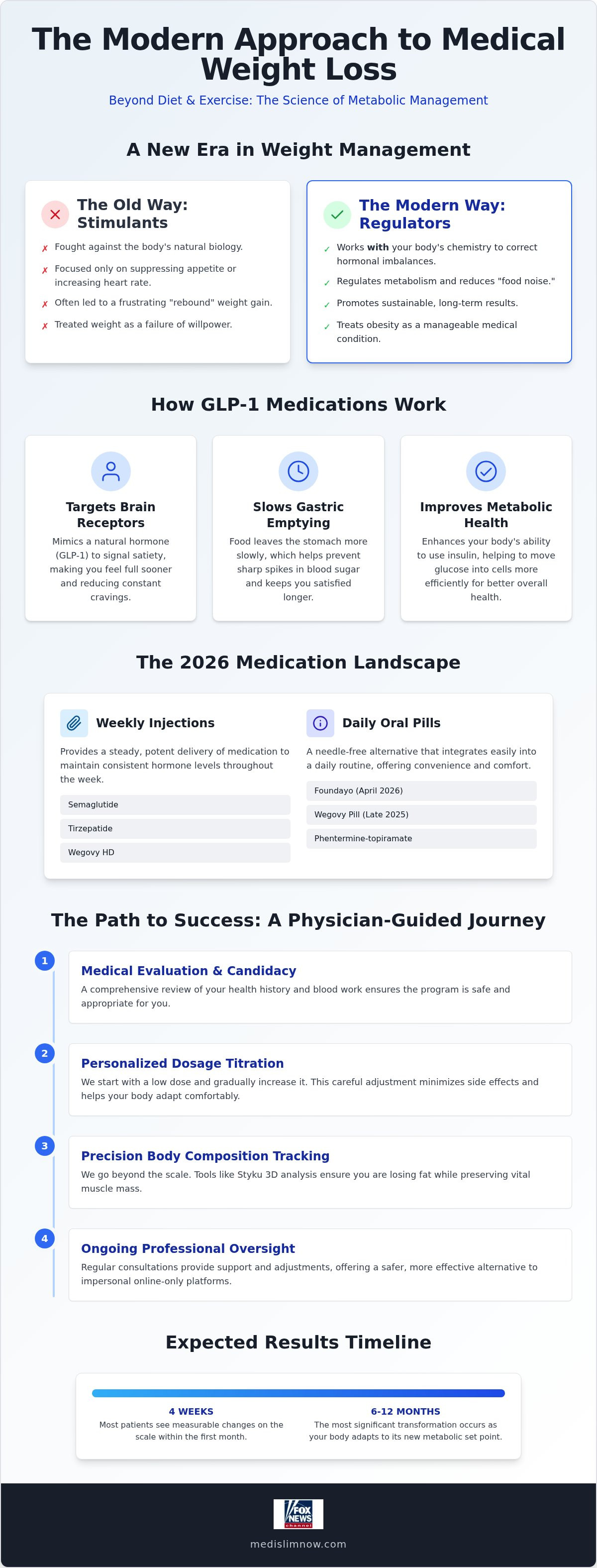
Modern weight loss medication represents a major shift in how we approach chronic weight management. For decades, the industry focused on stimulants that simply suppressed appetite or increased heart rates. These older methods often led to "rebound" weight gain because they didn't address the underlying biology. Today, we use prescription-strength biological regulators. These medications are not "diet pills" in the traditional sense. They are sophisticated metabolic treatments designed to correct hormonal imbalances that make losing weight difficult.
Current Anti-obesity medications work with your body's chemistry rather than against it. By targeting specific receptors, they help stabilize your metabolism and reduce the constant "food noise" that often leads to overeating. This scientific approach treats obesity as a manageable medical condition rather than a struggle of willpower. It's about giving your body the tools it needs to reach a healthier set point safely.
How GLP-1 Receptor Agonists Work
GLP-1 receptor agonists, such as Semaglutide, mimic a hormone your body naturally produces after a meal. This hormone, called glucagon-like peptide-1, sends signals to the brain to indicate satiety. When you use this weight loss medication, those signals become stronger and last longer. You feel full sooner and stay satisfied for a greater duration between meals.
The medication also slows down gastric emptying, which is the process of food leaving your stomach. This physical change helps prevent the sharp spikes and crashes in blood sugar that often trigger cravings. Additionally, GLP-1 agonists improve insulin sensitivity. This helps your body move glucose into your cells more efficiently, supporting better metabolic health markers across the board. It's a multi-layered process that addresses both the physical and neurological aspects of hunger.
The Importance of Medical Oversight
A "one size fits all" approach rarely works in medicine, and weight management is no exception. Professional clinical supervision is essential for several reasons. First, your health history and current blood work determine which medication is safest for you. A physician-led program ensures that any underlying conditions are monitored throughout the process. This personalized care creates a high level of trust and safety that online-only platforms often lack.
Second, medical oversight is crucial for managing dosage titration. We don't start at the maximum dose. Instead, we guide you through a methodical progression. This careful adjustment helps your body adapt to the weight loss medication while minimizing potential side effects like nausea or digestive changes. Regular consultations allow us to track your progress with tools like Styku 3D Body Composition Analysis. This ensures you are losing fat while maintaining muscle, which is the true key to sustainable transformation.
A Roundup of FDA-Approved Weight Loss Medications in 2026
The landscape of weight loss medication has evolved rapidly. By July 2026, patients have access to several FDA-approved prescription medications that target metabolic pathways with high precision. While weekly injections like Semaglutide and Tirzepatide remain the most common choice, the approval of oral options like the Wegovy pill in late 2025 and Foundayo in April 2026 offers a daily alternative for those who prefer to avoid needles. Older options like Phentermine-topiramate still serve specific use cases, particularly for short-term support or when a patient needs a different mechanism of action.
Most patients begin to see measurable changes on the scale within the first four weeks of treatment. However, the most significant transformation usually occurs between six and twelve months of consistent use. This timeline allows your body to safely adjust to its new metabolic set point. To see which of these options aligns with your health goals, you can schedule a medical weight loss consultation at one of our local clinics.
- Weekly Injections: These provide a steady, potent delivery of medication to maintain consistent hormone levels.
- Daily Oral Pills: Options like Foundayo offer a needle-free alternative that integrates easily into a morning routine.
- Combination Therapies: Some older medications use multiple pathways to address both appetite and cravings simultaneously.
Semaglutide: The Gold Standard for Satiety
Semaglutide has earned its reputation as a reliable foundation for long-term weight management. It works by mimicking the GLP-1 hormone to regulate appetite and slow digestion. In March 2026, the FDA approved Wegovy HD at a 7.2 mg dose. This provides a new path for patients who have tolerated the standard 2.4 mg dose but require additional weight loss. If you are looking for local care, our Semaglutide for weight loss in Richmond guide explains how we tailor this treatment to your specific needs. It remains a top choice because of its extensive safety profile and proven results.
Tirzepatide: The Dual-Action Breakthrough
Tirzepatide represents a major breakthrough in clinical obesity treatment. Unlike medications that only target one hormone, Tirzepatide activates both GLP-1 and GIP (glucose-dependent insulinotropic polypeptide) receptors. This dual-action approach often leads to greater weight reduction in clinical trials compared to single-agonist treatments. You can explore the mechanics of this therapy in our comprehensive guide to Tirzepatide. This medication is particularly effective for those with significant metabolic resistance who haven't reached their goals with other therapies.
Evaluating Candidacy: Is Prescription Weight Loss Right for You?
Standard medical guidelines often use Body Mass Index (BMI) as a starting point for treatment. Generally, a weight loss medication is considered for individuals with a BMI of 30 or higher. It is also an appropriate option for those with a BMI of 27 or higher who also manage weight-related comorbidities. However, these numbers don't tell the whole story of your metabolic health. We look at your complete health history and current blood work to determine if you are a safe candidate for these therapies.
Safety remains our primary focus throughout the consultation process. Certain medical conditions may disqualify a patient from using specific medications. For example, a personal or family history of medullary thyroid carcinoma or Multiple Endocrine Neoplasia syndrome type 2 (MEN 2) are significant contraindications for GLP-1 therapies. Additionally, these medications are not suitable for use during pregnancy or while breastfeeding. Understanding how weight-loss injections work helps patients appreciate why these screenings are necessary for long-term safety and success.
Clinical eligibility is about more than just a number on a chart. It is about identifying if your body is struggling with a biological resistance to weight loss that lifestyle changes alone cannot fix. By addressing the hormonal drivers of hunger, we help you reach a healthier metabolic state that supports your long-term goals.
Beyond the Scale with Styku 3D Body Scanning
Traditional scales only measure your total mass. They cannot distinguish between water weight, muscle mass, and fat tissue. This is a critical distinction in medical weight loss. Losing too much muscle can lead to a "skinny fat" outcome, which eventually slows your metabolism and makes weight maintenance difficult. We utilize Styku 3D Body Scanning to visualize exactly where your body is changing in real time.
This technology provides a precise map of your progress. It tracks your body fat percentage and visceral fat, which is the high-risk fat stored around your internal organs. By tracking Semaglutide results with Styku, we ensure that your weight loss is high-quality. Our goal is to help you lose fat while preserving the lean muscle that keeps your metabolism strong. This data-driven approach gives you a much clearer picture of your transformation than a standard scale ever could.
Identifying Weight-Related Health Conditions
Many patients choose to start a weight loss medication to improve specific health markers. These treatments are highly effective at helping patients manage high blood pressure and improve glycemic control for Type 2 Diabetes. As your weight stabilizes, you may also experience a significant reduction in systemic inflammation. This often leads to less chronic joint pain and improved mobility in your daily life.
Weight reduction also has a profound impact on sleep apnea. By reducing the physical pressure on your airway, many patients find they sleep more soundly and have more energy throughout the day. If you are in the Richmond or Glen Allen area, it's vital to consult with a specialist who can monitor these improvements. We focus on your total health journey, ensuring that your medication dosage is adjusted based on your evolving health needs and metabolic markers.
Maximizing Success: Nutrition and Side Effect Management
Starting a weight loss medication is a significant step toward metabolic health, but the prescription is only one part of the equation. You may experience common side effects like mild nausea, fatigue, or changes in your digestive rhythm during the initial weeks. These symptoms are usually temporary as your body adjusts to the hormonal signals. We prioritize semaglutide side effects management by using a careful titration schedule. This methodical approach allows your system to adapt gradually, which significantly reduces the likelihood of severe discomfort.
Success also depends on protecting your lean muscle mass. When weight drops quickly, the body might try to burn muscle for energy instead of fat. To prevent this, a protein-rich diet is essential. High protein intake supports tissue repair and helps maintain your basal metabolic rate. This creates a powerful synergy with the medication, ensuring that the majority of your weight loss comes from fat stores. By focusing on nutrition, you turn the medication from a temporary fix into a long-term metabolic reset.
Eating for Optimal Results
Hydration and fiber intake become even more important when using GLP-1 receptor agonists. Since these medications slow gastric emptying, staying hydrated helps maintain smooth digestion and prevents common issues like constipation. Our guide on what to eat on Semaglutide provides a roadmap for selecting nutrient-dense foods that support your energy levels throughout the day.
You might find that your appetite is suppressed more than you expected. While this helps with weight loss, it's vital to avoid under-eating. Consuming too few calories can lead to nutrient deficiencies and extreme fatigue. We help you find a balance where you achieve a sustainable calorie deficit while still fueling your body with the vitamins and minerals it needs to thrive. It's about quality of calories, not just the quantity.
The Role of Movement and Strength
Resistance training is a non-negotiable part of a successful medical weight loss program. Lifting weights or performing bodyweight exercises signals your body to keep its muscle while it sheds fat. This is where how Semaglutide helps with a calorie deficit becomes most apparent. It removes the "starvation" feeling that often makes exercise feel like a chore, allowing you to focus on building strength and endurance.
Developing these physical habits now ensures you have a foundation for life after the medication phase. Our goal is to help you transition into a lifestyle where healthy movement and nutrition are second nature. If you're ready to start a professionally managed program with local support, book your medical weight loss consultation to begin your personalized journey today.
Starting Your Journey: Finding Care in Richmond and Central Virginia
Choosing the right provider for your weight loss medication is a decision that impacts both your safety and your long-term success. While many online-only platforms offer quick prescriptions, they often lack the diagnostic depth required for a truly personalized metabolic reset. A local medical clinic provides a physical touchpoint where a physician can monitor your progress, adjust your dosage, and address side effects in real time. This level of professional oversight is what separates a temporary fix from a sustainable health transformation.
When evaluating a provider in the Richmond area, look for a team that combines clinical expertise with advanced diagnostic technology. Accessibility is also key to maintaining consistency. We have established local clinics to serve the Henrico, Midlothian, and Mechanicsville communities, ensuring that professional support is always within reach. A face-to-face consultation allows you to build a roadmap that accounts for your unique health history and lifestyle goals.
What to Expect During Your First Consultation
Your journey begins with a comprehensive medical screening to ensure you are a safe candidate for treatment. This initial visit includes a Styku 3D body scan to establish a precise baseline of your current body composition. We don't just look at the scale; we look at your fat distribution and muscle mass. This data allows us to set realistic milestones for your first 90 days, which is a critical period for metabolic adaptation.
We also use this time to discuss the logistics of your treatment. This includes a transparent conversation about insurance coverage versus self-pay options. With the 2026 landscape offering various manufacturer savings cards and the Medicare GLP-1 bridge program, we help you understand the most cost-effective way to access your weight loss medication. Our goal is to remove the confusion and provide a clear, manageable path forward.
Connecting with Medi Slim Wellness
Medi Slim Wellness specializes in physician-supervised, non-surgical weight loss. We believe that medical weight management should be integrated into a modern lifestyle with minimal friction. Our Richmond-area offices utilize Styku 3D technology to provide you with visual proof of your progress, focusing on fat loss rather than just total weight reduction. This authoritative approach ensures that every step of your journey is backed by scientific validation and professional care.
You don't have to navigate this process alone. By partnering with a local medical expert, you gain a reliable partner dedicated to your metabolic health. If you are ready to move beyond the frustration of failed diets and take a clinical approach to your health, we are here to guide you. Schedule your weight loss consultation at Medi Slim to begin building your personalized roadmap to success today.
Taking the Next Step Toward Metabolic Health
Modern medicine has transformed weight management from a struggle of willpower into a manageable biological process. You now have access to advanced weight loss medication that addresses the underlying hormonal signals driving hunger and fat storage. By combining these treatments with precision tools like Styku 3D Body Composition Tracking, you can focus on losing fat while protecting the lean muscle essential for a healthy metabolism.
Success is most sustainable when supported by professional clinical oversight. Our physician-managed programs provide the safety and personalized care you need to navigate these options with confidence. We serve the Richmond, Henrico, and Midlothian communities, offering a local alternative to online-only platforms. You deserve a clear roadmap that prioritizes your long-term health markers and metabolic stability.
Begin Your Supervised Weight Loss Journey at Medi Slim and discover the difference that expert medical support can make. Your transformation is a science-backed process, and we're here to guide you every step of the way.
Frequently Asked Questions
Which weight loss medication is the most effective in 2026?
Tirzepatide is currently considered the most effective option for significant weight reduction because it targets two different hormonal pathways. By activating both GLP-1 and GIP receptors, it provides a dual-action approach that often leads to higher total weight loss in clinical trials compared to single-agonist treatments. However, the most effective choice for you depends on your unique metabolic profile and how your body responds to the medication during the initial titration phase.
Do I need a prescription for Semaglutide or Tirzepatide?
Yes, you must have a valid prescription from a licensed healthcare provider to access these medications. They are regulated treatments that require professional medical oversight to ensure they are safe for your specific health history. A clinical consultation is necessary to review your blood work and determine if you meet the eligibility criteria. This process ensures that your dosage is managed correctly and that your progress is monitored by a physician.
How long do I need to stay on weight loss medication?
The duration of your treatment depends on your individual health goals and how your metabolism responds to the weight loss medication. Many patients use these therapies as long-term tools to maintain a healthy metabolic set point and prevent weight regain. You'll work with your doctor to develop a personalized timeline that includes a transition to a maintenance phase once you reach your target weight and health markers.
What happens if I stop taking weight loss shots?
If you stop the medication, the hormonal signals that regulate your appetite and satiety will eventually return to their baseline levels. This often results in a return of "food noise" and increased hunger, which can lead to weight regain if sustainable lifestyle habits haven't been established. We focus on nutritional education and strength training during your program to help you maintain your results even after you conclude the medication phase.
Are weight loss medications covered by insurance in Virginia?
Insurance coverage for weight loss medication in Virginia varies significantly based on your specific health plan and employer. While many private plans have expanded their coverage by 2026, some still require prior authorization or specific medical criteria. Our team helps you navigate these requirements and can discuss alternative options, such as manufacturer savings programs or the 2026 Medicare bridge program, to make your treatment as accessible as possible.
Can I get weight loss medication if my BMI is under 30?
You may be eligible for prescription treatment with a BMI of 27 or higher if you also have a weight-related health condition. These conditions include high blood pressure, Type 2 Diabetes, or sleep apnea. Clinical guidelines allow for this lower BMI threshold because the primary goal is to improve your overall metabolic health. A consultation will determine if your health history and current markers make you a candidate for a supervised program.
What are the most common side effects of GLP-1 medications?
Gastrointestinal symptoms like nausea, diarrhea, and constipation are the most frequently reported side effects. These issues are typically mild and occur most often when you first start the medication or when your dosage is increased. We use a methodical titration schedule to minimize these effects and provide practical nutritional guidance to manage any discomfort. Most patients find that these symptoms subside as their bodies adapt to the hormonal changes.
How does a Styku body scan help with my weight loss program?
A Styku 3D body scan provides a precise visual map of your transformation that a standard scale cannot offer. It tracks your body fat percentage and visceral fat while ensuring you are retaining vital lean muscle mass during your journey. This data allows us to make informed adjustments to your program in real time. Seeing exactly where you are losing fat provides a high level of motivation and scientific validation for your efforts.