

Is Medical Weight Loss Covered? 2026 Central Virginia Guide
Why does your insurance provider approve a medication for one diagnosis but deny it for another? It's a common point of confusion for patients in Richmond asking, "is medical weight loss covered by insurance?" The answer isn't a simple yes or no. It's a matter of documented medical necessity. While many assume these treatments are purely elective, 2026 insurance standards increasingly recognize obesity as a chronic condition that requires professional intervention.
You've likely felt the frustration of hitting a wall of prior authorization hurdles or worrying about hidden costs. It's draining to focus on your health while fighting with paperwork. We believe the process should be as streamlined as the treatment itself. This guide provides a clear roadmap for accessing Semaglutide and Tirzepatide treatments in Henrico and Midlothian.
We'll explain the specific criteria insurers use to define necessity and provide a checklist for verifying your benefits. You'll also see how tools like Styku 3D Body Composition Analysis provide the clinical data needed to support your case. This overview ensures you can move forward with confidence and professional oversight.
Key Takeaways
- Learn why many insurance plans that list "weight loss exclusions" may still cover treatments under the umbrella of metabolic health.
- Identify the specific BMI thresholds and documentation of previous attempts that insurers require to determine if medical weight loss is covered by insurance.
- Understand the distinction between brand names like Wegovy and Ozempic to ensure you're requesting the correct medication for your plan's formulary.
- Discover a simple two-step process for locating your Summary of Benefits and asking the right questions about Anti-Obesity Medications.
- See how physician-supervised clinics in Richmond and Henrico use Styku 3D analysis to provide the clinical documentation necessary for challenging insurance denials.
Understanding Insurance Coverage for Medical Weight Loss Programs
Medical weight loss is a physician-supervised approach to managing your health. It integrates prescription treatments, metabolic monitoring, and clinical oversight. Many patients start by asking, "is medical weight loss covered by insurance?" and feel discouraged by the fine print in their policy. However, the reality of coverage in 2026 is more nuanced than a simple yes or no. It often depends on how the treatment is categorized and documented by your provider.
You might see a "weight loss exclusion" in your policy documents. This often creates the myth that all related care is out-of-pocket. In many cases, insurers cover these services when they are billed under "metabolic health" or chronic disease management. They increasingly view obesity as a medical condition rather than a lifestyle choice. Success in securing coverage depends on distinguishing between your pharmacy benefits and your medical benefits. Pharmacy benefits typically cover the cost of medications, while medical benefits cover your office visits and diagnostic scans.
Why Medical Supervision is the Key to Coverage
Insurers rarely approve claims for self-guided or "DIY" efforts. They require a structured weight loss medication plan overseen by a healthcare professional. This clinical oversight provides the documentation trail that insurance companies demand. For example, physician documentation of comorbidities like hypertension, high cholesterol, or sleep apnea can change the coverage equation entirely. When a provider proves that weight loss is a medical necessity to manage these conditions, barriers often drop. Regular check-ins and body analysis data are also essential. Using tools like Styku 3D Body Composition Analysis allows your provider to show precise fat loss progress, which is far more persuasive to an insurer than a simple number on a scale. This data helps maintain your benefit eligibility throughout the duration of your program.
Common Insurance Terms You Need to Know
Understanding the language of insurance helps reduce the anxiety of the process. When you are investigating whether is medical weight loss covered by insurance, you will likely encounter these three terms:
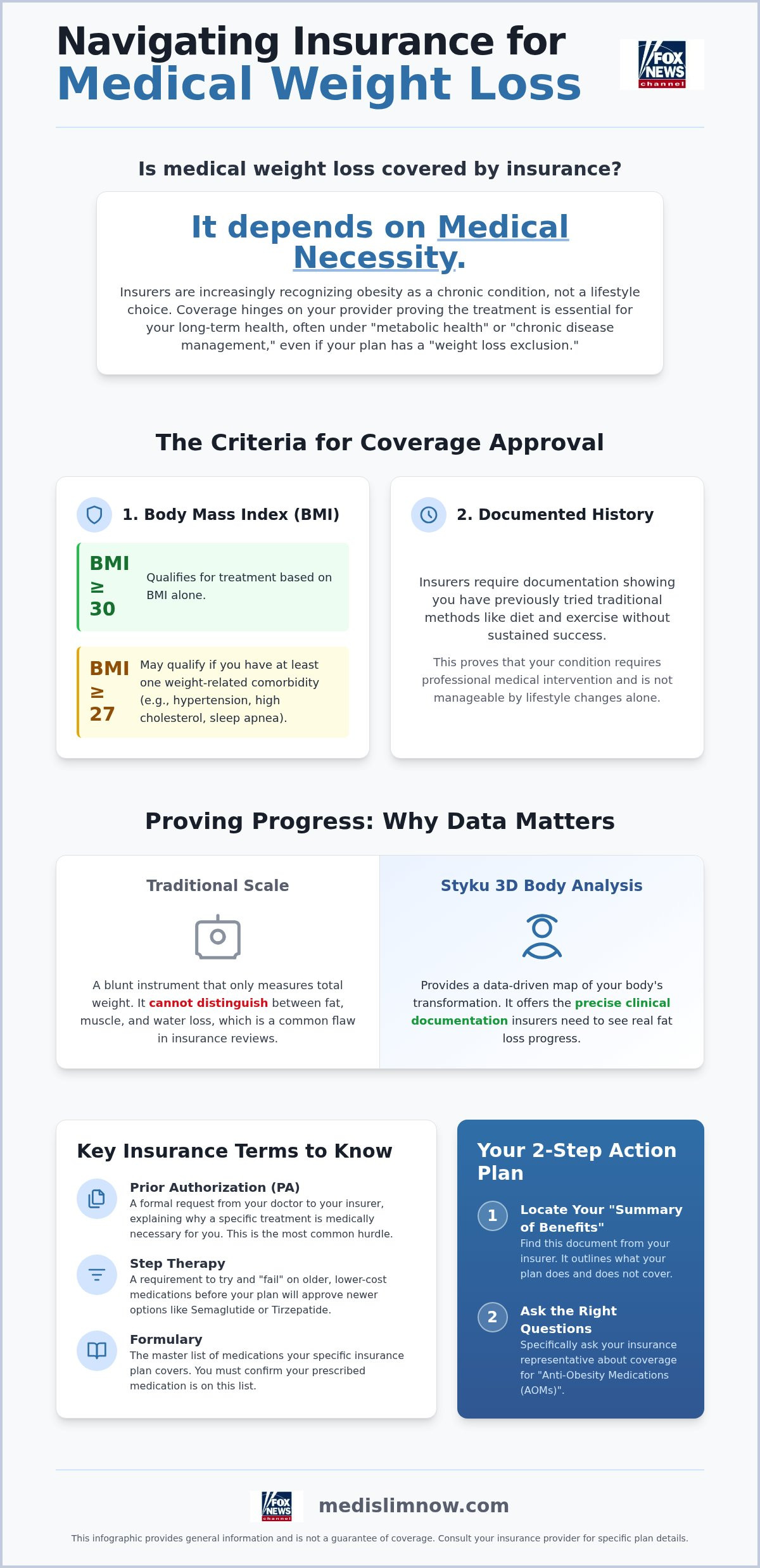
- Prior Authorization (PA): This is a formal request from your doctor to your insurer. It explains why a specific medication is medically necessary for your specific health profile. It is the most common hurdle for GLP-1 medications.
- Step Therapy: Some plans require you to "fail" on older, lower-cost medications before they approve newer options like Semaglutide or Tirzepatide.
- Formulary: This is the master list of drugs your plan covers. You must check if your specific medication is on the "approved" list for your employer-sponsored or private plan.
By working with a local clinic that understands these administrative requirements, you can focus on your health transformation while the experts handle the paperwork.
The Criteria: When Do Insurers Deem Weight Loss Medically Necessary?
Insurance companies require specific clinical markers before they authorize coverage. They don't view weight loss as a cosmetic goal. Instead, they view it as a medical intervention designed to prevent long-term health complications. The primary question of "is medical weight loss covered by insurance" often hinges on your Body Mass Index (BMI). Typically, a BMI of 30 or higher qualifies a patient for treatment. If your BMI is 27 or higher, you may still qualify if you have at least one weight-related medical condition. Insurers also look for a history of "failed" attempts at weight loss. They want to see documentation that you've tried traditional diet and exercise without achieving sustainable results. This proves that your condition requires medical oversight rather than just lifestyle changes.
Proving Progress with 3D Body Scanning
A significant gap in traditional insurance reviews is the heavy reliance on the scale. A scale is a blunt instrument. It cannot distinguish between muscle, water, and fat. This is why tracking Semaglutide results with Styku is a clinical advantage. Styku 3D body composition analysis provides a data-driven map of your body's transformation. Medical reviewers find it much harder to dispute visual 3D data than a standard scale reading. When we show a reduction in adipose tissue (fat) while maintaining muscle mass, we provide the precise "medical necessity" proof that adjusters require. This level of detail validates that the treatment is improving your health profile, not just your appearance. You can schedule a consultation to see how this data can support your journey.
Comorbidities That Trigger Coverage
The presence of other health issues, known as comorbidities, often speeds up the approval process. In 2026, insurance guidelines have shifted to be more inclusive of preventative care. Many plans now prioritize GLP-1 medications for patients with documented cardiovascular risks. If you have high cholesterol, hypertension, or pre-diabetes, your insurer may view weight loss as an essential preventative measure for heart events. There is a specific coverage gap between medications like Ozempic, which is labeled for diabetes, and Wegovy, which is labeled for obesity. However, conditions like sleep apnea or chronic joint pain often serve as secondary qualifiers. When a physician documents how your weight impacts these specific conditions, the likelihood of coverage increases. We focus on providing this comprehensive clinical documentation to help you navigate these requirements and confirm if is medical weight loss covered by insurance for your specific plan.
Coverage Specifics for Semaglutide and Tirzepatide Medications
Choosing the right medication involves more than just a clinical decision. It requires an understanding of how your specific drug is classified. When patients ask, "is medical weight loss covered by insurance," they are often caught in a brand name maze. Medications like Wegovy and Zepbound are FDA-approved specifically for weight loss. Conversely, Ozempic and Mounjaro are labeled for Type 2 Diabetes. Even though these drugs contain the same active ingredients, your insurer will categorize them differently based on the label. This classification determines which "bucket" of benefits your treatment falls into.
In 2026, employer-sponsored health plans are trending toward more inclusive coverage for GLP-1 agonists. Many companies now realize that treating obesity early reduces long-term costs associated with heart disease and stroke. The landscape is also shifting due to the 2026 Medicare drug price negotiations. While these negotiated prices primarily impact federal programs, they set a new benchmark for commercial insurance tiers. This often leads to more predictable co-pays and structured approval pathways for the most common medications.
Semaglutide: Coverage for Wegovy and Ozempic
Insurers typically require a detailed prior authorization for Semaglutide injections. If you are prescribed Wegovy for weight management, the reviewer will verify your BMI and any weight-related health conditions. A common hurdle is a denial based on "off-label" use. This happens when Ozempic is prescribed for weight loss without a primary diagnosis of diabetes. To challenge these denials, we provide clinical documentation that explains the medical necessity of the treatment. Semaglutide functions as a GLP-1 receptor agonist that mimics naturally occurring hormones to regulate appetite and slow gastric emptying.
Tirzepatide: Coverage for Zepbound and Mounjaro
Tirzepatide is often viewed differently by insurers because of its dual-action mechanism. Some plans prioritize Tirzepatide for weight loss because clinical data suggests it may lead to faster metabolic improvements. However, because it's a newer medication, it often sits on a higher formulary tier. This means you might face a higher co-pay or more rigorous documentation requirements compared to older treatments.
Insurers frequently review coverage after the initial 90-day period. They want to see measurable progress to justify the ongoing cost of the medication. This is where tracking Tirzepatide results with Styku becomes a strategic advantage. By providing a 3D visual of fat loss and muscle retention, we provide the objective proof that the medication is working effectively. This data-driven approach makes it much harder for an insurer to claim the treatment is not medically necessary. It ensures you have the clinical support needed to confirm if is medical weight loss covered by insurance for your long-term health journey.
How to Verify Your Weight Loss Benefits in Richmond and Henrico
Verifying your benefits is the most critical step in your journey. While the question of "is medical weight loss covered by insurance" is complex, a methodical approach ensures you get the most accurate information. Residents in Richmond and Henrico often deal with local variations in Anthem BCBS or Aetna policies. You shouldn't assume coverage is unavailable without a direct inquiry. Use this five-step process to get clear answers from your carrier.
- Step 1: Locate your 'Summary of Benefits and Coverage' (SBC) document. This is a standardized document provided by your employer or insurer. Look specifically for the "Exclusions" and "Prescription Drug" sections.
- Step 2: Call your insurer and ask about 'Anti-Obesity Medications' (AOMs). Don't just ask about "weight loss drugs." Using the clinical term AOM ensures the representative looks at the correct therapeutic category in your formulary.
- Step 3: Provide specific ICD-10 codes. Ask the representative if coverage is available for code E66.9 (Obesity, unspecified) or E66.01 (Morbid obesity). This helps them check for specific "medical necessity" triggers.
- Step 4: Confirm network status. Ask if Medi Slim is considered an in-network or out-of-network provider for your specific plan. This affects your out-of-pocket costs for office visits.
- Step 5: Inquire about 'Quantity Limits.' Most GLP-1 medications have strict limits, such as one box of four pens per 28-day cycle. Knowing this helps you plan your treatment schedule.
Questions to Ask Your Virginia Insurance Provider
Central Virginia residents typically hold plans through Anthem BCBS, Aetna, or UnitedHealthcare. Each has different "riders" or add-ons for weight management. Ask if your plan covers 'Medical Nutrition Therapy' as a separate benefit from 'Weight Management.' Some plans deny "weight loss" but approve "nutritional counseling" for metabolic health. You should also verify if they cover diagnostic tools like 3D body composition analysis. While some insurers view this as elective, others accept it as a valid method for tracking clinical progress. You can schedule a medical weight loss consultation to receive a detailed breakdown of the codes we use for billing.
Gathering Your Documentation
Before you call your insurer, have your current BMI and blood pressure readings ready. The representative may ask for these to verify if you meet the initial "medical necessity" thresholds discussed earlier. It's also vital to have your Semaglutide for weight loss consultation notes available. These notes provide the clinical narrative your insurer needs to see. Finally, ask your provider for a 'Letter of Medical Necessity.' This document summarizes your health history, previous weight loss attempts, and the physician’s recommendation for supervised treatment. Having this paperwork ready reduces the time spent in the prior authorization phase.
Navigating Insurance Denials and Affordable Options at Medi Slim
A denial letter from your insurer isn't always the final word. It's often just the beginning of a clinical conversation. If you've been asking "is medical weight loss covered by insurance" only to receive a rejection, you have the right to an internal appeal. Medi Slim acts as your expert partner during this process. We provide the specific clinical documentation that insurance adjusters often find missing in initial requests. Our team understands the specific language required to demonstrate medical necessity to Virginia-based carriers.
Some patients face a "hard exclusion" where an employer has explicitly opted out of covering weight loss medications. In these situations, an appeal may not change the outcome. However, this doesn't mean your health journey has to stop. We focus on providing transparent pricing and streamlined care in Glen Allen and Midlothian to ensure our services remain accessible regardless of your insurance status.
The Appeal Process: A Clinical Approach
An effective appeal requires more than just a doctor's signature. It needs objective clinical evidence. We use Styku 3D body scans to create a comprehensive profile of your metabolic health. These scans provide visual and data-driven proof of adipose tissue distribution and muscle mass. This data is much harder for a medical reviewer to dispute than a simple BMI calculation. In 2026, most internal appeals are processed within 30 to 60 days. If your plan is employer-sponsored, you may also choose to involve your HR department. They can sometimes advocate for an override if the medical necessity is clearly documented by a specialist. Providing this high level of detail makes your case much stronger than a standard appeal.
Affordable Alternatives to Insurance
Many Richmond patients find that a self-pay program is the most efficient path forward. You should compare the cost of high insurance premiums and deductibles against the value of a managed direct-pay program. Self-pay offers immediate accessibility without the need for insurance gatekeepers or lengthy waiting periods. It also provides a higher level of privacy for your personal health journey. You won't have to worry about your insurer changing their formulary or requiring new prior authorizations in the middle of your treatment.
Professional oversight is a financial investment in your safety. It prevents the costly trial-and-error of self-guided efforts. By ensuring the efficacy of your treatment from the start, you avoid the risks and hidden costs of unsupervised medication use. Your next step is to determine the best financial and clinical path for your needs. We offer a structured experience to help you transition from interest to participation. You can book your consultation today to review your options and confirm if is medical weight loss covered by insurance for your specific situation.
Take the Next Step Toward Your Health Goals
Securing coverage for Semaglutide or Tirzepatide requires more than just a prescription. It demands a partnership between you and a clinical team that understands the administrative landscape. You now know that the question of is medical weight loss covered by insurance often depends on documented necessity and the presence of comorbidities. By focusing on metabolic health rather than just lifestyle, you can unlock benefits that previously seemed out of reach.
We provide expert physician oversight and advanced Styku 3D body composition tracking to ensure your progress is measurable and medically validated. With convenient locations in Richmond and Henrico, we make it easy to transition from confusion to a structured, professional plan. Our team is ready to help you navigate the paperwork and find the most efficient path to your goals.
Schedule your medical weight loss consultation at Medi Slim today to start your transformation with confidence. You don't have to manage this process alone. We are here to support your long-term health and provide the quiet confidence you need to succeed.
Frequently Asked Questions
Does Medicare cover Semaglutide or Tirzepatide for weight loss in 2026?
Medicare Part D generally excludes medications labeled strictly for weight loss. However, in 2026, some plans cover these medications if they're prescribed for a secondary FDA-approved use, such as reducing cardiovascular risk in patients with obesity. You should check your specific Part D or Medicare Advantage formulary to see if your diagnosis meets their updated clinical criteria for coverage.
What should I do if my insurance denies my prior authorization for Wegovy?
You should request a formal internal appeal through your healthcare provider. This process involves submitting a letter that includes clinical evidence of your medical necessity, such as your BMI history and documented weight-related health conditions. Providing objective data from a Styku 3D scan can strengthen your case by showing precise body composition metrics that a standard scale reading might miss.
How do I know if my employer-sponsored plan excludes weight loss treatments?
You can find this information in your Summary of Benefits and Coverage (SBC) document, typically located under the "Exclusions" section. Look for specific language regarding "weight loss programs" or "anti-obesity medications." If the document is unclear, call your benefits administrator and ask specifically if your plan includes a "rider" for weight management services or metabolic health treatments.
Are the office visits at a weight loss clinic covered even if the medicine isn't?
Office visits are often covered under your standard medical benefits even if your pharmacy benefits exclude the medication. These consultations are typically billed as medical evaluations for metabolic health or chronic disease management. You should verify your co-pay for specialist office visits to understand your out-of-pocket costs for the clinical supervision and professional oversight portion of your program.
Can I use my HSA or FSA funds for medical weight loss programs?
You can typically use HSA or FSA funds for medical weight loss when a physician treats a specific diagnosed condition like obesity or hypertension. Most administrators require a Letter of Medical Necessity from your doctor to approve these expenses. This allows you to use pre-tax dollars for your program fees, required lab work, and any out-of-pocket prescription medication costs.
Is Tirzepatide more likely to be covered than Semaglutide?
Coverage likelihood depends entirely on your plan's specific formulary rather than the medication's clinical profile. While some insurers now prioritize Tirzepatide due to its dual-action efficacy, it often sits on a higher cost tier because it's a newer treatment. You must check which medication is listed as a "preferred" brand on your plan's drug list to determine your lowest co-pay option.
How long does the insurance approval process usually take for weight loss shots?
The prior authorization process typically takes between two business days and two weeks. This timeline depends on how quickly your provider submits the required clinical documentation and your insurer's current processing volume. You can often speed up this process by ensuring all your initial lab work and BMI readings are submitted correctly with the first request to avoid unnecessary delays.
Do I need a specific BMI to get insurance coverage for medical weight loss?
Most insurers require a BMI of 30 or higher to meet the standard criteria for treatment. If your BMI is 27 or higher, you may still qualify if you have at least one weight-related condition such as high blood pressure or sleep apnea. Confirming if is medical weight loss covered by insurance for your specific profile requires verifying these thresholds with your provider during your initial consultation.