

Managing Menopause Weight Gain in Midlothian: A Medical Guide to Reclaiming Your Metabolism
The stubborn weight gain around your midsection during menopause isn't a sign of failing willpower; it's a measurable medical shift in your metabolic biology. For many women reaching the average menopause age of 51, the sudden change in body composition feels both permanent and exhausting. You might feel that no matter how much you restrict calories or increase your activity, the scale simply refuses to budge. It's a common frustration, and it's important to know that you aren't alone in this experience.
Managing menopause weight gain Midlothian requires moving beyond traditional dieting to address the underlying hormonal transitions that stall your metabolism. This article provides a clear medical explanation for why these shifts occur and introduces a step-by-step clinical approach to reversing them. You'll discover how modern treatments such as Semaglutide and Tirzepatide are being used under physician supervision to restore balance. We also look at how advanced tools like Styku 3D Body Composition Analysis provide visible data that goes far beyond a standard bathroom scale, helping you track your transformation with scientific precision and quiet confidence.
Key Takeaways
- Understand the biological link between declining estrogen levels and the redistribution of fat to the midsection.
- Learn why standard bathroom scales are ineffective and how Styku 3D Body Composition Analysis provides a more accurate metabolic baseline.
- Explore how GLP-1 medications like Semaglutide and Tirzepatide target the insulin resistance that often accompanies menopause.
- Discover a structured, physician-led framework for managing menopause weight gain Midlothian through personalized medical protocols.
- Identify the specific steps involved in a clinical weight loss journey, from initial blood work to ongoing metabolic monitoring.
Understanding the Midlife Metabolic Shift: Why Menopause Weight Gain Happens
The weight gain experienced during middle age isn't a simple matter of eating more. It's a complex metabolic transformation driven by shifting hormones. For many women, Understanding Menopause means recognizing that the body effectively changes its rules for energy storage. Managing menopause weight gain Midlothian involves addressing these internal changes rather than just cutting calories. When estrogen levels decline, the body's ability to regulate glucose and fat distribution shifts significantly.
Estrogen and the "Menopause Belly"
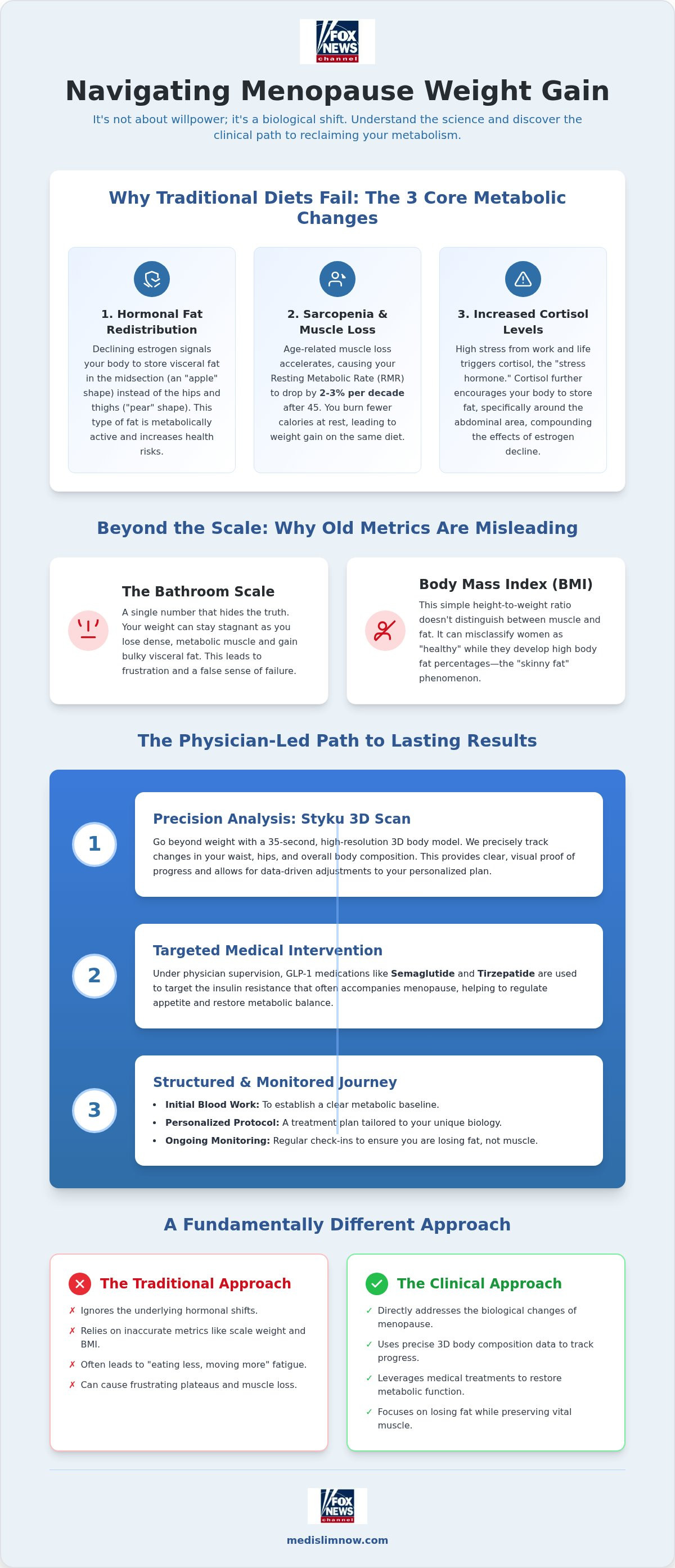
As estrogen drops, your body moves away from storing fat in the hips and thighs, often called a "pear" shape. It begins depositing visceral fat deep within the abdominal cavity, creating an "apple" shape. This isn't just a cosmetic change. Visceral fat is metabolically active and increases your risk for insulin resistance and cardiovascular strain. Traditional steady-state cardio often fails to burn this specific type of fat because the hormonal environment now favors storage over mobilization.
The Sarcopenia Trap: Losing Your Calorie Burner
Sarcopenia is the age-related loss of skeletal muscle mass, which accelerates during the menopause transition. Because muscle is your primary engine for burning calories, losing it causes your resting metabolic rate (RMR) to plummet. After age 45, most women experience a metabolic decline of approximately 2% to 3% per decade due to this loss of lean tissue. You might eat the same amount of food as you did in your 30s, yet you'll gain weight because your body no longer requires the same energy to maintain itself.
The fast-paced professional and family environments in Midlothian add another layer of difficulty. High stress levels trigger the release of cortisol, a hormone that further encourages fat storage in the midsection. When you combine high cortisol with declining estrogen and muscle loss, standard dieting becomes ineffective. Many women find that "eating less and moving more" leads to fatigue rather than fat loss. Managing menopause weight gain Midlothian requires a clinical approach that accounts for these specific biological hurdles.
Beyond the Scale: Using 3D Body Analysis to Track Menopause Progress
The standard bathroom scale is often the biggest source of frustration when you're managing menopause weight gain Midlothian. It provides a single, blunt number that fails to account for the complex physiological shifts happening inside your body. During menopause, your weight might stay the same even as your waistline expands. This happens because you're losing metabolic muscle and gaining visceral fat. Relying solely on a scale can lead to a false sense of failure, even when your health is actually improving through medical intervention.
Why BMI Fails Menopausal Women
Body Mass Index (BMI) is a mathematical formula that doesn't distinguish between muscle, bone, and fat. For women in their 40s and 50s, this metric is particularly deceptive. Many experience the "skinny fat" phenomenon, where their weight remains within a "normal" range while their body fat percentage climbs to unhealthy levels. This shift increases the risk of metabolic disease without ever triggering a warning on a traditional scale.
If you're using medications to assist with weight loss, tracking semaglutide results with styku is essential. Without precise monitoring, you might inadvertently lose lean muscle tissue instead of fat. Preserving muscle is the only way to maintain your resting metabolic rate. Medical supervision ensures that your weight loss comes from the right places, protecting your long-term health and vitality.
The Styku Advantage in Midlothian
We utilize Styku 3D Body Composition Analysis to provide a clear, scientific picture of your progress. In just 35 seconds, the scanner creates a high-resolution 3D model of your body with millions of data points. This technology allows us to track inch loss in the waist, hips, and thighs with a level of accuracy that a tape measure can't match. Seeing a visual representation of your body shrinking provides powerful motivation, especially during weeks when the scale remains stagnant.
This data is vital for personalizing your treatment. When we see exactly how your body is responding to medications like Tirzepatide for Menopause weight management, we can make real-time adjustments to your plan. This level of precision ensures you aren't just losing weight, but transforming your body composition. If you're ready to see what's happening beneath the surface, you can schedule a Medical Weight Loss Consultation to begin your data-driven journey.
Medical Interventions: Semaglutide and Tirzepatide for Menopause
General lifestyle advice often fails to account for the biochemical reality of the menopause transition. When estrogen levels drop, your body's sensitivity to insulin frequently decreases, making it much harder to process carbohydrates and maintain a stable weight. Managing menopause weight gain Midlothian requires a clinical strategy that addresses these underlying metabolic shifts. Medical interventions like Semaglutide and Tirzepatide provide a way to bypass the hormonal roadblocks that make traditional dieting ineffective.
Hormonal Synergy: How GLP-1s Work with Your Body
GLP-1 receptor agonists mimic a naturally occurring hormone that regulates appetite and blood sugar. For women in menopause, these medications are particularly effective because they target the insulin resistance that drives abdominal fat storage. They also significantly reduce "food noise"-the persistent, intrusive thoughts about eating that often intensify during hormonal fluctuations. By stabilizing these signals, you can regain control over your nutritional choices without the constant struggle of willpower.
It is helpful to view these treatments as a tool to restore metabolic balance. You can learn more about how these options fit into a broader clinical plan in our weight loss medication guide. When your hormones are no longer working against you, sustainable progress becomes a realistic expectation rather than a source of anxiety.
Choosing Between Semaglutide and Tirzepatide
While both medications are highly effective, they work through slightly different mechanisms. Semaglutide is a single-agonist medication that focuses solely on the GLP-1 receptor. In contrast, Tirzepatide is a dual-agonist. It targets both the GLP-1 and GIP (glucose-dependent insulinotropic polypeptide) receptors. This dual-action approach often leads to more significant weight loss and better glucose regulation for women with severe insulin resistance. You can find a deeper analysis of this technology in our guide to tirzepatide for weight loss.
Professional medical supervision is non-negotiable when starting these treatments. A physician ensures that your dosage is titrated correctly to minimize side effects like nausea or fatigue while protecting your lean muscle mass. Managing menopause weight gain Midlothian through a supervised program allows for real-time adjustments based on your specific symptoms and progress. This clinical oversight transforms a "trendy" medication into a safe, long-term health strategy tailored to your aging body's unique requirements.
A Step-by-Step Guide to Managing Menopause Weight in Midlothian
Successfully managing menopause weight gain Midlothian requires a shift from guesswork to clinical precision. You cannot rely on the same strategies that worked in your 20s because your hormonal landscape has fundamentally changed. A structured, medical approach ensures that you are losing fat while protecting your vital muscle mass and bone density. Following a clear progression of steps helps remove the anxiety of the unknown and replaces it with a predictable, data-driven path to results.
- Step 1: Clinical Consultation and Blood Work. We begin by assessing your current metabolic health through comprehensive labs. This includes checking insulin levels, thyroid function, and inflammatory markers that often shift during menopause.
- Step 2: Establishing a 3D Baseline. We use Styku 3D Body Composition Analysis to map your current visceral fat and lean muscle distribution. This provides a more accurate starting point than a standard scale.
- Step 3: Metabolic Support. We implement a nutritional plan focused on high protein intake and introduce resistance training to counteract age-related muscle loss.
- Step 4: Medical Intervention. If your metabolism remains stalled, we consider physician-supervised GLP-1 therapy, such as Semaglutide or Tirzepatide, to address insulin resistance.
- Step 5: Ongoing Monitoring. Regular follow-up appointments allow us to track your progress, adjust dosages, and ensure your health markers are improving alongside your body composition.
Prioritizing Protein and Strength
Protein is the most critical macronutrient for women over 40. It provides the building blocks necessary to maintain muscle mass, which is your primary engine for burning calories. While many women focus on reducing calories, increasing your protein intake is the most effective way to protect your resting metabolic rate. Resistance training is equally vital. Lifting weights or using resistance bands "restarts" a stalled metabolism by creating metabolic demand. Local Midlothian fitness resources, such as specialized small-group training for women, can provide the supportive environment needed to master these movements safely.
The Importance of Physician Oversight
Attempting to manage medical weight loss through unverified online sources is dangerous, especially during the menopause transition. Your body is already navigating significant hormonal fluctuations, and adding powerful medications like Semaglutide or Tirzepatide requires expert supervision. A physician monitors your bone density and muscle mass to ensure you aren't losing the wrong kind of weight. We adjust your treatment based on your specific symptoms, ensuring that the process is both safe and effective for your unique biology. If you are ready to stop guessing and start a professionally managed program, you can book your Medical Weight Loss Consultation today to begin your journey.
The Medi Slim Approach: Personalized Care Near Midlothian
Local care is a critical component in managing menopause weight gain Midlothian. While digital platforms offer convenience, they often lack the personalized oversight required to navigate complex hormonal shifts. Our clinic provides a physical space where your progress is monitored by medical professionals who understand the nuances of the menopause transition. This face-to-face interaction allows for immediate adjustments to your treatment plan based on your physical response and metabolic data. You aren't just a number in a database; you're a patient receiving focused, clinical attention.
Your Journey at Our Midlothian-Area Clinic
When you visit our facility, you'll encounter a supportive, judgment-free environment designed for your comfort. We understand that menopause can be a vulnerable time, and our medical team is here to act as your partner rather than a distant authority. The process is designed for logistical ease, fitting seamlessly into a modern lifestyle. A typical visit includes a 35-second Styku scan and an efficient consultation to review your health markers. Our program focuses exclusively on delivering non-surgical, science-based results through a combination of advanced medication and precise body analysis.
Integrating Semaglutide or Tirzepatide into your daily life becomes much simpler with professional guidance. We help you manage nutritional balance and side effects in real-time, ensuring the medication supports your energy levels rather than draining them. By using Styku 3D Body Composition Analysis at every milestone, we provide objective proof that your plan is working. You won't have to wonder if you're losing muscle or fat; the data will show your transformation clearly and accurately.
Taking the First Step Toward Transformation
A one-size-fits-all diet is rarely effective for the metabolic challenges of middle age. You deserve a personalized plan that accounts for your unique blood work, body composition, and hormonal profile. This clinical approach removes the guesswork and provides a clear, manageable path toward reclaiming your metabolism. Managing menopause weight gain Midlothian is a medical process, and it's much easier to navigate when you have a well-defined, professionally managed roadmap to follow.
Booking your initial appointment is the first step in moving from frustration to action. Our team is ready to help you interpret your metabolic data and choose the right medical tools for your journey. Schedule your medical weight loss consultation at Medi Slim today to begin addressing menopause weight gain with the professional oversight you deserve.
Reclaiming Your Metabolic Health in Midlothian
Menopause weight gain is a clinical reality driven by hormonal shifts and muscle loss, but it doesn't have to be permanent. By moving away from generic diets and embracing a physician-supervised approach, you can address the root causes of metabolic decline. Managing menopause weight gain Midlothian is most effective when you combine advanced treatments like Semaglutide or Tirzepatide with precise body composition data.
Our clinic offers a convenient Central Virginia location where you can access expert medical oversight and Styku 3D Body Scanning to track your transformation with scientific accuracy. This structured path replaces guesswork with professional validation and safety. You don't have to navigate this transition alone or feel that your body is working against you. Reclaiming your metabolic health is a manageable, medical process. We are here to help you take that first step toward a healthier, more confident version of yourself.
Book Your Menopause Weight Loss Consultation in Midlothian
Frequently Asked Questions
Is menopause weight gain permanent or can it be reversed?
Menopause weight gain is not permanent and can be reversed with the right medical intervention. While hormonal shifts make it harder to lose weight through traditional means, addressing insulin resistance and metabolic decline allows the body to release stored fat. Reversing this gain requires a clinical strategy that accounts for your specific hormonal profile and prioritizes fat loss over simple calorie restriction.
Can I take Semaglutide if I am also on Hormone Replacement Therapy (HRT)?
Yes, you can typically take Semaglutide while on HRT under professional medical supervision. These treatments often work well together because HRT addresses estrogen deficiency while Semaglutide targets the metabolic insulin resistance that often persists despite hormonal replacement. A physician-supervised consultation ensures that both therapies are balanced to optimize your health outcomes and reduce the symptoms of metabolic syndrome.
How much weight can I expect to lose with medical supervision in Midlothian?
Weight loss results vary based on your starting point and metabolic health, but many patients see significant, measurable progress within the first few months. Managing menopause weight gain Midlothian through a clinical program focuses on sustainable, body-composition-based results rather than just a number on the scale. We prioritize fat loss while protecting your lean muscle mass to ensure your metabolism remains strong for long-term success.
Will I lose muscle while taking Tirzepatide during menopause?
Muscle loss is a risk with any rapid weight loss, but it can be minimized through proper medical oversight and nutritional planning. When taking Tirzepatide, we emphasize high protein intake and resistance training to preserve your metabolic engine. Using Styku 3D body scans allows us to monitor your muscle mass in real-time and adjust your plan to prevent the sarcopenia often associated with aging.
Why is visceral fat more dangerous during menopause than other types of fat?
Visceral fat is dangerous because it surrounds your internal organs and is metabolically active. Unlike subcutaneous fat, visceral fat releases inflammatory markers that increase your risk for heart disease and type 2 diabetes. Menopause triggers a biological shift toward this specific fat storage, making clinical intervention vital for your long-term cardiovascular health. Reducing this fat is a primary goal of our medical weight loss programs.
How often should I get a Styku 3D body scan during my program?
We typically recommend a Styku 3D body scan every four to six weeks to track your progress accurately. This frequency provides enough time for measurable changes in body composition and inch loss to occur. These scans offer objective data on fat reduction and muscle preservation, helping you stay motivated even if the bathroom scale is slow to move during certain phases of your journey.
Are weight loss injections safe for women in perimenopause?
Weight loss injections are generally safe for women in perimenopause when prescribed and monitored by a physician. Managing menopause weight gain Midlothian often starts during this transition phase to prevent the significant metabolic slowdown that occurs later. Early intervention helps stabilize blood sugar and appetite before the most dramatic hormonal shifts take place. This proactive approach makes the eventual transition into menopause much more manageable.
What is the best exercise for menopause belly fat?
Resistance training is the most effective exercise for targeting menopause-related abdominal fat. Lifting weights or using resistance bands builds muscle mass, which increases your resting metabolic rate and improves insulin sensitivity. While walking is beneficial for general health, adding strength training is essential for changing body composition and reducing visceral fat. We help you integrate these movements into your lifestyle to support your medical treatment.