

Overcoming a Weight Loss Plateau in Mechanicsville: A Medical Guide
Your weight loss plateau isn't a sign that you've failed; it's a sign that your body's survival mechanisms are working exactly as they were designed. It's exhausting to maintain a strict routine only to watch the scale remain stagnant for weeks at a time. If you're struggling with overcoming a weight loss plateau Mechanicsville medical experts can help you understand the biological shifts happening beneath the surface. Many people feel a deep sense of frustration when their effort no longer matches their results, leading to the fear that they've reached a permanent "set point" that cannot be changed.
The truth is that metabolic adaptation is a complex biological process, not a lack of willpower. This guide provides a clear roadmap to restart your progress safely through professional oversight and scientific validation. You'll discover the specific reasons behind these stalls and learn how medical interventions like Semaglutide and Tirzepatide can reset your trajectory. We will also explain how Styku 3D Body Composition Analysis reveals the difference between losing fat and losing muscle. By shifting from self-guided efforts to a physician-supervised approach, you can finally move past the "scale lie" and reach your goal weight with confidence.
Key Takeaways
- Identify the biological triggers of a stall, such as metabolic adaptation and the body's natural defense of its set point.
- Learn why overcoming a weight loss plateau Mechanicsville residents experience requires moving beyond willpower to address physiological factors with medical oversight.
- Discover how Styku 3D Body Composition Analysis offers a clearer picture of your progress by measuring fat loss instead of just scale weight.
- Understand the role of GLP-1 medications like Semaglutide and Tirzepatide in resetting your metabolism and restarting stalled progress.
- Master practical strategies like conducting a calorie audit and increasing protein intake to preserve lean muscle while losing fat.
What is a Weight Loss Plateau and Why Does it Happen?
A weight loss plateau is defined medically as a period of three to four consecutive weeks where your scale weight remains unchanged despite continued adherence to your diet and exercise program. It's a common phase in any health journey, but it can be deeply discouraging. Understanding the Plateau principle helps explain why your body's initial rapid progress eventually levels off into a more stable state. When you're focused on overcoming a weight loss plateau Mechanicsville professionals often point to the "Set Point Theory." This biological concept suggests your body has a preferred weight range it works hard to maintain. To defend this weight, your system may subconsciously lower your metabolic rate or increase your hunger signals.
Distinguishing between a temporary stall and a true physiological plateau is essential for your mental health and your strategy. A stall might last only a few days due to a high-sodium meal or a particularly strenuous workout. In contrast, a true plateau is your body's way of recalibrating to its new size and metabolic needs. It requires a different clinical approach than simply "trying harder."
The Difference Between Weight and Fat Loss
Your bathroom scale is a blunt instrument that cannot distinguish between different types of tissue. It measures the total weight of your bones, organs, water, fat, and muscle. During a plateau, you might actually be experiencing body recomposition. This occurs when you lose body fat while simultaneously gaining lean muscle mass. Because muscle is significantly denser than fat, your physical measurements and clothing fit may improve even if the number on the scale remains stagnant. Relying solely on the scale often obscures the real progress you're making toward your health goals, making it the least reliable metric for long-term success.
Common Local Triggers in Central Virginia
Living in Mechanicsville and the greater Richmond area presents specific environmental factors that can influence your physiological progress. Seasonal shifts play a significant role. During the peak of Virginia's humid summers, outdoor activity often drops as residents seek air-conditioned spaces, leading to a subtle decrease in daily movement. This intense humidity also impacts hydration levels, which can lead to temporary water retention that masks actual fat loss on the scale.
Additionally, local social habits contribute to "calorie creep." Central Virginia's vibrant food scene and frequent community events can introduce hidden calories that stall progress without you realizing it. Identifying these local triggers is a vital part of overcoming a weight loss plateau Mechanicsville residents frequently face. Whether it's a shift in your walking routine at local parks or a change in your hydration needs, recognizing these factors allows for a more precise adjustment of your medical weight loss strategy.
The Biological Mechanics of a Weight Loss Stall
Your body is a finely tuned survival machine that views rapid weight loss as a threat to its energy reserves. When you begin a new regimen, the initial drop you see is often the result of depleted glycogen stores. Glycogen is the way your body stores carbohydrates, and it's bound to a significant amount of water. As these stores are used, the "water weight" disappears quickly, creating a false expectation of a linear decline. Once your glycogen levels stabilize, the rate of loss naturally slows down, which can feel like a sudden halt in progress.
Another factor in this process is the "whoosh effect." When fat cells release stored triglycerides, they don't always shrink immediately. Instead, they often fill with water temporarily to maintain their structure. This can lead to a scale that doesn't budge for weeks, even though fat loss is still occurring. Eventually, the body releases this water, resulting in a sudden, significant drop in weight overnight. If you're focused on overcoming a weight loss plateau Mechanicsville medical insights can help you navigate these biological hurdles with patience and precision.
Hormonal shifts also play a major role in why your progress might stall. As you lose body fat, your levels of leptin, the hormone responsible for feeling full, begin to drop. Simultaneously, ghrelin, the hormone that triggers hunger, starts to rise. Your biology is effectively signaling you to eat more to protect its current energy stores. Understanding these mechanics is the first step toward managing them through a medical weight loss consultation that addresses your specific hormonal profile.
Metabolic Adaptation Explained
Metabolic adaptation is the body's "starvation response" to prolonged calorie deficits. As you lose weight, your Basal Metabolic Rate (BMR) naturally decreases because a smaller body requires less energy to function. This is often called the "cost of weight loss." For example, a 150lb person burns significantly fewer calories than a 200lb person while performing the exact same task, like walking a mile or sitting at a desk. Your metabolism becomes more efficient, meaning you must continue to adjust your strategy to maintain a deficit.
Cortisol and Stress Stalls
Chronic stress from restrictive dieting or excessive exercise can trigger the production of cortisol. This hormone is known for causing the body to retain water, particularly in the abdominal area. When you attempt to "try harder" by slashing more calories or adding more intense cardio, you may inadvertently increase your stress levels. This spikes cortisol further and masks your fat loss results with water retention. In these cases, the best medical advice is often to stabilize your intake and focus on recovery rather than pushing your body into a deeper state of stress.
Evaluating Your Progress with Styku 3D Body Analysis
When the scale stops moving, it's easy to assume your progress has ended. However, total body weight is often a poor indicator of your actual body composition. Styku 3D Body Composition Analysis serves as a critical tool for overcoming a weight loss plateau Mechanicsville patients often face. By creating a high-resolution 3D model of your body, this technology captures changes in your physical shape that a standard scale cannot detect. It allows you to see exactly where you're losing inches, providing visual evidence of fat loss even when your total weight remains the same.
This precision is vital for tracking different types of fat. Subcutaneous fat sits just under the skin, while visceral fat surrounds your internal organs and poses higher health risks. Styku helps distinguish between the two, ensuring your medical weight loss program is improving your internal health metrics. Visualizing these changes helps maintain motivation during a scale stall. It turns a period of frustration into a data-driven phase of your journey, showing you that your body is still transforming beneath the surface.
Why the Scale Lies During a Plateau
A standard bathroom scale doesn't account for temporary physiological changes like inflammation or muscle repair. If you've increased the intensity of your workouts, your muscles may retain water as they heal, causing a temporary weight spike. This "scale obsession" often leads to unnecessary anxiety and can derail long-term success. For those using medical interventions, tracking semaglutide results with styku provides the gold standard for monitoring body transformation beyond the number on the dial.
Mapping Your Transformation in Mechanicsville
Local patients at Medi Slim utilize these scans to validate their hard work with clinical precision. While a standard tape measure is prone to human error and inconsistent placement, a 3D scan provides exact measurements of your waist, hips, and limbs every time. This data is indispensable for our physician-supervised team. It helps us decide whether you need a lifestyle change or a medical adjustment in your dosing. By using objective data, you can move forward with the quiet confidence that your efforts are yielding real, measurable results. This clarity is often the missing piece in overcoming a weight loss plateau Mechanicsville residents need to stay on track toward their goal weight.
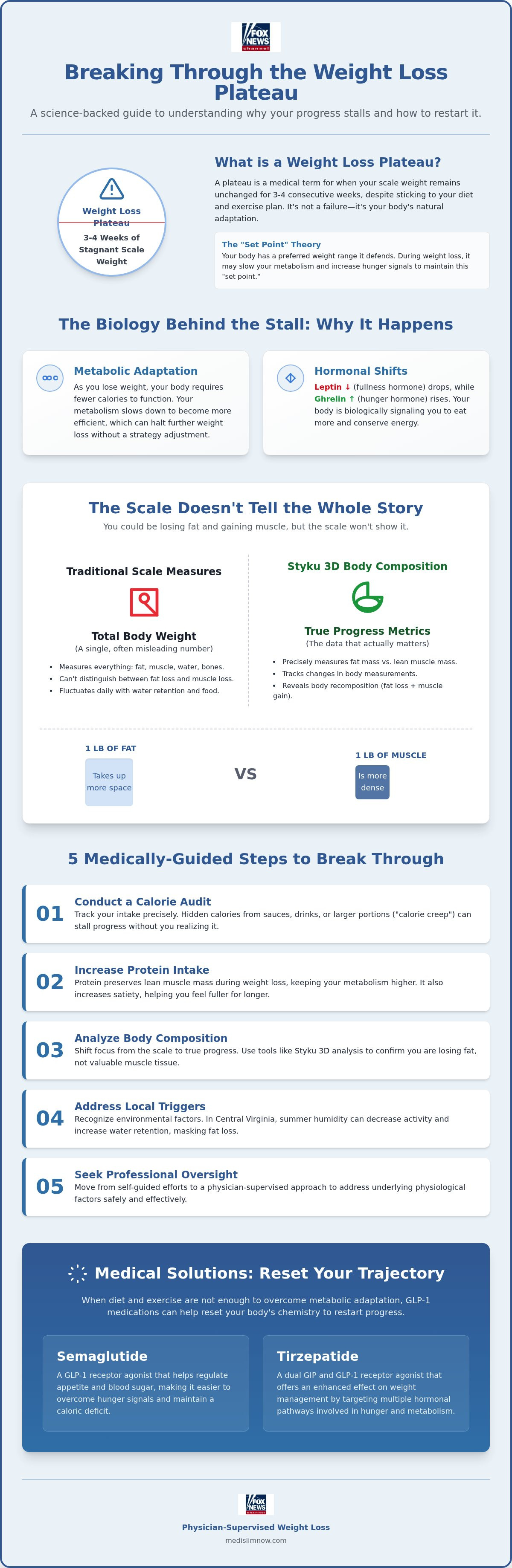
5 Steps to Overcome a Weight Loss Plateau
While biological factors are influential, you can take practical steps to restart your progress. Overcoming a weight loss plateau Mechanicsville residents often find that a structured approach provides the necessary momentum to break through a stall. Following these five clinical and lifestyle steps helps realign your results with your efforts.
- Step 1: Conduct a Calorie Audit. Portion distortion is a common issue where we unknowingly consume more than we track. Re-measuring your intake for one week identifies hidden calories that have crept back into your routine.
- Step 2: Increase Protein Intake. Protein has a high thermic effect, meaning your body burns more energy digesting it compared to fats or carbohydrates. It also preserves lean muscle during a deficit.
- Step 3: Implement Strength Training. Lifting weights or performing resistance exercises counteracts the metabolic slowing mentioned earlier by building metabolically active tissue.
- Step 4: Prioritize Sleep and Recovery. Aim for seven to nine hours of quality sleep. This lowers cortisol levels and helps regulate the hunger hormones, ghrelin and leptin, which we discussed in previous sections.
- Step 5: Consult a Professional. If lifestyle changes don't yield results after four weeks, it's time for a medical review to check for underlying hormonal or metabolic issues that require clinical intervention.
Recalibrating Your Caloric Deficit
As you lose weight, your body's energy requirements decrease. The calorie goal that worked when you were twenty pounds heavier may now be your maintenance level. It's a common trap to cut calories too low, which can trigger a deeper metabolic adaptation and further slow your progress. Finding the right balance is essential for calculating daily calories for effective weight loss without compromising your health. A physician-supervised plan ensures you stay in a safe, effective deficit tailored to your current body composition and activity level.
Switching Up Your Exercise Routine
Your body adapts to repetitive exercise. If you've been doing the same steady-state cardio for months, try High-Intensity Interval Training (HIIT) to challenge your cardiovascular system and boost your calorie burn. However, don't overlook Non-Exercise Activity Thermogenesis (NEAT). Simply walking more throughout the day is often more effective than adding an extra gym session because it doesn't spike cortisol levels as intensely. Mechanicsville offers excellent spots to increase your daily steps, such as the trails at Pole Green Park. Increasing your activity in these local environments provides a low-stress way to boost your daily caloric burn and break through a stubborn plateau.
If you're ready to move past the scale frustration and see real results through a supervised program, book a medical weight loss consultation with our team today.
Medical Solutions: Breaking Plateaus with Semaglutide and Tirzepatide
When lifestyle adjustments reach their limit, medical interventions offer a path through the physiological barriers your body has constructed. Overcoming a weight loss plateau Mechanicsville patients often find that GLP-1 medications like Semaglutide provide the necessary biological reset. These medications work by mimicking hormones that target areas of the brain involved in appetite regulation. By shifting your body's internal "set point," they help suppress the hunger signals that typically spike during a stall. This medical approach addresses the hormonal imbalances mentioned earlier. It makes it possible to continue losing weight even when your metabolism has adapted to a lower calorie intake.
Medication titration is a key component of this process. It involves starting with a low dose to allow your body to adjust. We then incrementally increase it based on your progress and tolerance. If your weight loss has stalled for several weeks, a physician-supervised dose adjustment can often restart the fat-burning process. This isn't about simply taking more medication. It's about finding the precise therapeutic level that overrides your body's survival responses. Physician oversight is critical during these transitions to ensure safety and to monitor how your system responds to each change.
Semaglutide and Tirzepatide Adjustments
Choosing between different GLP-1 options depends on your specific metabolic profile. For instance, tirzepatide for weight loss targets two distinct hunger pathways, GLP-1 and GIP, providing a dual-action breakthrough that can be particularly effective for breaking stubborn stalls. When a dose increase is necessary, our medical team monitors your symptoms closely. Professional monitoring helps manage common side effects like nausea or digestive changes. This ensures your journey remains comfortable and sustainable as we push past metabolic adaptation.
The Medi Slim Approach in Mechanicsville
At Medi Slim, we don't rely on guesswork. Our personalized consultations focus on identifying the root cause of your plateau, whether it's hormonal, behavioral, or metabolic. We combine clinical-grade medication with the objective data from Styku 3D body tracking. If the 3D scan shows you're still losing fat despite a stagnant scale, we might maintain your current dose. If the data confirms a true physiological halt, we adjust your plan accordingly. This dual-action approach ensures every medical decision is backed by visual proof and scientific validation. You can schedule your medical weight loss consultation in Mechanicsville to begin a professionally managed program designed to overcome your specific biological hurdles.
Take the Next Step Toward Your Weight Loss Goals
A weight loss plateau isn't a permanent barrier; it's a physiological signal that your body is adapting to change. By understanding the mechanics of metabolic adaptation and using clinical data, you can move past the frustration of a stagnant scale. Overcoming a weight loss plateau Mechanicsville residents face requires a shift from self-guided guesswork to a structured, medical approach. We use Styku 3D Body Composition Analysis to reveal the fat loss that standard scales often ignore. This data, combined with physician-supervised Semaglutide or Tirzepatide programs, allows for precise adjustments that restart your progress safely. We are proud to serve patients throughout Mechanicsville, Richmond, and Henrico with evidence-based solutions. You don't have to navigate this journey alone. Our team is here to provide the professional oversight and scientific validation you need to reach your target weight. Book Your Medical Weight Loss Consultation at Medi Slim Mechanicsville today to reclaim your momentum and finish your transformation with confidence.
Frequently Asked Questions
How long does a weight loss plateau typically last?
A true weight loss plateau is typically defined as three to four consecutive weeks without any movement on the scale. Shorter stalls are often just temporary fluctuations in water weight or glycogen. If you've been consistent for a full month without results, your body has likely reached a metabolic equilibrium. This is the ideal time to evaluate your strategy and consider a medical consultation to identify the underlying physiological cause.
Is it normal to stop losing weight on Semaglutide?
It is common to experience a stall even while using Semaglutide. Your body naturally attempts to adapt to the medication and the reduced calorie intake by slowing its metabolism. This doesn't mean the treatment has stopped working. Often, a physician-supervised adjustment in your dosage or a review of your nutritional intake is necessary to restart your progress. We monitor these shifts closely to ensure you continue moving toward your goal weight safely.
Can eating more actually help break a weight loss plateau?
Increasing your caloric intake strategically can sometimes help, but it must be done with precision. A temporary diet break or a slight increase in complex carbohydrates can lower cortisol levels and signal to your body that it isn't in a starvation state. This can help reset certain metabolic hormones. However, this approach should be managed by a professional to avoid accidental weight gain and ensure the extra calories support your metabolic health.
Does a plateau mean I've reached my 'set point'?
A plateau doesn't mean you've reached a permanent limit. It simply indicates that your body is currently defending its current weight, often referred to as a set point. This is a biological survival mechanism, not a failure of willpower. For those focused on overcoming a weight loss plateau Mechanicsville medical programs provide the tools to reset this set point. Using medications like Tirzepatide helps override these defensive signals to allow for continued fat loss.
How often should I get a Styku 3D body scan during a plateau?
We generally recommend a Styku 3D body scan every four to six weeks. This frequency allows enough time for significant physical changes to occur in your body composition. During a scale plateau, these scans are invaluable because they often show a reduction in inches even when your weight remains the same. Seeing these visual improvements helps maintain your motivation and provides the data needed to validate that your fat loss is still occurring.
Should I change my exercise or my diet first to break a stall?
We typically recommend auditing your dietary habits first. Hidden calories and portion distortion are the most common reasons for a stall. Once your nutrition is verified, you can then adjust your exercise routine. Adding resistance training or increasing your daily steps through NEAT can help boost your metabolic rate. If you're struggling with overcoming a weight loss plateau Mechanicsville experts can help you determine which variable needs the most immediate attention for your specific body.
When should I see a doctor about a weight loss plateau in Mechanicsville?
You should seek medical advice if your weight has not changed for four consecutive weeks despite strict adherence to your program. A physician can perform a comprehensive review to check for hormonal imbalances or metabolic adaptation that lifestyle changes alone cannot fix. Our clinic in Mechanicsville specializes in these clinical reviews. We provide the professional oversight necessary to adjust your medication or nutrition plan, ensuring your efforts lead to measurable results once again.
Can stress in my daily life in Richmond cause my weight loss to stall?
Chronic stress from daily life in Richmond can definitely impact your progress. High stress levels trigger the production of cortisol, a hormone that promotes water retention and can even encourage fat storage around the midsection. This hormonal shift can mask your actual fat loss on the scale, making it appear as though you've stalled. Managing your recovery and sleep is just as important as your diet when you're trying to break through a stubborn plateau.