

Semaglutide Weight Loss in Midlothian, Texas
Yes, semaglutide can kickstart weight loss: clinical trials found that weight loss may begin within four weeks, and participants in one trial lost about 2% of their body weight after the first month. The semaglutide success stories in Midlothian are best understood as individual experiences, not a forecast of what any one person will lose.
If you’re looking for semaglutide success stories in Midlothian, it helps to know that personal experiences vary and can’t predict your own results. Semaglutide is a prescription medication used in medical weight management; treatment response may differ with health history, prescribed plan, and lifestyle.
This guide explains what patients have reported, how treatment typically works, and what can influence progress here in Midlothian, Texas. You’ll also learn what a medically supervised weight-loss process with Medi Slim may involve, so you can consider whether semaglutide is a suitable next step for your goals.
Key Takeaways
- Semaglutide may support early weight loss by influencing appetite, but progress depends on factors such as dosage, starting weight, health conditions, and consistency.
- Patient experiences can offer perspective, but individual results and experiences after stopping treatment differ.
- Learn what a medically supervised treatment plan may involve and which factors help guide progress tracking.
- Compare reported patient outcomes with your own goals, then consider whether a medical weight loss consultation is a suitable next step.
How much weight can you lose in a month on semaglutide?
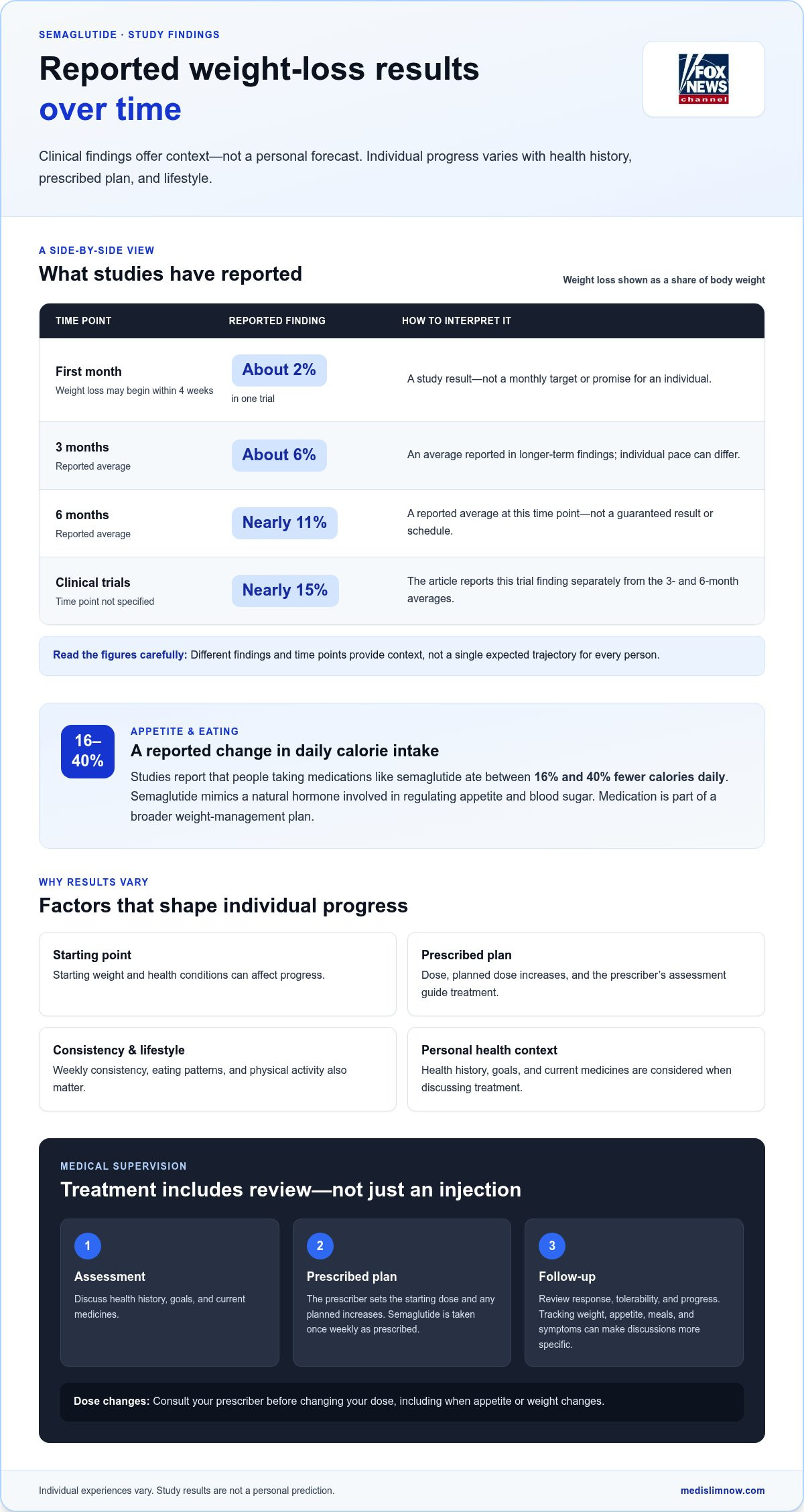
Clinical trial results suggest weight loss can begin within four weeks of starting semaglutide. In one trial, participants lost about 2% of their body weight after the first month. That figure describes a study result, not a personal monthly target. Your starting weight, dose, health conditions, weekly consistency, and lifestyle changes all affect progress.
Semaglutide is a GLP-1 receptor agonist. It mimics a natural hormone that helps regulate appetite and blood sugar. Studies report people taking medications like semaglutide ate between 16% and 40% fewer calories daily. Lower appetite may make it easier to follow eating changes, but medication works within a broader weight-management plan.
Longer-term findings offer context beyond the first month. Reported averages include about 6% of body weight lost at three months and nearly 11% at six months. Clinical trials found patients taking semaglutide experienced nearly 15% weight loss. These different time points reflect study results, not a guaranteed pace for each person.
Medical weight-loss options can include semaglutide and tirzepatide. These are different medications, and a clinician considers your health history, goals, current medicines, and response when discussing treatment. That assessment also helps identify which measures are useful for tracking progress.
Wegovy is approved for weight management for certain people with obesity or overweight. A prescriber assesses health and treatment needs before prescribing. This approval applies to Wegovy’s indicated use, not to every semaglutide product or situation.
Treatment starts with a medical assessment and a prescribed plan. The prescriber sets the starting dose and any planned dose increases, then follow-up visits review response, tolerability, and progress. Consult your prescriber before changing your dose, including when your appetite or weight changes.
Medical supervision gives you an opportunity to discuss side effects and review your plan as treatment progresses. Semaglutide is taken once weekly as prescribed. Eating patterns and physical activity also matter. Tracking weight, appetite, meals, and symptoms can make follow-up discussions more specific.
Insurance coverage and payment options vary by individual plan and circumstances, and medication may not be fully covered. At Medi Slim, you can discuss insurance and financing assistance as part of a medical weight-loss consultation. Consider the overall care process, including assessment and follow-up, rather than comparing medication alone.
Patient experiences with Ozempic and semaglutide
People report different experiences with semaglutide, including changes in weight and appetite and decisions about continuing treatment. Treat each story as one person’s account, not a forecast for someone else.
Reported Patient Experiences
Stories from people in Midlothian, Virginia, and elsewhere offer personal context, but their circumstances differ. Andrea Mullinax, a 35-year-old mother of two adolescent girls, described walking eight or nine miles at work and receiving weekly injections. Her goal was 160 pounds. Meredith Schorr, 25, said she lost 50 pounds over 11 months after starting weekly injections in February 2022.
Other accounts describe different outcomes. Marissa H. reported losing 30 pounds after starting Ozempic, while Whittnie A. reported losing 30 pounds over a year. These reports don’t establish what another person will experience. Look at the timeframe, treatment context, and personal goals behind each story. Readers searching for semaglutide success stories in Midlothian can use them to prepare practical questions for a medical discussion.
Side Effects and Serious Risks
Some people report gastrointestinal side effects. An interview described a four-month period in which most people would get through these effects, but experiences differ. Eating or drinking too little can contribute to nausea and dizziness, so recording meals, fluids, and symptoms can help make follow-up discussions more useful.
Serious concerns also deserve direct discussion. About 4% of people taking semaglutide were described as developing gallstones or needing gallbladder removal over 16 months. Ozempic and Wegovy should not be taken during pregnancy because available safety data are insufficient. Tell the prescriber about symptoms, health changes, and pregnancy plans, and consult them before changing a dose.
Weight Regain and Maintenance
Weight may return after treatment stops. Meredith Schorr said she initially gained about 10 pounds after stopping semaglutide. Five to six weeks later, she noticed stronger hunger. She also said she stopped in January while preparing to try to become pregnant, illustrating why treatment decisions can change with life circumstances.
ABC News medical contributor Darien Sutton said patients have reported regaining up to two-thirds of lost weight after stopping semaglutide. That report makes planning for maintenance an important part of treatment discussions. Review how appetite, eating routines, and weight trends may change if medication ends. Don’t adjust or stop a prescribed dose without consulting the prescriber. A clinician-led treatment discussion can help you consider these questions alongside your goals.
Semaglutide treatment in Midlothian, Texas
For people in Midlothian, Virginia, semaglutide treatment involves more than a weekly injection. Learning how care is structured can help you prepare to discuss whether medication fits your health goals. A plan considers the medication, prescribed schedule, eating and activity habits, and how progress will be reviewed.
A medical assessment is a practical first step. Be ready to discuss your goals, health conditions, current medications, and previous weight-management experiences. Bringing a medication list and writing down questions can help keep the conversation focused on your health profile and treatment options.
Semaglutide is a GLP-1 receptor agonist that mimics a natural hormone involved in appetite and blood sugar regulation. Wegovy is specifically approved for weight loss for people with obesity or who are overweight. Semaglutide for weight management is given as a 2.4-milligram subcutaneous injection once per week. Ozempic is used for type 2 diabetes at a 1.0-milligram dose, so product and treatment purpose matter.
After the assessment, the prescriber explains the prescribed schedule and any planned dose increases. Do not change your dose without consulting your prescriber. Follow-up discussions can review weight trends, appetite, tolerability, and health changes that may affect the plan.
Weekly consistency is one factor in outcomes, along with starting weight, dosage, other health conditions, and lifestyle changes. For example, tracking appetite and meals can help you identify patterns to discuss during follow-up. Clinical trial results provide context, but they don’t set an individual’s monthly progress. Treatment discussions should account for your routine and response.
Medication is one part of a broader weight-management approach. Eating habits and physical activity can support that approach, while regular tracking gives more context than a single weigh-in. Record weight trends, meals, activity, and symptoms to review with your prescriber.
Before starting, write down questions about injection technique, prescribed instructions, side effects, and missed doses. Ask how progress will be reviewed and what may influence treatment decisions as your response becomes clearer. These details can help you understand the plan and prepare for follow-up in Midlothian, Virginia.
Semaglutide was initially approved to treat Type 2 diabetes and is also allowed to be prescribed for weight loss. Its role can be discussed alongside the broader care plan, rather than treated as a substitute for nutrition, physical activity, or behavioral support. A prescriber can help clarify how the medication fits your circumstances and what follow-up is appropriate.
Structured programs offer another point of comparison: in structured diet, physical activity, and behavioral treatment programs, about 80% of participants stayed in treatment for 16 to 26 weeks. Participants in structured behavioral treatment programs lost an average of 6% to 10% of their body weight, while behavioral treatment programs typically produce an average weight loss of about 7% to 8% of body weight. These are program-level figures, not a forecast for any one person. Use them as context for discussing realistic goals, supports you can maintain, and how your care team will assess progress over time.
What semaglutide success stories are reported by patients in Midlothian, Virginia?
Midlothian, Virginia, testimonials describe substantial weight changes, but they don’t establish that semaglutide caused them. These are personal clinic testimonials, not controlled trial results or semaglutide-specific treatment records. They also refer to Virginia, not Midlothian, Texas, the location named in this article. That distinction matters when using local stories to set expectations or make treatment decisions.
One testimonial reports that Erin lost 90 pounds. Another says Jennifer lost 34 pounds. Those figures describe reported outcomes, but they don’t include a shared starting weight, treatment duration, or complete medical history. Without that context, comparing the two numbers directly can be misleading. A weight change is most meaningful alongside the person’s starting point, goals, and treatment circumstances.
Renate’s testimonial reports an 86-pound loss. Jessalyn and Chad each reportedly lost over 60 pounds in seven months. The timeframe is given for the couple, but the testimonials don’t establish which treatments they used. These accounts illustrate the range of reported outcomes, rather than showing what a particular medication can produce for another person.
For readers exploring semaglutide success stories in Midlothian, separate a reported result from its possible causes. A testimonial shares one person’s account, but not every factor behind the outcome. Medication, eating patterns, physical activity, health history, and support can all shape an individual’s weight-management experience.
Use local testimonials as conversation starters. Note the reported amount and timeframe, then consider what details would help put that result in context. For example, Erin’s 90-pound loss and Jennifer’s 34-pound loss are not a direct comparison unless their starting weights, timelines, and treatment plans are known. A large number alone doesn’t show whether the same approach would suit your health needs.
Keep geography clear, too. The testimonials above concern Midlothian, Virginia; they aren’t reports from patients in Midlothian, Texas. If you’re evaluating treatment in Texas, focus on your own medical assessment, goals, and progress measures. Personal accounts can help you understand the questions to raise, while treatment decisions rely on your individual health profile and response.
A practical step is to record what you eat and drink, when you do so, and when symptoms or changes in how you feel occur. Victoria Newcom advises patients to track food, fluids, and timing because eating or drinking too little can cause nausea and dizziness. This record can help you discuss your experience with a healthcare professional, but it cannot show that a reported weight change came from semaglutide or predict another person’s response. Ask how your progress and symptoms should be monitored rather than treating a testimonial as a target.
Medi-Weightloss Midlothian lists its address as 230 Browns Way Road, Midlothian, Virginia 23114. Depending on the prescription and payment method, medication may be shipped directly to the patient in 1-4 days. Those details describe the clinic’s location and a possible delivery timeframe, not the results or treatment circumstances behind the testimonials. For anyone considering care, clarify the prescription, payment arrangements, and follow-up with the provider, and keep personal expectations grounded in an individual medical assessment rather than another patient’s reported outcome.
Which Midlothian clinics offer semaglutide for weight loss, and what results do patients report?
The clinic testimonials in this section concern Midlothian, Virginia. They report weight changes, but those figures are not semaglutide-specific results or a complete picture of local care. Location and treatment details matter when you compare personal accounts with the care you’re considering.
Virginia testimonials report Erin lost 90 pounds, Jennifer lost 34 pounds, and Renate lost 86 pounds. Jessalyn and Chad each reportedly lost over 60 pounds in seven months. These are individual reported outcomes. They don’t establish that each person used semaglutide or that the same treatment approach produced every result.
A testimonial shares what one person says happened, not the result of a controlled comparison. Pounds lost alone don’t show starting weight, health history, or changes in eating and activity. Use personal stories as accounts of individual experiences, not as a forecast.
For a more useful comparison, consider the reported outcome, timeframe, and treatment described. Jessalyn and Chad’s testimonial includes a seven-month timeframe. Other reported outcomes list pounds lost without a shared timeframe, so comparing them as though they show the same rate of progress would be misleading.
Medical weight-loss care considers more than a headline result. A plan may take into account health history, goals, medication response, and lifestyle. Progress tracking, including body-composition measurements, can add context beyond body weight, while follow-up offers a chance to discuss response and concerns.
If you’re considering semaglutide in Midlothian, Virginia, treat local stories as context, not predictions. A testimonial may help you identify questions, but it can’t determine whether medication suits your health needs. Your own medical assessment provides relevant context for considering goals, treatment options, and monitoring.
Look for a clear explanation of the treatment plan, how progress is tracked, and how follow-up informs decisions. These details offer more context than pounds lost alone and connect a reported success story to the practical steps in supervised weight management.
To discuss your goals and whether semaglutide may suit your situation, schedule a medical weight-loss consultation.
Medi Slim: Semaglutide
Medi Slim offers medical weight-loss consultations and prescription semaglutide and tirzepatide treatment. At a consultation, you can discuss your goals, health history, and treatment options. Your plan is tailored to your health profile, with medical oversight and progress reviews.
Tracking progress can involve more than watching the scale. Styku 3D Body Composition Analysis measures changes in body composition, including fat loss and muscle gain, to help you follow your progress over time. This can add useful context to discussions about your plan and goals.
If you’re ready to discuss your options, contact Medi Slim to arrange a medical weight loss consultation.
Take the Next Step With a Clear Plan
Use the stories you’ve read as starting points for a personal conversation, not as a template for your own progress. The reported semaglutide success stories in Midlothian include Virginia experiences, while this article focuses on treatment in Texas. Keep that geographic difference in mind as you consider what matters for your health, goals, and day-to-day routine.
A useful next step is to outline what you want to discuss: your treatment goals, questions about medication, and how you’d like progress monitored. Medi Slim offers semaglutide and tirzepatide, along with Styku 3D Body Composition Analysis to track body composition changes. A medical weight loss consultation can help you explore options in the context of your health needs.
Contact Medi Slim about semaglutide to begin a conversation about your next step. A thoughtful, individualized plan can help you move forward with clarity and confidence.
Frequently Asked Questions
Can semaglutide kickstart weight loss?
Yes, semaglutide can support weight loss, and clinical trials found that changes may begin within four weeks. The practical sign may be reduced appetite, which can make planned meals easier to follow. For example, track appetite and eating patterns alongside weight, then discuss those observations during follow-up. A result in the first month is an early response, not a reliable prediction of your longer-term progress or an individual guarantee.
How much weight do people typically lose on semaglutide, and over what timeframe?
Clinical trial results offer benchmarks across several timeframes: about 2% of body weight after the first month, about 6% at three months, and nearly 11% at six months. Trials found nearly 15% weight loss overall. These figures describe study outcomes, not a personal schedule. For Midlothian readers comparing semaglutide success stories, note the timeframe and individual circumstances alongside the reported amount. Starting weight, dose, health conditions, consistency, and lifestyle changes influence progress.