

Tirzepatide patient reviews in Virginia: costs, effects, and care
A patient review can describe what treatment felt like, but it cannot predict your response. Tirzepatide is taken as a once-weekly injection, and reviews may discuss appetite, weight changes, side effects, medication delivery, and cost. If you are reading tirzepatide patient reviews in Virginia, separate personal experiences from what treatment may mean for you.
It is reasonable to want more than weight-loss claims. You may be weighing potential benefits against side effects, eligibility, and the practical details of treatment. Reviews can provide context, but they reflect individual experiences and do not replace a medical assessment.
This article explains tirzepatide and summarizes what patients report about appetite, fullness, weight changes, side effects, delivery, and costs. It also covers factors that may affect eligibility and why medical oversight matters when considering treatment.
Key Takeaways
- Use patient reviews to understand varied experiences, not to predict your own response to tirzepatide.
- Learn which common side effects patients describe and which serious symptoms call for prompt medical attention.
- Compare reports of appetite changes and fullness with the factors that can shape an individual’s weight-loss experience.
- Consider how medication delivery and customer service can affect the overall treatment experience.
- Explore how a medical weight loss consultation and body composition tracking can support a personalized care plan.
Reported side effects and serious risks
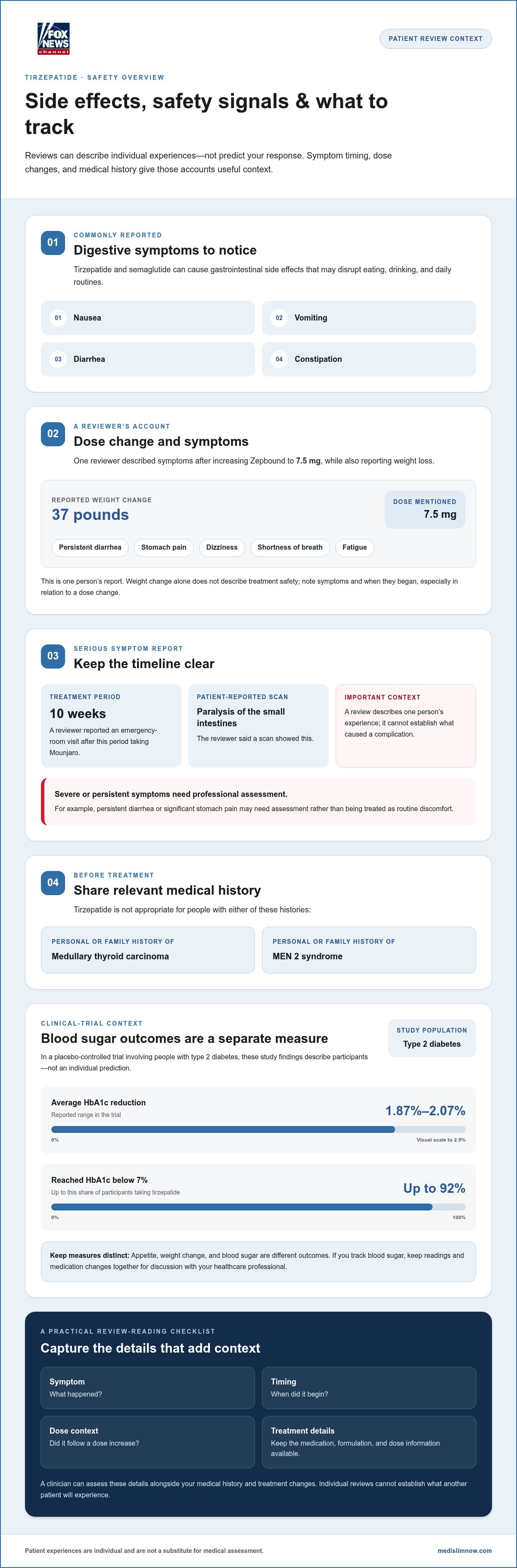
Tirzepatide can cause gastrointestinal side effects, and patient reports include serious symptoms. It isn’t appropriate for people with a personal or family history of medullary thyroid carcinoma or MEN 2 syndrome.
Gastrointestinal Side Effects
Gastrointestinal side effects affect the digestive system and can disrupt eating, drinking, and daily routines. Nausea, vomiting, diarrhea, and constipation are common effects reported with tirzepatide and semaglutide.
One reviewer described persistent diarrhea and stomach pain after increasing Zepbound to 7.5 mg, alongside dizziness, shortness of breath, and fatigue. Another reported side effects recurring after dose increases while taking Mounjaro. These examples show why noting symptoms and when they begin can help a clinician assess changes during treatment.
Blood Sugar and Metabolic Effects
Tirzepatide can affect blood sugar as well as weight, so those outcomes are important to distinguish. In a placebo-controlled trial involving people with type 2 diabetes, tirzepatide lowered HbA1c by an average of 1.87%-2.07%.
In a clinical trial, up to 92% of people with type 2 diabetes taking tirzepatide achieved an HbA1c below 7%. These results describe study participants, not an individual prediction. If you track blood sugar, keep readings and medication changes together; that context helps explain how treatment and daily health patterns relate.
Safety Monitoring and Serious Risks
Safety monitoring means paying attention to symptom timing, dose changes, and relevant medical history. A patient reported an emergency-room visit after 10 weeks of Mounjaro; the patient said a scan showed paralysis of the small intestines. A review describes one person’s experience, but cannot establish what caused the complication.
Before treatment, disclose a personal or family history of medullary thyroid carcinoma or MEN 2 syndrome, since tirzepatide is not appropriate with either history. Report severe or persistent symptoms to a healthcare professional. For example, persistent diarrhea or significant stomach pain may require assessment rather than being treated as routine discomfort.
Potential Side Effects
Other potential side effects can affect more than digestion. One reviewer reported severe dizziness, shortness of breath, fatigue, stomach pain, and persistent diarrhea after increasing Zepbound to 7.5 mg, despite reporting 37 pounds of weight loss.
This account shows why weight change alone does not describe treatment safety. Note the symptom, when it started, and whether it followed a dose increase, then share those details with your prescriber. For compounded tirzepatide, keep the formulation and dose information available for safety discussions, since these details help identify what was taken.
Patient-reported medication delivery and customer service
Virginia patient reviews compare tirzepatide and semaglutide through personal experiences, but they don’t establish which medication will work better for you. In a 28-week weight-loss trial, participants taking 1 mg of semaglutide had a similar reduction in appetite and calorie intake to those taking 15 mg of tirzepatide.
Delivery and customer-service comments matter because treatment involves more than medication. A useful review distinguishes pharmacy processing, communication about delays, and the patient’s experience receiving a prescription. For example, “my order was late” offers little context unless the reviewer explains what the pharmacy communicated and how the delay affected treatment.
Look for specific details rather than relying on an overall star rating. A review describing a pharmacy status update, a delivery-time change, or difficulty reaching customer service gives more context about that person’s experience. It does not establish a standard delivery schedule or predict how another patient’s prescription will be handled.
For practical context, keep prescription and pharmacy information together. If a delivery issue affects a scheduled dose, note the date, the pharmacy’s message, and the instructions from your prescriber. This gives your care team a clear example to discuss, rather than relying on an online post that may leave out the timeline or medication details.
Reviews may also mention appetite and cravings alongside weight loss. Treat these as separate observations: someone might describe feeling full sooner, eating smaller portions, or noticing fewer cravings. Such examples help explain what a reviewer means by “working,” but they don’t show whether blood sugar or A1C changed.
Those measures require separate context. In a 40-week trial involving people with type 2 diabetes, tirzepatide reduced HbA1c by 2.3%, compared with 1.86% with semaglutide. That trial result is not a patient-review comparison, and an A1C result cannot be inferred from appetite comments or weight loss alone.
When comparing review accounts, note the medication, prescribed dose, treatment stage, and outcome being described. For example, an appetite change and an A1C result answer different questions. The 28-week appetite finding also compared specific doses, so it shouldn’t be read as proof that every patient will experience the same effect.
If you want to connect personal goals with medication, a supervised treatment discussion can help put appetite, blood sugar, and treatment history into context.
Cost and outcome accounts can add context, but they remain individual reports. Another reported losing 45 pounds while taking tirzepatide and managing constipation with probiotics; a separate reviewer reported losing 6 pounds during the first week on a 2.5 dose of tirzepatide.
One reviewer reported losing 59 pounds after starting Mounjaro at 404 pounds and reaching 345 pounds in a little less than two months. The page states that Medicare has a pilot program covering GLP-1 medications for weight management for eligible beneficiaries as of 2026. Check eligibility and costs with the relevant plan and care team.
Appetite reduction and fullness
Appetite reports describe a personal experience, not a reliable forecast for every adult taking tirzepatide. One clinical comparison helps frame those accounts: over 28 weeks, participants taking 1 mg of semaglutide had a similar reduction in appetite and calorie intake to participants taking 15 mg of tirzepatide. That finding compares specific doses and a study group, not every patient’s response.
“Feeling full sooner” and “eating less” are related but different observations. A reviewer might describe leaving food on the plate, choosing smaller portions, or having fewer cravings between meals. These examples show what appetite changes can look like in daily life. On their own, they do not show a particular amount of weight loss or a change in blood sugar.
To make an appetite report useful, record a specific meal or moment instead of using a broad label. Note whether you finished your usual lunch, felt full earlier, or still wanted snacks later. Comparing similar meals over time can help you describe changes during a medical conversation. Do not treat one day as proof of a lasting pattern.
Nausea is different from reduced appetite. Someone may eat less because they feel full, while another person may avoid food because of nausea. Describe the sensation and situation clearly, such as whether nausea appeared around a meal or affected your ability to eat normally.
Diabetes adds another reason to separate appetite observations from measurements. Feeling less hungry doesn’t tell you what your blood sugar or A1C is doing. A food diary and glucose readings answer different questions; keeping both can help explain what changed. The 28-week comparison focused on appetite and calorie intake, not on proving that appetite reports predict diabetes outcomes.
Mounjaro is a brand name associated with tirzepatide, but a review mentioning Mounjaro still reflects one person’s experience. An approved use indicates whether a medicine is authorized for a particular purpose; it does not establish how full an individual will feel. A blood pressure reading is also a separate measure, not a substitute for tracking appetite or blood sugar.
When comparing reviews, look for the details behind phrases such as “less hungry.” Does the person describe meal size, cravings, nausea, or another change? That distinction makes patient stories more useful without treating them as medical advice. A clear example, such as smaller portions at lunch, tells you more than a rating alone.
What do Virginia patients report about tirzepatide effectiveness and weight loss?
Patient accounts describe a wide range of weight changes, from early losses to larger changes over longer treatment periods. One reviewer reported losing 16 pounds during the first 3 weeks of tirzepatide treatment. Another reported losing 40 pounds in two months while taking Mounjaro. These stories show what individuals described, not a typical pace or expected result.
Other reviews describe different starting points and timelines. One person reported weighing 244.6 pounds eight weeks after starting tirzepatide, down from 270 pounds. Another reported losing 4 pounds during the first two weeks on Zepbound at the initial 2.5 dose. A separate reviewer described losing 14 pounds in less than three weeks while taking the lowest 2.5 mg dose.
Longer-term accounts can look different again. A reviewer reported losing 115 pounds after taking Mounjaro for ten months, including four months at 15 mg/0.5 mL. Another reported losing 56 pounds while taking Mounjaro at 5 mg. These examples include treatment duration and dose, details that help readers understand the context behind a reported total.
Clinical trial results offer a broader comparison than individual reviews. In a study of people with obesity but without diabetes, participants taking tirzepatide lost 15%-20.9% of their body weight over 72 weeks. In a study of people with type 2 diabetes, participants lost an average of about 13%-15% over 72 weeks. The populations and outcomes differ, so these figures shouldn’t be treated as interchangeable.
SURMOUNT-1 provides another reference point: more than half of participants taking tirzepatide lost at least 20% of their body weight. That study result puts individual stories in perspective, but it doesn’t explain each reviewer’s diet, health history, or treatment course. A review reporting pounds lost may not include those factors.
For a useful comparison, note the starting weight, medication, dose, and elapsed time in each account. For example, “40 pounds in two months” gives a different timeline from “115 pounds in ten months.” Also separate weight change from side effects or appetite reports. Each describes a distinct part of the treatment experience.
Weight may change over time rather than following a straight line. In SURMOUNT-4, patients who stopped tirzepatide regained a substantial portion of their lost weight within a year. That finding highlights why a review’s treatment timeline matters: a reported result during treatment doesn’t describe what happened after treatment stopped.
What are Virginia patients' experiences with compounded tirzepatide?
Virginia readers may encounter varied accounts of compounded tirzepatide, but a review describes one person’s experience, not everyone’s treatment course. A reported benchmark is approximately 22% average weight loss at 72 weeks. That group average provides context, while an individual review may describe a different timeline, dose, or outcome.
Read the details behind a reported result. Note whether a reviewer identifies the medication as compounded, describes the treatment period, and explains how their weight changed. Without those details, a number alone offers little context. Weight loss also does not show whether the person experienced appetite changes, side effects, or changes in blood sugar.
Compounded tirzepatide reviews can be difficult to compare with accounts naming Mounjaro or Zepbound. Record the product named, the reported dose, and the period covered. An account describing a treatment timeline and one giving only a final weight change do not provide equivalent detail.
Delivery and dispensing details can shape a person’s account, too. If a review mentions a pharmacy, note whether it describes receiving medication, communicating about an order, or using the product. These are distinct parts of the experience. The account may not explain how the medication was prepared or provide enough information for comparison with another person’s treatment.
For your own records, keep the product label and prescription details together. Note the medication name, dose instructions, and any symptoms or weight changes over time. If you discuss a review with a healthcare professional, these details help distinguish your circumstances from the reviewer’s. A specific example is more useful than a general claim such as “it worked.”
The approximately 22% figure describes an average over 72 weeks; it doesn’t describe every individual outcome. Reviews can add personal context, but they can’t establish why one person’s result differs from another’s. Starting weight, treatment duration, dose changes, health conditions, and tolerability are relevant details to consider when reading an account.
Patient stories can help you prepare focused questions about compounded treatment, medication details, and monitoring. They work best alongside a discussion grounded in your medical history and goals. Explore a supervised treatment discussion to connect those questions with your personal weight-management needs.
Trial findings can offer a separate reference point, but they are not accounts of compounded products. In a clinical trial, over 80% of people with type 2 diabetes taking tirzepatide achieved an HbA1c of 6.5% or below, and people with type 2 diabetes taking tirzepatide lost an average of 15-21 pounds during the cited trial. In a 40-week trial of people with type 2 diabetes, participants taking tirzepatide lost 4-12 more pounds than those taking semaglutide.
In the cited 28-week trial, participants taking tirzepatide lost 9.7% of body fat, compared with 5.9% among those taking semaglutide. In the SURMOUNT-5 head-to-head trial, tirzepatide produced average weight loss of 20.2% of body weight, compared with 13.7% for semaglutide. These comparisons do not verify a reviewer’s product or explain a specific person’s experience. The page states that Zepbound may be an option for people with a BMI of 30 or higher.
Medi Slim: Semaglutide
Medi Slim offers medical weight loss consultations to discuss treatment options and your goals. If you are comparing semaglutide and tirzepatide, a consultation can put your questions, health history, and preferences into context. The discussion can also cover how your progress will be monitored.
Medi Slim also offers Styku 3D Body Composition Analysis, which tracks fat loss and muscle gain throughout your weight-management journey. This can add useful context beyond the scale when reviewing changes over time. The consultation and body composition analysis support a more individualized approach, while treatment choices remain grounded in professional oversight.
Contact Medi Slim to discuss a medical weight loss consultation.
Make your next step a personal one
Use tirzepatide patient reviews in Virginia as prompts for a focused conversation, not as a checklist your progress must match. Consider what matters most to you, such as treatment options, how changes will be monitored, or how to raise concerns. Your response and treatment plan depend on your health history, goals, and clinical assessment.
Medi Slim offers tirzepatide and semaglutide, with Styku 3D Body Composition Analysis to track changes in fat and muscle. A conversation about your goals can help connect treatment considerations with a way to monitor progress. You can bring questions about reviews, appetite, or side effects and discuss what matters in your situation.
Contact Medi Slim to discuss tirzepatide. A thoughtful, professionally guided next step can help you move forward with clarity.
Frequently Asked Questions
What is tirzepatide?
Tirzepatide is a prescription medication given as a once-weekly injection. It’s used in treatment plans related to weight management and type 2 diabetes. Mounjaro and Zepbound are brand names associated with tirzepatide, though the prescribed product and purpose depend on the treatment plan. For example, someone reviewing a prescription should note the exact medication name, since brand names and compounded formulations aren’t interchangeable descriptions.
How Long Does It Take to See Results?
There is no single timeline for seeing results with tirzepatide. Some people notice appetite changes before weight trends become clear; others focus on longer-term measurements. Track weight consistently under similar conditions and record meaningful changes in eating patterns. Do not judge progress from one weigh-in. A series of observations gives you more to discuss during follow-up care.
What side effects do Virginia patients mention in tirzepatide reviews?
Virginia patient accounts mention digestive symptoms, including nausea, vomiting, diarrhea, and constipation. Some reviews describe symptoms after dose increases, so note when an effect began and whether the dose changed. When comparing tirzepatide patient reviews in Virginia, useful records include the medication, symptoms, and timing. Share severe or persistent symptoms with a healthcare professional instead of relying on another reviewer’s experience to guide your response.
What are the steps to get a tirzepatide prescription in Virginia?
Complete an online health intake for a clinician to review, typically within 12-24 hours. The clinician must review and update your medical history, perform an appropriate examination, and arrange follow-up to establish a practitioner-patient relationship before considering a prescription.