

Tracking Progress Beyond the Scale: Why Body Composition Is the New Gold Standard
The bathroom scale only measures your relationship with gravity, not your health. If your clothes fit better and you feel stronger, yet the number on the dial hasn't budged, you aren't imagining things. Daily fluid shifts, routine inflammation, and muscle retention can easily mask genuine fat reduction. That is why tracking progress beyond the scale is essential for understanding what is truly happening beneath the surface, particularly if you are using medical weight loss treatments like semaglutide or tirzepatide.
You deserve clear proof that your efforts are working without the constant anxiety of morning weigh-ins or fears of losing vital muscle tissue. In this guide, you will discover why the scale is an unreliable indicator of physical wellness, and how advanced technologies like Styku 3D body composition analysis reveal your true fat loss and body transformation. We will break down key clinical benchmarks, evaluate essential non-scale victories, and outline a sustainable path to maintain your metabolic health for the long haul.
Key Takeaways
- Understand why daily weight swings often stem from fluid shifts and inflammation rather than changes in body fat.
- Learn why preserving lean muscle tissue is essential for protecting your metabolic rate during medical weight loss programs.
- Discover how tracking progress beyond the scale with Styku 3D body composition analysis provides an accurate, radiation-free breakdown of fat loss.
- Identify high-impact non-scale victories, from reduced waist circumference to improved stamina, that reflect real physiological improvements.
- Build a clear, data-driven plan to monitor fat reduction and maintain long-term metabolic health with physician oversight.
The Weight Illusion: Why the Scale Is a Flawed Metric
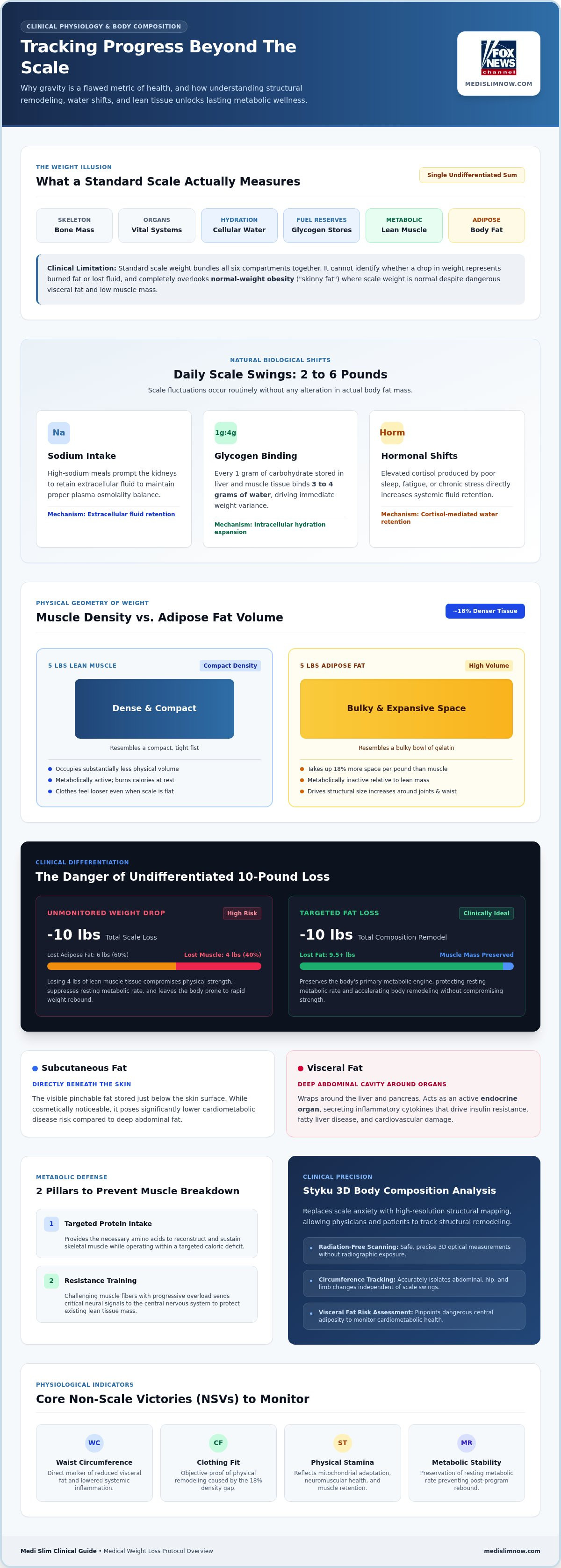
When you step onto a standard bathroom scale, the dial gives you a single number: your total mass against gravity. It bundles your skeleton, organs, intracellular water, glycogen reserves, muscle tissue, and adipose fat into one undifferentiated sum. This aggregate reading can't tell you whether a two-pound drop is lost fluid or burned fat. It also completely misses normal-weight obesity, often called "skinny fat," where a person carries an apparently normal scale weight yet harbors excessive visceral fat and insufficient muscle. Effective medical oversight requires far deeper physiological data than a home scale can deliver.
The Problem with Daily Fluctuations
Your scale weight can easily swing by two to six pounds in a single day without any change in actual fat mass. These shifts are natural biological responses to everyday variables:
- Sodium intake: Higher-salt meals prompt your kidneys to retain extracellular water to balance plasma osmolality.
- Glycogen storage: Every gram of carbohydrate stored in your liver and muscles binds three to four grams of water.
- Hormonal shifts: Elevated cortisol from poor sleep or chronic stress increases systemic water retention.
Fixating on these daily ups and downs creates unnecessary anxiety and stalls motivation. That is why tracking progress beyond the scale provides the objective reassurance you need to stay consistent with your routine.
Muscle Density vs. Fat Volume
Muscle tissue is roughly 18% denser than adipose tissue. Five pounds of lean muscle occupies substantially less physical space than five pounds of body fat, resembling a compact fist compared to a bulky bowl of gelatin.
This physical difference explains why your clothes feel looser even when the scale stays flat. As your body composition improves, you shed voluminous fat while preserving or building dense tissue. Muscle is metabolically active, burning more calories at rest than fat and supporting long-term metabolic stability. Ultimately, tracking progress beyond the scale ensures you measure structural remodeling instead of transient water weight.
Understanding Body Composition: Fat Loss vs. Weight Loss
Body composition measures the direct ratio between lean tissue and adipose fat. While traditional scales treat every lost pound equally, clinical health depends entirely on which tissue you lose. Standard weight metrics fall short here; as public health research confirms, standard body mass index does not distinguish between fat, muscle, and bone mass. Dropping ten pounds sounds positive on paper, but losing four pounds of muscle alongside six pounds of fat compromises your physical strength and metabolic health. True transformation requires protecting skeletal muscle while selectively eliminating excess fat.
The Dangers of Visceral Fat
Not all fat functions the same way. Subcutaneous fat sits directly beneath your skin, while visceral fat hides deep within your abdominal cavity, wrapping around vital organs like your liver and pancreas. This deep abdominal fat acts like an endocrine organ, secreting inflammatory cytokines that drive insulin resistance, fatty liver disease, and cardiovascular complications.
A person can present with an average scale weight yet carry dangerous concentrations of visceral tissue. Because standard scales cannot detect fat location, tracking progress beyond the scale is essential for pinpointing abdominal fat reduction and assessing genuine cardiometabolic risk.
Lean Tissue: Your Metabolic Engine
Skeletal muscle serves as your body's primary metabolic furnace. It demands constant energy to maintain, burning significantly more calories at rest than inactive adipose tissue. Sustaining this lean tissue makes it much easier to adhere to a targeted calorie deficit for weight loss without stalling your progress.
When caloric intake drops during medical treatments, the body naturally attempts to draw energy from both fat and muscle reserves. Preventing muscle breakdown requires two clinical priorities:
- Targeted protein intake: Consuming adequate daily dietary protein supplies the amino acids needed to rebuild and preserve tissue.
- Resistance training: Challenging muscles with progressive strength exercises signals the central nervous system to protect existing lean mass.
Preserving muscle prevents the resting metabolic rate from collapsing. This metabolic protection is what stops rapid weight rebound after completing a program. Partnering with a dedicated medical team at Medi Slim ensures your weight loss protocol actively preserves muscle while accelerating true fat reduction.
Essential Non-Scale Victories (NSVs) to Track
Non-scale victories are qualitative and clinical markers that prove your body is remodeling, even during inevitable scale plateaus. Academic research highlights the limitations of relying solely on BMI and the scale to assess physiological recovery. Documenting these milestones each week gives patients in Richmond and Henrico the tangible reinforcement needed to stay committed to their protocol.
When scale weight stalls due to fluid shifts or muscle retention, non-scale indicators confirm that metabolic fat loss continues uninterrupted. These victories reflect lasting functional improvements that directly enhance daily vitality and longevity.
Physical and Functional Markers
Changes in day-to-day physical function offer immediate evidence that your tissues are adapting. Pay attention to how your body performs and feels across ordinary tasks:
- Clothing drape and fit: Dropping pant sizes or tightening your belt by two notches confirms lost inches, regardless of scale weight.
- Sustained physical stamina: You will notice increased energy while walking the trails in Deep Run Park or managing a busy workday.
- Joint relief and mobility: Every pound of excess load eliminated takes roughly four pounds of mechanical pressure off your knees. That eases everyday stiffness.
Metabolic and Clinical Markers
Internal biomarkers provide rigorous medical validation that your health profile is transforming beneath the surface. Consistent tracking progress beyond the scale should include evaluating these clinical metrics alongside your physician:
- Resting blood pressure: Peripheral resistance declines as abdominal adipose stores decrease, normalizing arterial readings.
- Resting heart rate: A downward trend indicates improved cardiovascular efficiency and decreased myocardial strain.
- Sleep architecture: Reductions in neck and visceral tissue frequently alleviate airway obstruction, easing sleep apnea symptoms and deepening restorative rest.
- Glycemic and lipid stability: Standard blood panels often show lower fasting glucose, improved insulin sensitivity, and reduced circulating triglycerides long before reaching an arbitrary target weight.
Tracking these clinical markers transforms weight management from an anxious fixation on pounds into a structured medical optimization plan.
Advanced Progress Tracking: The Styku 3D Body Scan
While standard scales obscure structural changes, modern optical imaging brings clinical clarity to your health journey. A medical-grade Styku body scan uses non-invasive infrared depth sensors to capture millions of spatial data points across your frame in seconds. Unlike DEXA scans, which require specialized radiology facilities and expose patients to low-dose radiation, Styku delivers zero-radiation imaging. Its predictive software estimates body composition metrics with an accuracy within 1% to 2% of DEXA benchmark standards. By calculating detailed circumferences across the waist, hips, and thighs with a margin of error under 0.5%, it offers objective proof of targeted fat loss.
How Styku Tracks Your Real Progress
The scanning experience is fast, private, and straightforward. You stand in light athletic attire on an automated turntable that completes a 360-degree rotation in roughly 35 seconds. Depth sensors quickly construct an exact three-dimensional digital avatar, calculating your body fat percentage and lean mass volume.
The primary psychological benefit is Styku’s digital overlay tool. Looking in the mirror daily makes progressive body reshaping almost impossible to perceive. The overlay tool superimposes your current 3D silhouette directly over your initial baseline avatar. Seeing your midsection contract and your posture align provides concrete proof that tracking progress beyond the scale delivers insights no simple scale can match.
Data-Driven Decision Making
Detailed surface metrics serve as an essential diagnostic compass for your clinical care team. When patients use medical weight loss protocols featuring semaglutide or tirzepatide, tracking progress beyond the scale ensures weight reduction originates from adipose tissue rather than structural muscle.
If a follow-up scan detects an unnecessary loss of lean soft tissue, your provider can act immediately. They can adjust your medication dosage, increase your daily protein intake, or adapt your resistance routine before your metabolic rate slows. For patients in Midlothian and the greater Richmond region, this continuous analysis removes guesswork from the equation. To evaluate your baseline body composition and build a clear plan for sustainable health, schedule a medical weight loss consultation with our clinical team today.
Integrating Advanced Tracking with Medical Weight Loss
Modern GLP-1 and dual-action medications have transformed obesity treatment by regulating appetite and improving glycemic control. However, their potency makes clinical monitoring vital. When you take semaglutide for weight loss, the rapid drop in appetite creates a significant caloric deficit. Clinical studies show that without careful intervention, anywhere from 20% to over 40% of weight lost on incretin therapies can come from lean muscle tissue rather than fat. That silent muscle loss lowers your resting metabolic rate and compromises long-term vitality.
Pairing tirzepatide for weight loss with regular Styku 3D scanning solves this problem. It separates lean soft tissue preservation from visceral and subcutaneous fat reduction, giving you a full, transparent picture of your transformation. In this context, tracking progress beyond the scale becomes your greatest clinical safeguard.
The Role of Professional Supervision
Self-directed dieting often leads to lean tissue wasting and metabolic rebound. When you cut calories without medical guidance, your body frequently catabolizes muscle alongside fat stores. Professional supervision transforms this process into a structured medical treatment.
During regular check-ins in Richmond, our providers evaluate scan data alongside your symptoms, energy levels, and nutritional intake. If a scan shows that muscle loss is outpacing fat loss, we intervene immediately. We can adjust medication dosages, establish higher dietary protein targets, or modify physical activity requirements. This clinical approach pairs hard diagnostic data with empathetic support, keeping your health journey safe and sustainable.
Your Next Steps at Medi Slim
True body transformation requires both the right clinical treatment and objective proof that it works. Medi Slim provides both under one roof, serving patients across Richmond, Midlothian, and Henrico. Here is what you can expect when starting your program:
- Initial consultation: We review your complete medical history, health goals, and metabolic markers to determine whether semaglutide or tirzepatide fits your needs.
- Baseline Styku scan: We establish a precise 3D baseline of your circumferences, body fat percentage, and lean mass distribution in less than a minute.
- Targeted protocol: You receive an individualized treatment plan focused on active fat reduction while safeguarding your metabolic health.
It is time to move past morning weigh-in anxiety and step into comprehensive body composition analysis. Start tracking progress beyond the scale by scheduling your medical weight loss consultation with Medi Slim today.
Take Control of Your Health Beyond the Numbers
A single number on a bathroom scale cannot capture your true metabolic progress. While daily water retention and shifts in lean mass distort standard weigh-ins, focusing on body composition reveals the actual fat loss you achieve. Prioritizing lean muscle preservation protects your resting metabolic rate and ensures your hard-earned results last for years to come.
Adopting a modern strategy by tracking progress beyond the scale replaces self-doubt with clear clinical evidence. At Medi Slim, we pair physician-supervised semaglutide and tirzepatide programs with Styku 3D body composition analysis to give you definitive, visual validation of your transformation. Our clinical team supports patients across the Greater Richmond area, including Henrico and Midlothian, ensuring every phase of your care is safe, structured, and sustainable.
You don't have to navigate your journey alone or rely on misleading metrics. Schedule your medical weight loss consultation and Styku scan at Medi Slim to see what your body is truly capable of achieving.
Frequently Asked Questions
Why does my weight stay the same even though I am losing inches?
Your weight stays constant because you are experiencing body recomposition: reducing voluminous adipose tissue while retaining or building denser lean muscle. Muscle tissue occupies significantly less physical space than body fat. Fluctuations in intracellular water, sodium consumption, and glycogen storage also mask genuine fat loss on a bathroom scale. When your clothes fit more loosely, you are successfully trimming inches regardless of the stationary scale reading.
What is a healthy body fat percentage for my age and gender?
Healthy body fat ranges vary by biological sex and fitness goals based on American Council on Exercise standards. For men, an acceptable range spans 18% to 24%, with fitness levels falling between 14% and 17%. For women, an acceptable range is 25% to 31%, with fitness levels between 21% and 24%. Body composition scans evaluate where you sit relative to these clinical benchmarks rather than relying on generalized height-weight tables.
How often should I get a Styku 3D body scan to track results?
Most patients benefit from a scan every four to eight weeks. Because meaningful lean mass synthesis and deep visceral fat reduction occur over several weeks, monthly assessments provide the clearest view of physical remodeling. At Medi Slim, we use regular scanning sessions for patients across Richmond, Henrico, and Midlothian to verify progress, optimize nutritional guidelines, and ensure your program consistently moves in the right direction.
Can I lose fat and gain muscle at the same time?
Yes, achieving concurrent fat loss and muscle gain, known as body recomposition, is entirely possible. It occurs most reliably when patients maintain a moderate caloric deficit, consume adequate dietary protein (typically 1.2 to 1.6 grams per kilogram daily), and engage in progressive resistance exercise. In this scenario, tracking progress beyond the scale ensures you celebrate true lean mass development instead of misinterpreting flat scale weight as a plateau.
Is visceral fat more dangerous than the fat I can see?
Visceral fat is significantly more hazardous than subcutaneous fat. While subcutaneous fat sits directly below the skin, visceral fat accumulates deep in the abdominal cavity around organs like your liver and pancreas. It secretes inflammatory cytokines that promote systemic insulin resistance, cardiovascular disease, and metabolic dysfunction. Tracking waist circumference and abdominal volume helps clinical teams evaluate and reduce this hidden cardiometabolic risk directly.
Does Semaglutide cause muscle loss if I don’t track my protein?
Rapid weight reduction on semaglutide can cause substantial muscle loss if protein intake and resistance training are ignored. Incretin clinical trials indicate that lean soft tissue can account for 20% to over 40% of total mass lost without targeted nutritional support. Maintaining protein intake at 1.2 to 1.6 grams per kilogram daily protects lean mass, keeping your resting metabolic rate elevated during treatment.
How accurate is a 3D body scanner compared to a DEXA scan?
Styku 3D body scanners estimate body composition with high clinical correlation, typically falling within 1% to 2% of DEXA scan results. While DEXA uses low-dose X-ray radiation to measure tissue density, Styku utilizes harmless infrared optical sensors to capture millions of surface points. With circumference error margins under 0.5%, it offers medical-grade physical precision in a 35-second, radiation-free evaluation.
What are the most important health markers to track besides weight?
Essential non-weight markers include waist circumference, waist-to-hip ratio, resting blood pressure, fasting blood glucose, and resting heart rate. Tracking progress beyond the scale through these objective clinical indicators gives patients in Glen Allen and Mechanicsville concrete evidence of improved cardiovascular performance, enhanced metabolic health, and reduced joint strain long before a home scale reflects your full physical transformation.