

Weight Loss Before Knee Surgery in Glen Allen: A Medically Guided Plan
Losing weight before knee surgery isn’t a guaranteed way to improve your surgical outcome. If you’re considering weight loss before knee surgery, Glen Allen care teams can help you weigh that decision against your health, pain, and surgical plan.
It’s understandable to feel unsure. You may have heard that reaching a specific weight is essential, while knee pain makes activity harder and medication raises questions about timing. There isn’t one target or approach for every patient. Your orthopedic team can explain whether weight management is recommended for you and how it fits your care.
This article reviews what the evidence says, what to ask your surgeon, and why gradual, supervised changes matter. You’ll also learn how a medical weight-loss consultation can help you discuss whether options such as semaglutide or tirzepatide fit alongside your surgical team’s guidance. The goal is a safe, individualized plan, not a promise of a better surgical result.
Key Takeaways
- Weight loss before knee surgery Glen Allen patients consider should be guided by individual health needs, not assumptions about a universal target.
- Research on preoperative weight loss reports mixed findings. Understand what the evidence can and cannot tell you about surgical outcomes.
- Use a four-step framework to clarify your goals, discuss timing, review options, and agree on monitoring with your care team.
- Your orthopedic team sets surgery-related requirements and instructions, including guidance on medication timing around surgery.
- A medical weight-loss consultation can help you discuss whether supervised treatment, weekly support, and body-composition tracking fit your surgical plan.
Weight Loss Before Knee Surgery in Glen Allen: What Patients Need to Know
If you’re preparing for knee replacement, you may hear different advice about your weight. One person may be told to lose weight first, while another hears that surgery can still help without reaching a particular number. It’s reasonable to ask what applies to you. Weight loss before knee surgery in Glen Allen should be an individualized discussion with your orthopedic team, not an assumed requirement or a promise of a better result.
Preoperative weight management means considering whether and how changes in weight might fit your health needs and surgical timeline. It doesn’t mean every patient needs to lose weight. Weight loss also can’t guarantee fewer complications, faster recovery, or a specific level of pain relief. General information about knee replacement surgery and weight can provide background, but it can’t determine the right plan for an individual patient.
Does losing weight before knee replacement improve outcomes?
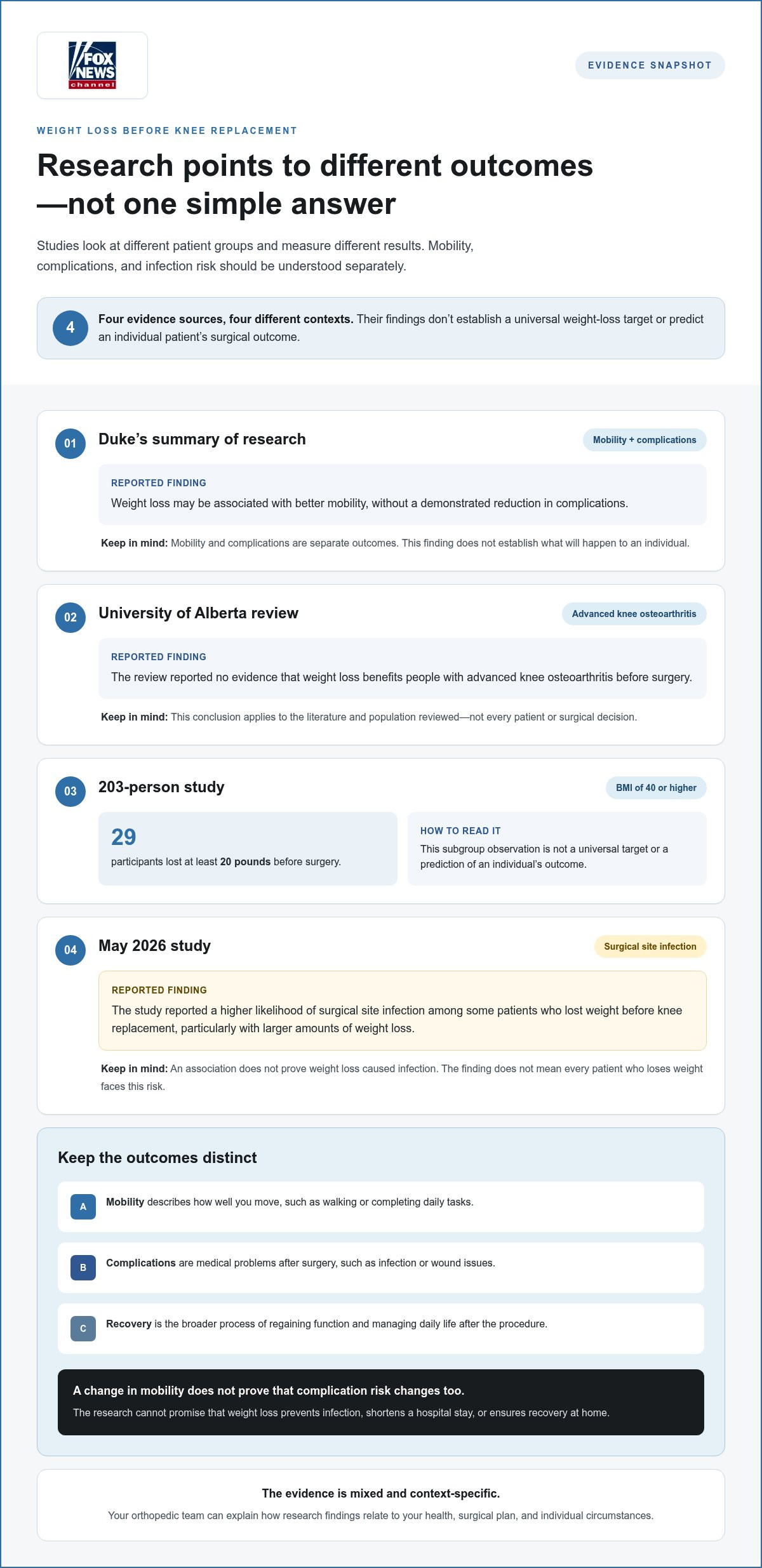
The research doesn’t offer one simple answer. A University of Alberta review of literature on advanced knee osteoarthritis reported no evidence that weight loss benefits patients in that group. Other findings suggest weight loss may support mobility or function, without showing a corresponding reduction in surgical complications. A May 2026 study also reported a higher likelihood of surgical site infection among some patients who lost weight before knee replacement, particularly with larger amounts of weight loss. That finding raises questions about the method and stability of weight loss. It doesn’t show that every patient who loses weight faces increased risk.
Weight loss may support mobility for some people, but that possibility is not proof that it reduces surgical complications. These findings address different outcomes. Mobility and function are not the same as infection risk, wound healing, or eligibility for surgery. The studies also involve particular patient groups and methods, so their results can’t predict what will happen in your case.
Why the right goal depends on your situation
Your surgeon considers the condition of your knee alongside your overall health and functional needs. BMI may be part of that assessment, but it doesn’t capture every relevant factor, such as how comfortably you move or the broader health context behind a measurement. A BMI number alone can’t tell you whether weight loss is necessary, what target is suitable, or whether surgery should proceed.
Start by asking your orthopedic team what they’re aiming to address. Is the discussion about a surgical-program requirement, a concern related to your individual health, or a potential benefit to daily mobility? Ask whether there is a specific target and how it affects your timeline. Your surgeon sets surgery-related requirements and perioperative instructions. If weight management is part of the plan, discuss a safe, realistic approach rather than pursuing rapid weight loss on your own. The goal is a decision grounded in your circumstances, with expectations that reflect what the evidence can and can’t establish.
What Research Says About Weight Loss Before Knee Surgery
Research on preoperative weight loss doesn’t point to one result for every patient. Studies examine different groups and measure different things, from walking ability to complications after surgery. Looking at these outcomes separately helps make sense of seemingly conflicting headlines.
| Source or evidence | Population or evidence type | Reported finding | Limitation |
|---|---|---|---|
| Duke’s summary of research | Patients undergoing knee replacement; outcomes included mobility and complications. | Weight loss may be associated with better mobility, without a demonstrated reduction in complications. | Mobility and complications are separate outcomes, and the finding doesn’t establish what will happen to an individual. |
| University of Alberta review | Review of literature concerning people with advanced knee osteoarthritis. | The review reported no evidence that weight loss benefits this population before surgery. | This conclusion applies to the literature and population reviewed. It isn’t a blanket answer for every patient or surgical decision. |
| 203-person study, as described by Arthritis-health | People with a BMI of 40 or higher; 29 participants lost at least 20 pounds before surgery. | The subgroup’s weight loss was an observation within that study, not a universal target. | A subgroup of 29 people can’t establish a recommended goal or predict an individual’s outcome. |
| May 2026 study | Patients who lost weight before knee replacement. | The study reported a higher likelihood of surgical site infection among those who lost weight, with risk increasing alongside the amount lost. | An association doesn’t prove weight loss caused infection, and the result doesn’t mean every patient who loses weight faces this risk. |
Mobility, complications, and recovery are different outcomes
Mobility describes how well you move, such as walking or completing daily tasks. Complications are medical problems after surgery, such as infection or wound issues. Recovery refers to the broader process of regaining function and managing daily life after the procedure. A change in mobility doesn’t prove that complication risk changes too. Research also can’t support promises that weight loss prevents infection, shortens a hospital stay, or ensures you can recover at home.
What study findings can, and can’t, tell you
Study participants may differ from you in health, knee condition, amount or timing of weight loss, and treatment approach. The 20-pound subgroup finding describes what happened in one study. It isn’t a goal to copy. The evidence is mixed, and study results cannot determine an individual patient’s outcome. For weight loss before knee surgery Glen Allen patients are considering, discuss relevant findings with your surgeon, who can interpret them in light of your case and surgical plan. A medical weight-loss consultation can also help you discuss whether supervised support fits that plan.
If you’re weighing that option, a medical weight-loss consultation can help you consider a supervised approach alongside your surgical team’s guidance.
Should You Pursue Weight Loss Before Knee Surgery? A Personal Decision Framework
There’s no single answer that fits every patient. Start with your surgical goals and circumstances, then include your orthopedic team in any discussion about weight change or treatment. Pain, mobility, other health conditions, surgery timing, and your preferences all matter. Weight loss or medication shouldn’t be assumed to be a prerequisite for surgery. Your orthopedic team sets surgery-related requirements and perioperative instructions.
Use these four steps to organize the conversation:
- Clarify your surgical goals. Describe what knee pain limits, such as walking, sleep, or daily activities. Discuss how your joint condition and overall health factor into the plan, and whether weight change relates to a specific concern or goal.
- Ask about timing. Find out whether there’s a target, timeline, or program-specific requirement in your case. If surgery is scheduled or being considered, explain that timing before starting a weight-loss plan. Don’t assume another patient’s target applies to you.
- Review treatment options. Discuss which approaches may fit your health and preferences. If you’re considering medication, suitability requires an individual medical assessment. The prescribing clinician and surgical team should coordinate guidance about its use around surgery.
- Agree on monitoring. Decide what progress to track and when to revisit the plan. Monitoring can include more than scale weight, but the measures should support your agreed goals, not imply a particular surgical result.
Questions to discuss with your orthopedic surgeon
Bring direct questions to your appointment: Is weight change relevant to my surgical plan, and why? Is there a target, timeline, or requirement for my specific program? How would starting or stopping a medication affect my preoperative instructions? Ask who should coordinate medication guidance and when to share updates. Your treating clinicians’ instructions take priority over general information or advice intended for another patient.
When medical weight management may be worth discussing
If you want structured, clinician-guided support, a medical weight-loss consultation can help you review whether it fits alongside your surgical plan. Treatment isn’t suitable for everyone, and a clinician assesses your individual health before discussing options. Share your surgery timeline and any instructions from your orthopedic team so medication decisions can be considered in context. For background on prescription options, see this prescription weight loss medication guide.
For weight loss before knee surgery Glen Allen patients can use this framework to keep the decision collaborative: clarify the reason, understand the timing, review suitable options, and agree on follow-up. The aim is an informed plan that respects your preferences and your surgical team’s guidance, not a promise of a specific outcome.
How to Coordinate a Weight-Loss Plan With Your Knee Surgery Team
A weight-loss plan should fit around your knee surgery plan, not compete with it. Clear communication helps your clinicians consider your goals, timeline, and treatment together. If you’re exploring weight loss before knee surgery in Glen Allen, use these steps to keep everyone informed and avoid making medication decisions based on general advice.
- Speak with your surgeon. Ask whether weight management is relevant to your individual surgical plan and whether there are specific requirements. Your orthopedic team determines surgery-related instructions.
- Share the timeline. Tell your weight-loss clinician whether surgery is being considered, scheduled, or approaching. Update them if the date or surgical guidance changes.
- Attend a medical weight-loss consultation. Bring the details of your surgical plan and discuss whether structured support or medication is appropriate for you.
- Follow agreed monitoring. Keep follow-up appointments and share relevant updates with your care team. Medication timing around surgery must follow your treating clinicians’ instructions.
What to share at a medical weight-loss consultation
Bring your expected surgery timeline, a current list of medicines, relevant health history, and any instructions from your surgical team. Include concerns such as pain limiting activity, uncertainty about a weight goal, or questions about medication timing. These details help the clinician understand your circumstances, but they don’t mean medication is necessary or suitable. Treatment choices, including whether a prescription is appropriate, are individualized following clinical assessment. Keep your surgeon informed about any plan being considered so medication guidance can be coordinated with perioperative instructions.
How to track progress without making promises
Weight management isn’t measured only by the scale. Medi Slim offers Styku body-composition scans to track changes beyond body weight, along with weekly accountability support as part of its weight-management care. These tools can help you and your clinician review progress and discuss whether a plan remains appropriate. They don’t replace surgical assessments or monitoring by your orthopedic team.
Progress and the time it takes to see changes vary from person to person. A scan or change in scale weight can’t predict how surgery will go, establish readiness for surgery, or promise fewer complications or faster recovery. Keep goals realistic and connected to the plan you’ve discussed with your clinicians. If pain or mobility changes make your current approach difficult, raise that at follow-up rather than trying to compensate with rapid changes on your own.
For coordinated, clinician-guided support, explore medical weight loss and discuss how a personalized plan may fit alongside your surgical team’s instructions.
Medical Weight-Loss Support Near Glen Allen: What Medi Slim Offers
If you’re considering weight loss before knee surgery in Glen Allen, a clinician-guided consultation can help you explore whether medical weight management fits your goals and surgical timeline. Medi Slim serves patients in Glen Allen, Richmond, Henrico, Mechanicsville, and Midlothian from its Henrico office. Medi Slim provides weight-management support, not surgical care. Your orthopedic team remains responsible for decisions about your knee procedure and surgery-related instructions.
What a Medi Slim consultation can help you explore
A consultation is an opportunity to discuss your personal goals, health background, current medicines, and questions about weight management before surgery. A clinician can assess whether medical weight management may be appropriate and discuss treatment options based on your individual circumstances. Medication isn’t an automatic recommendation. Semaglutide or Tirzepatide may be prescribed when appropriate following clinical assessment.
If you’re learning about one of these options, Medi Slim’s Semaglutide weight-loss patient guide offers additional background. Any medication decision should also account for your surgical timeline. Bring the instructions you’ve received from your orthopedic team and share them during the consultation. Medication timing around a procedure must follow your treating clinicians’ directions.
Ongoing support and progress tracking
Medi Slim provides weekly accountability support and Styku body-composition scans. Scans offer one way to follow changes beyond scale weight, while regular support can help you review progress and discuss your plan with a clinician. These services support medical weight management. They don’t assess your knee, determine whether you’re ready for surgery, or replace follow-up with your orthopedic team.
There’s no guaranteed amount or pace of weight loss, and outcomes vary from person to person. A scan or scale reading can’t promise a particular surgical result. The focus is on setting an individualized plan, reviewing how it’s working, and keeping your surgical team’s guidance central as your circumstances change.
Taking a local next step while keeping your care coordinated
Medi Slim’s office is at 201 Towne Center West Blvd, Unit 706, Henrico, VA 23233. For a consultation, bring your expected surgery timeline, current medication list, health history, and any written instructions from your orthopedic team. This information can help the clinician consider whether weight-management support fits your goals and care plan. Continue to rely on your surgical team for decisions about the procedure and instructions before and after surgery.
You don’t need to arrive with a predetermined weight goal or medication choice. The consultation is a chance to review your situation and discuss whether a supervised approach makes sense for you. Schedule a medical weight-loss consultation to talk through your goals and care plan.
Take the Next Step With a Plan That Fits You
You don’t have to settle every question about surgery and weight management on your own. Before your next appointment, note what you want to clarify: whether weight change matters to your plan, what timing your surgeon recommends, and what kind of support feels realistic while managing knee pain. Those questions can make the conversation more practical.
For weight loss before knee surgery, Glen Allen patients can take an individualized approach guided by their orthopedic team’s requirements and their own health goals. If you’re interested in whether clinician-guided weight management could complement your care plan, a consultation is a measured place to start. You can discuss your goals and circumstances without assuming medication or a particular target is right for you.
Schedule a medical weight-loss consultation to discuss your next step. Keep your surgical team’s guidance central and make an informed decision at a pace that respects your health.
Frequently Asked Questions
Should I lose weight before knee replacement surgery?
Not automatically. Whether to pursue weight loss before knee replacement depends on your health, surgical plan, and orthopedic team’s advice. The evidence is mixed: some sources discuss possible mobility or recovery benefits, while a University of Alberta review of literature on advanced knee osteoarthritis found no evidence of benefit in that population. Neither finding predicts your outcome. Ask your surgeon which goals matter for your case, and don’t assume a specific target is necessary.
Can losing weight before knee surgery reduce complications?
Weight loss can’t be promised to reduce complications. Duke’s report highlights possible mobility benefits, but that is distinct from showing fewer complications after surgery. A finding about movement doesn’t establish lower infection risk or safer healing, and one study can’t guarantee an individual result. Ask your surgeon which risks and outcomes are most relevant to your procedure and health, and how any proposed weight-management plan fits your surgical instructions.
How much weight should I lose before knee surgery?
There’s no universal weight-loss target established for every patient in the evidence discussed here. A reported subgroup’s weight change in one study is an observation, not a prescription for you. If your surgeon or surgical program recommends a goal, ask what it is intended to address and how it affects your care plan. Don’t set a number, deadline, or rapid-loss approach based on another patient’s experience.
Can I take weight-loss medication before knee surgery?
Possibly, but medication isn’t required or appropriate for everyone. A clinician can assess your health and discuss whether a prescription option, such as semaglutide or tirzepatide, may fit your needs. Tell both the prescribing clinician and your orthopedic team about any planned or current treatment. They should guide medication timing around the procedure. Follow their specific instructions rather than starting, stopping, or changing treatment based on general advice.
Does a high BMI mean I cannot have knee replacement surgery?
Not by itself in every case. Surgical eligibility depends on your individual health and the criteria used by your orthopedic team or surgical program. BMI is one measure, not a complete picture of health, knee function, or likely outcomes. If BMI has been raised as a concern, ask your surgeon how it applies to your circumstances and whether the program has a specific requirement. Avoid treating a general cutoff as a decision about your case.
Where can I discuss medical weight loss near Glen Allen?
Medi Slim serves Glen Allen and nearby communities, including Richmond, Henrico, Mechanicsville, and Midlothian, from its Henrico office at 201 Towne Center West Blvd, Unit 706, Henrico, VA 23233. A medical weight-loss consultation can help you discuss your goals and whether clinician-guided care is appropriate. Bring your surgical timeline and orthopedic instructions so the discussion reflects your care plan. Medi Slim doesn’t perform knee surgery, so continue surgical decisions and care with your orthopedic team.