

What Happens When You Stop Taking Tirzepatide? Your 2026 Maintenance Guide
Recent clinical data from 2026 indicates that individuals who discontinue advanced weight-loss medications without a structured plan regain an average of 9.9 kg within the first year. If you're nearing your goal weight, you're likely asking what happens when you stop taking tirzepatide and whether your results can truly last. It's natural to feel anxious about the return of hormonal hunger signals or the fear that you've wasted a significant financial and emotional investment.
We understand that you want a clear exit strategy rather than a lifetime of injections. This guide provides a physician-led roadmap for transitioning from hormonal assistance to metabolic independence. You'll discover the biological shifts that occur during the maintenance phase, the latest statistics on weight regain, and how a supervised tapering process helps stabilize your metabolism. By focusing on precise tracking and gradual titration, you can move forward with the confidence that your transformation is permanent.
Key Takeaways
- Understand what happens when you stop taking tirzepatide as your body's natural hunger signals return and the medication's hormonal effects begin to fade.
- Review the 2026 data showing why nearly half of patients keep the weight off and how to stay on the right side of those statistics.
- Learn why a gradual tapering strategy is more effective than quitting cold turkey for managing appetite and stabilizing your metabolism.
- Discover why monitoring body composition with Styku scans is more important than the scale for preventing "skinny fat" weight regain.
- Gain a clear exit strategy through a physician-led maintenance program that prioritizes long-term metabolic health and professional oversight.
The Biological Shift: What Happens When Tirzepatide Leaves Your System?
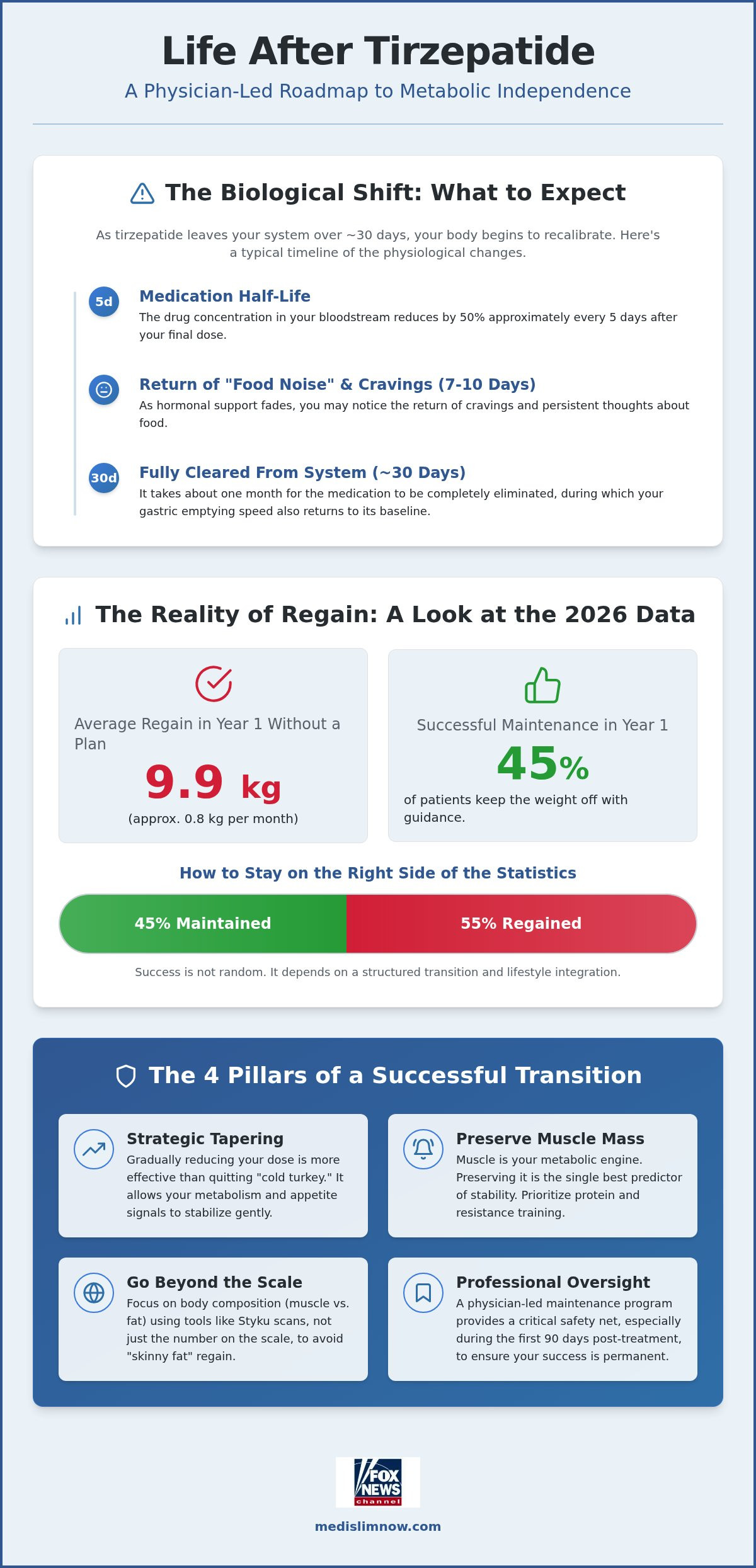
Tirzepatide has a half-life of approximately five days. This means that after your final injection, the concentration of the medication in your bloodstream drops by half every five days. It generally takes about 30 days for the medication to clear your system entirely. During this month, your body begins to recalibrate its internal signaling and hormonal balance. Understanding what happens when you stop taking tirzepatide is the first step in managing the transition and maintaining your health results.
As the drug levels decline, the most immediate change is often the return of food noise. These are the persistent, intrusive thoughts about eating that the medication effectively silenced during your treatment. Many patients worry about what happens when you stop taking tirzepatide because they fear a sudden return of intense hunger. Additionally, your gastric emptying speed returns to its baseline. This means food moves through your stomach faster, which can lead to feeling hungry much sooner after a meal than you did while on the medication.
The Role of GIP and GLP-1 Receptors
Clinically, Tirzepatide functions as a dual agonist. It mimics two natural hormones: glucose-dependent insulinotropic polypeptide (GIP) and glucagon-like peptide-1 (GLP-1). Together, these hormones optimize how your body handles insulin and how your brain perceives reward. While on the medication, your brain's reward centers are quieted, making high-calorie foods less appealing. When this exogenous support is removed, your metabolic rate must rely once again on endogenous hormone production. For some, this shift can lead to a temporary decrease in insulin sensitivity as the body adjusts to managing blood glucose without pharmaceutical assistance.
Immediate Physical Changes to Expect
You may notice cravings returning within 7 to 10 days of your last dose. This occurs as the receptor saturation levels begin to fall below the therapeutic threshold. Digestion speed also increases, which directly impacts how long you feel full after eating. It's a period of significant physiological adjustment that requires a structured plan. Metabolic adaptation is the body's natural reduction in energy expenditure as it attempts to defend a previous, higher weight set point. This biological pull toward your old weight is why professional oversight during the first 90 days post-treatment is so critical.
Will the Weight Come Back? Real-World Data on Post-Tirzepatide Regain
The primary concern for most patients is the risk of a "rebound" once they reach their goal weight. A meta-analysis from January 2026 shows that the average weight regain in the first year after stopping is approximately 9.9 kg. This averages out to about 0.8 kg per month. However, these averages don't tell the whole story. What happens when you stop taking tirzepatide depends heavily on your transition plan and individual metabolic factors.
The "Regain Gap" refers to the disparity between patients who stay stable and those who see a steady monthly increase. Duration plays a role here. Data suggests that staying on the medication for at least 72 weeks allows your body more time to adapt to a lower weight set point. It's also vital to distinguish between water weight and adipose tissue. When you stop the medication, your glycogen stores may fluctuate. This often leads to a quick 3 to 5 pound scale increase that isn't actual fat regain.
Analyzing the 2026 Clinical Insights
A 2026 Cleveland Clinic study found that 45% of patients successfully maintained their weight loss for at least one year post-treatment. This real-world data is often more encouraging than early clinical trials. One reason for this is that patients in clinical settings often receive better nutritional guidance than trial participants. Patients with obesity alone generally show higher maintenance rates compared to those with Type 2 diabetes. The latter group often faces more complex metabolic hurdles. Statistically, if you can maintain at least 80% of your total weight loss through the first six months, your long-term outlook improves significantly.
Factors That Predict Success
Muscle mass preservation is the single best predictor of metabolic stability. If you lose significant muscle during treatment, your resting metabolic rate drops. This makes regain more likely once the hormonal support ends. Behavioral changes established during your program also act as a buffer against hunger spikes. These habits don't disappear just because the medication does. Consistent physician check-ins provide a safety net that catches small gains before they become significant. If you're concerned about your specific risk profile, a medical weight loss consultation can help you identify your metabolic strengths and weaknesses before you transition.
Strategic Tapering: How to Wean Off Tirzepatide Safely
Stopping your medication abruptly can lead to a significant rebound in hunger. This "cold turkey" approach often triggers a sharp increase in ghrelin, the hormone that signals hunger to your brain. When you consider what happens when you stop taking tirzepatide without a medical plan, the most common result is a rapid return of intrusive food noise. A strategic taper allows your body to adjust slowly. This method helps your metabolic system find its new balance without the sudden loss of hormonal support.
A key clinical strategy is the "Maintenance Dose." Instead of stopping entirely, you might stretch your injection intervals from every seven days to every ten or fourteen days. This gradual reduction keeps a small, declining amount of the medication in your system. It acts as a physiological safety net while you practice the lifestyle habits you've built. During this step-down process, your physician will monitor metabolic markers to ensure your blood glucose and insulin levels remain stable as the exogenous assistance fades.
The Step-Down Dosing Protocol
A structured weaning process typically follows three distinct phases. First, you should achieve your goal weight and maintain it for four to eight weeks before making any changes. Stability at your goal is essential. Second, your physician may reduce the milligram dosage of your tirzepatide. This reduction usually happens every two to four weeks to minimize side effects and appetite surges. Third, you will extend the time between injections. This tests your body's natural satiety and gives you a chance to manage your intake without constant pharmaceutical assistance.
Nutritional Pivot Points
Your diet must shift as the medication leaves your system. Increasing your protein intake to 1.2g to 1.5g per kilogram of body weight is vital. This level of protein protects your lean muscle mass, which serves as your primary metabolic engine. You should also adopt a volume eating strategy. By choosing high-fiber, low-density foods like leafy greens and cruciferous vegetables, you can feel physically full even as your natural appetite returns. Referring to a weight loss medication guide is essential for long-term planning because it helps you understand how different prescription options fit into a permanent lifestyle strategy. Adjusting your caloric intake gradually prevents the weight gain that often occurs when what happens when you stop taking tirzepatide is left to chance.
Beyond the Scale: Monitoring Body Composition During Maintenance
Most patients focus exclusively on the number on the scale as they reach their goal weight. However, the scale is often a liar during the transition phase. It cannot distinguish between inflammatory water retention, lean muscle tissue, and actual adipose tissue. When you consider what happens when you stop taking tirzepatide, the most significant risk isn't just a higher number on the scale. It is the danger of "skinny fat" regain. This occurs when you regain body fat while simultaneously losing the calorie-burning muscle mass you worked hard to maintain during treatment.
Muscle mass is the primary driver of your resting metabolic rate (RMR). For every pound of muscle you lose, your body burns fewer calories while at rest. If your RMR drops significantly during maintenance, you would have to eat progressively less just to stay at the same weight. This creates an unsustainable cycle of restriction. 3D body scanning provides a visual map of your metabolic health, allowing you to see exactly where your body is changing before the scale even moves.
Using Styku 3D Scans for Post-Medication Success
Effective maintenance requires data that goes deeper than total body weight. Tracking Tirzepatide results with Styku allows you to identify fat regain in its earliest stages. This technology creates a high-resolution digital twin of your body, measuring circumferences at the waist, hips, and limbs with medical-grade precision. By visualizing changes in your waist-to-hip ratio, you can monitor internal health markers that correlate with insulin sensitivity. Setting specific body composition goals, such as maintaining a certain skeletal muscle mass percentage, is far more protective than chasing a specific weight goal alone.
Preserving Muscle to Prevent Regain
Resistance training is the most effective way to lock in your results. Muscle acts as a "glucose sink," absorbing excess blood sugar and preventing the insulin spikes that lead to fat storage. As the hormonal support of the medication fades, your muscles must take over the heavy lifting of metabolic regulation. What happens when you stop taking tirzepatide is that your body's efficiency at handling calories shifts. Without the drug, your lean mass becomes your best defense against weight rebound.
Styku scans are the gold standard for patients in Richmond and Henrico who want to ensure their transition is successful. These scans provide the objective proof that your lifestyle habits are working. If you want to stop guessing and start measuring your metabolic progress, you can schedule a Styku 3D Body Composition Analysis to secure your long-term success. This data-driven approach ensures that any weight you carry is healthy, functional, and sustainable for years to come.
Long-Term Success in Richmond: The Medi Slim Maintenance Program
Modern weight management requires more than just a prescription; it demands a transition strategy. Many patients feel anxious about what happens when you stop taking tirzepatide because they fear the loss of control. Medi Slim provides a structured maintenance program designed specifically for the Richmond community. Our approach shifts the focus from weight loss to metabolic stability. We operate clinics in Richmond, Henrico, and Midlothian to ensure you have local, physician-supervised support throughout your journey. This physical presence is a significant advantage over distant telehealth services that lack the tools for precise metabolic tracking.
A key component of our "Safety Net" is the use of scheduled check-ins and advanced diagnostics. We don't simply end your treatment once you reach your goal. Instead, we monitor your body's reaction to the absence of the medication. If your weight regain exceeds a specific threshold, such as five pounds, we have a protocol in place to re-engage with treatment immediately. This proactive stance prevents small fluctuations from turning into significant setbacks. You can move forward knowing that a professional team is watching your progress.
The Value of Clinical Supervision
Regain often triggers a sense of failure, yet it is a common biological response to hormonal changes. Our team offers a non-judgmental environment where your health is the only priority. We utilize advanced diagnostics and Styku 3D scanning to monitor your progress with medical precision. This allows us to ensure your long-term safety and hormonal balance once your Tirzepatide for weight loss treatment concludes. By identifying metabolic shifts early, we can adjust your lifestyle plan before significant regain occurs. Our coaching is personalized to the Central Virginia lifestyle, making your habits sustainable in the real world.
Taking the Next Step
Securing your results begins with a maintenance consultation. During this session, you will work with your doctor to create a personalized "Relapse Prevention Plan." This document outlines your specific caloric needs, activity goals, and a weight threshold for re-engaging with medical support. Having a pre-defined plan removes the guesswork and reduces the anxiety of what happens when you stop taking tirzepatide. You are not just finishing a medication; you are starting a new phase of metabolic health. Schedule your consultation at Medi Slim Wellness today to finalize your exit strategy and protect your investment in yourself.
Securing Your Metabolic Future
Transitioning from hormonal assistance to metabolic independence requires more than willpower; it requires a data-driven strategy. You have learned that a gradual taper and precise body composition tracking are the primary tools for avoiding the "regain gap." Understanding what happens when you stop taking tirzepatide allows you to prepare for the return of natural hunger signals with confidence rather than anxiety. By focusing on muscle preservation and metabolic stability, you can ensure that your weight loss becomes a permanent lifestyle change.
Our team at Medi Slim provides physician-led tapering protocols and advanced Styku 3D Body Composition Analysis to protect your hard-earned results. With convenient locations in Richmond, Henrico, and Midlothian, expert local support is always accessible as you navigate this final phase of your journey. You have already done the heavy lifting of losing the weight. Now, it is time to build the metabolic safety net that keeps it off for good. Book Your Maintenance Consultation at Medi Slim Now and take the next step toward lasting health.
Frequently Asked Questions
Will I immediately feel hungry after my last Tirzepatide shot?
You won't feel hungry immediately because tirzepatide has a five-day half-life. It takes roughly 30 days for the medication to clear your system entirely. Most patients notice food noise returning after 7 to 10 days as drug levels in the bloodstream drop. This gradual return of appetite is a primary reason why our Richmond clinics recommend a structured tapering plan to help your body adapt slowly.
Is it possible to stay on a low maintenance dose of Tirzepatide indefinitely?
Long-term maintenance is a valid clinical approach for many patients. Obesity is a chronic condition, and some individuals require a low dose to maintain their metabolic set point. At Medi Slim, we customize dosing based on your specific health markers and progress. Some patients in Henrico stay on a reduced dose for extended periods, while others successfully transition to lifestyle-only management after a supervised weaning process.
How much weight do people typically gain back after stopping Tirzepatide?
Data from 2026 indicates that patients who stop medication without a plan regain an average of 9.9 kg in the first year. This is often what happens when you stop taking tirzepatide without metabolic support. However, 45% of patients in real-world studies maintain their weight loss for over a year. Your success depends on muscle preservation and whether you follow a physician-led titration schedule rather than quitting cold turkey.
Can I restart Tirzepatide if I begin to gain weight back?
You can absolutely restart treatment if your weight begins to trend upward. We establish a safety net threshold for our patients in Midlothian and Glen Allen. If you regain five pounds, we re-evaluate your metabolic markers and lifestyle habits. Early intervention is more effective than waiting until significant regain occurs. Resuming a low dose can often stabilize your progress before you lose the results you worked hard to achieve.
What is the best diet to follow after stopping weight loss injections?
A high-protein, high-fiber diet is the most effective approach for weight maintenance. Aim for 1.2 to 1.5 grams of protein per kilogram of body weight to protect your lean muscle mass. Volume eating with leafy greens and cruciferous vegetables helps manage satiety as your natural hunger signals return. This nutritional strategy, combined with resistance training, provides the metabolic foundation needed to stay stable once hormonal assistance ends.
Does insurance cover Tirzepatide for weight maintenance?
Insurance coverage for maintenance varies significantly by provider and plan. As of August 2026, some commercial plans cover medications like Zepbound or Mounjaro for long-term use with a savings card. The Medicare GLP-1 Bridge program also provides coverage for eligible beneficiaries. Our team helps you navigate these options during your consultation to determine the most cost-effective path for your long-term success in the Richmond area.
How often should I get a Styku body scan after stopping medication?
We recommend a Styku 3D body scan every 30 to 60 days during the maintenance phase. These scans are essential for identifying skinny fat regain, which is fat gain that occurs while losing muscle mass. By tracking your waist-to-hip ratio and skeletal muscle mass, we can adjust your program before the scale shows a change. This diagnostic tool is available at our local clinics to provide objective proof of your metabolic health.
Can lifestyle changes alone really replace the effects of Tirzepatide?
Lifestyle changes are the foundation of health, but they don't always address the complex hormonal signals that tirzepatide manages. The medication changes how your brain perceives hunger and how your body processes insulin. While habits like strength training and high-protein intake are vital, a physician-supervised maintenance program bridges the gap between pharmaceutical support and long-term metabolic independence. This combined approach offers the highest probability of permanent success.