

How Semaglutide Helps with Calorie Deficit: A Medical Guide to Fat Loss
Your inability to stick to a strict diet isn't a lack of willpower. It is a biological battle against your own brain's hunger signals. For many, the mental energy required to maintain a lower intake feels like a full-time job that never ends. Understanding how semaglutide helps with calorie deficit is the first step in moving away from the cycle of restriction and regain. This medication doesn't just suppress your appetite. It fundamentally changes how your body signals fullness, allowing you to focus on your health instead of your next meal.
You've likely dealt with the frustration of weight loss plateaus or the constant "food noise" that makes every evening a challenge. It's a common experience that can make even the most dedicated person feel defeated. We'll show you how to leverage clinical science to make fat loss sustainable and predictable.
This guide explains the mechanics of metabolic health, the importance of tracking body composition with tools like Styku 3D scans, and why medical oversight is essential for long-term success. You'll discover how a structured, physician-led program helps you reach your goals without the anxiety of self-guided dieting.
Key Takeaways
- Learn the biological foundation of a calorie deficit and why energy balance is the primary driver of successful fat loss.
- Discover how to calculate a sustainable 15-20% deficit to avoid the metabolic stress and hunger spikes associated with crash dieting.
- Understand how semaglutide helps with calorie deficit by regulating hunger signals in the brain and extending the feeling of fullness.
- Identify why Styku 3D Body Composition Analysis is more effective than a standard scale for tracking actual fat loss and muscle preservation.
- Recognize the hormonal triggers, like ghrelin, that make traditional dieting difficult and how medical supervision can help you bypass these biological barriers.
What is a Calorie Deficit? The Biological Foundation of Fat Loss
A calorie deficit is the fundamental requirement for fat loss. It occurs when your total energy expenditure exceeds your energy intake. In the simplest terms, your body must use more fuel than you provide through food and drink. This concept is often referred to as "Energy In vs. Energy Out" (CICO). While this sounds straightforward, the biological reality involves a complex balance of metabolic processes that determine how your body stores or burns fuel.
Your body requires energy for every function, from breathing to walking. When you maintain a deficit, your system can't find enough immediate energy in your bloodstream from recent meals. It must turn to its backup power source: stored adipose tissue, or body fat. This is the only biological path to reducing fat. Understanding how semaglutide helps with calorie deficit is essential because it addresses the physiological signals that make maintaining this energy gap so difficult for most people.
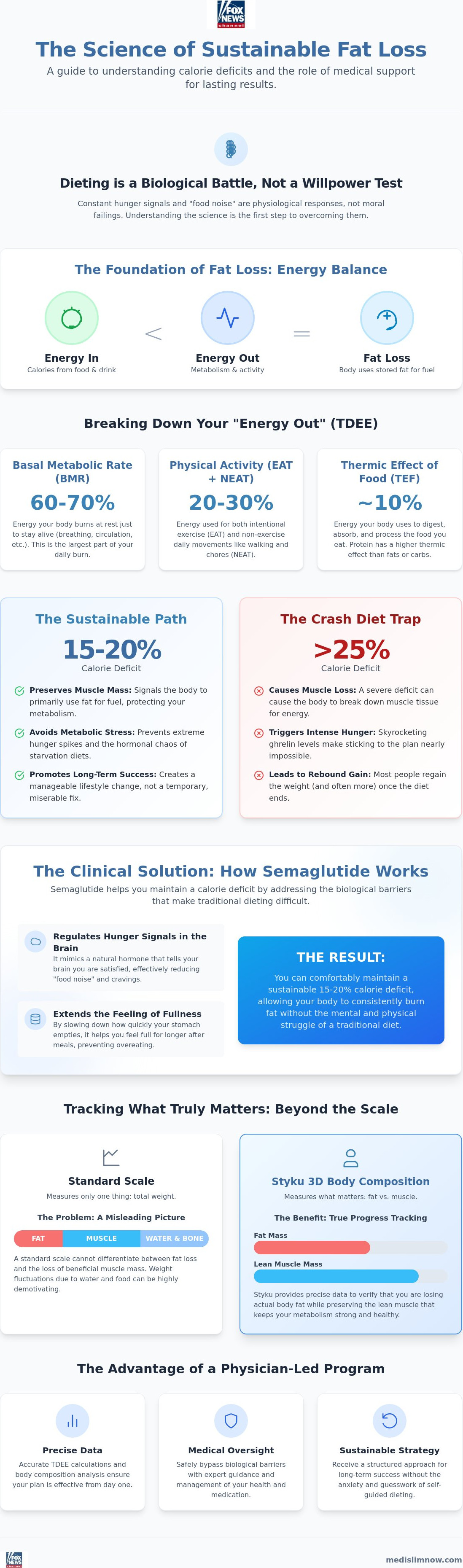
The total energy you burn each day comes from three primary pillars. These include your resting metabolism, your daily movement, and intentional exercise. When these three factors combined are higher than your caloric intake, you are in a deficit. Without this gap, even the most nutritious diet won't result in fat loss.
BMR vs. TDEE: Understanding Your Burn
Your Basal Metabolic Rate (BMR) represents the energy your body needs just to stay alive. It covers the "survival energy" required for your heart to beat, your lungs to expand, and your brain to function while you are at rest. This accounts for the majority of your daily burn. Your Total Daily Energy Expenditure (TDEE) is the sum of your BMR plus all physical activity and the energy used to digest food.
Many Richmond patients find that generic online calculators miss the mark. These tools use broad averages that don't account for your specific muscle mass or metabolic health. Relying on an inaccurate TDEE calculation is a common reason for weight loss plateaus. We prioritize precise data because an accurate starting point is the only way to ensure your deficit is effective rather than just exhausting.
Why a Deficit is Mandatory for Weight Loss
Fat loss is a process of fat oxidation. When your body senses a lack of incoming energy, it releases stored fatty acids into the bloodstream to be used as fuel. This is a survival mechanism. However, there is a significant difference between losing "weight" and losing "body fat percentage." If a deficit is too aggressive, the body may break down muscle tissue for energy instead of fat.
Medical tools like Semaglutide help protect this process by making a moderate, sustainable deficit easier to maintain. You don't have to resort to "crash" diets that trigger muscle loss. Instead, you can focus on high-quality nutrition while the medication manages your appetite. You can see the impact of this approach when tracking Semaglutide results with Styku. This technology allows us to verify that you are losing actual fat while preserving the lean muscle that keeps your metabolism strong.
How to Calculate Your Calorie Deficit for Sustainable Results
Determining your calorie deficit starts with identifying your maintenance calories. This is the amount of energy required to keep your weight exactly where it is today. To find this, we use the Mifflin-St Jeor equation to calculate your Basal Metabolic Rate and then multiply it by your activity level. A sedentary professional in Henrico will have a different requirement than someone with a physically demanding job in Midlothian. Activity levels in Central Virginia vary significantly, and a mismatch between your calculated activity and your actual daily movement is a frequent cause of stalled progress.
Once you have your maintenance number, we generally recommend a 15-20% reduction. This range is more sustainable than aggressive "crash" diets that often lead to metabolic stress. Understanding how semaglutide works is vital during this stage. The medication slows gastric emptying and manages blood sugar, which helps you stay within this 15-20% window without feeling the intense deprivation usually associated with dieting. This is how semaglutide helps with calorie deficit management; it makes the math of fat loss physically tolerable for the long term.
The Math of Fat Loss: Setting Your Targets
A common goal is a 500-calorie daily deficit. Theoretically, this leads to approximately one pound of fat loss per week. However, you must avoid dropping below 1,200 calories per day without direct medical supervision. When intake is too low, your body may enter a state of metabolic adaptation, slowing your heart rate and reducing non-exercise activity to conserve energy. To avoid this, focus on macronutrient balance. Prioritizing protein pacing is essential. Consuming protein at regular intervals helps protect your lean muscle mass while your body burns fat for fuel. This is how semaglutide helps with calorie deficit success by bridging the gap between your biological hunger and your clinical targets.
Adjusting for Metabolic Adaptation
Weight loss is not a linear process. As you lose weight, your body requires less energy to function. This means your maintenance calories will drop as you get smaller. It is a moving target. To avoid plateaus, you should recalculate your deficit every 10 to 15 pounds. This ensures your targets remain accurate for your current body composition. For specific meal ideas that fit these targets, you can review our guide on what to eat on Semaglutide. If you are ready to see how a supervised plan can simplify this process, consider a medical weight loss consultation to get your personalized numbers and professional guidance.
Why Willpower Fails: The Biological Barriers to a Deficit
Dieting is often framed as a test of character. This is the "Willpower Myth." In reality, your brain is hardwired to resist a calorie deficit to ensure survival. When you eat less, your body doesn't see a health goal. It sees a threat to its energy stores. This triggers a cascade of hormonal responses designed to force you to eat. Understanding how semaglutide helps with calorie deficit management starts with recognizing that your biology is more powerful than your intentions.
The primary driver of this resistance is Ghrelin, often called the hunger hormone. When you restrict calories, your stomach produces more Ghrelin, which sends urgent signals to your hypothalamus. At the same time, your body experiences "food noise." This is a term for constant, intrusive thoughts about your next meal. Clinical research indicates that this medication has demonstrated the largest weight loss of any obesity medication to date by directly addressing these neurological signals. It quietens the noise, making a deficit a medical process rather than a mental struggle.
Your body also employs metabolic adaptation, often called "starvation mode." As you lose weight, your Basal Metabolic Rate (BMR) naturally slows down. Your system becomes more efficient, burning fewer calories to perform the same tasks. This is a survival mechanism that can make even a well-planned deficit feel like a losing battle without medical intervention.
The Hormonal Sabotage of Dieting
Leptin is the hormone responsible for telling your brain you are full. When you lose body fat, your leptin levels drop. Your brain interprets this as a sign that you are starving, even if you still have significant fat stores. This hormonal shift increases your drive to eat while simultaneously slowing your metabolism.
Many Richmond residents struggle with this biological wall despite "knowing what to do" regarding nutrition. You may follow a plan perfectly for days, only for your hormones to trigger an uncontrollable binge. This isn't a lack of discipline. It is a physiological response to a drop in leptin. How semaglutide helps with calorie deficit sustainability is by mimicking natural satiety hormones, which compensates for this leptin drop and keeps your brain in a state of perceived fullness.
Overcoming the Weight Loss Plateau
A true plateau occurs when fat loss stops for several weeks, but it's often confused with water retention. High-stress levels or a high-sodium meal can cause the scale to stay still even while you are losing fat. However, hidden calories in oils, dressings, and "healthy" snacks can also accidentally close your energy gap. At Medi Slim, our clinical oversight identifies these underlying metabolic issues. We use precise data to distinguish between temporary stalls and true plateaus, ensuring your plan stays on track.
Tracking Progress: Why Styku 3D Scanning Beats the Scale
The standard bathroom scale is a blunt instrument that often fails to reflect your actual physiological progress. It measures total mass, which includes water, bone, and muscle, rather than just adipose tissue. For our patients in Central Virginia, we utilize Styku 3D Body Composition Analysis to provide a precise view of your transformation. This technology creates a high-resolution 3D avatar of your body, allowing us to see exactly where you are losing inches, even when the scale remains stagnant.
This data is crucial for understanding how semaglutide helps with calorie deficit success by ensuring the weight you lose is primarily fat. A scale might show a five-pound loss, but it cannot tell you if that loss came from your muscle or your fat stores. By tracking your waist-to-hip ratio, we can monitor your cardiovascular health risk more accurately than through BMI or total weight alone. This clinical approach replaces the frustration of home weighing with the quiet confidence of scientific data.
Visualizing Fat Loss vs. Muscle Gain
Styku's precision is unmatched in a clinical setting. It measures millimeters of loss across your entire frame, capturing changes in your chest, waist, thighs, and arms. This level of detail confirms how semaglutide helps with calorie deficit management by allowing us to verify that your fat-burning processes are optimized. We prioritize muscle retention because lean tissue is the primary driver of your resting metabolic rate. If you lose muscle, your BMR drops, making it harder to maintain your results. For a detailed look at how this data differs from traditional metrics, see our guide on tracking Tirzepatide results with Styku.
The Psychological Power of 3D Data
Seeing a 3D visualization of your progress prevents the diet fatigue that often occurs during a weight loss plateau. When the scale doesn't move due to water retention or hormonal shifts, your 3D avatar can still show a significant reduction in body volume. This visual proof provides the motivation needed to stay compliant with your medical protocol. We use these body measurements to adjust your calorie targets in real-time. This ensures that your plan evolves as your body composition changes. Richmond patients prefer this level of clinical data because it removes the guesswork and provides a clear, uncomplicated path forward. To experience this precision for yourself, book your Styku 3D Body Composition Analysis at our clinic.
How Semaglutide Helps You Maintain a Calorie Deficit
Semaglutide functions as a GLP-1 receptor agonist. It mutes hunger signals directly in the hypothalamus, the part of your brain that regulates appetite. This is the core of how semaglutide helps with calorie deficit adherence. By altering these neurological pathways, the medication eliminates "food noise." You no longer experience the intrusive, persistent thoughts about food that typically lead to overeating. This makes maintaining your energy gap feel like a natural state rather than a constant effort.
The medication also slows down gastric emptying. This means food stays in your stomach for a longer duration, signaling to your brain that you are full far sooner than usual. When you feel physically satisfied for hours after a small meal, the psychological urge to snack disappears. This physiological change is why many patients finally succeed after years of failed self-guided diets. It transforms the deficit from a math problem into a physical reality.
Some critics view medical intervention as a shortcut. However, weight loss shots near me are clinical tools designed to improve compliance with a necessary health protocol. They aren't "cheating." They are a way to level the biological playing field. When your hormones are working with you instead of against you, a calorie deficit becomes a manageable medical process. This medical support is often the missing piece for those with underlying metabolic resistance.
Bridging the Gap Between Math and Behavior
A successful deficit requires a change in daily behavior. Semaglutide helps you naturally choose smaller portions without the feeling of deprivation. It also reduces cravings for high-calorie, ultra-processed foods by dampening the brain's reward response to sugar and fat. To ensure you remain comfortable throughout this transition, we provide comprehensive Semaglutide side effects management. This oversight ensures that your journey toward fat loss is both effective and well-tolerated, allowing you to stay consistent with your goals.
Your Clinical Journey in Richmond
At Medi Slim, your transformation begins with a medical weight loss consultation. Our physicians review your health history and use Styku 3D data to build a personalized calorie plan. We don't just provide medication. We provide a structured environment where your progress is monitored and your protocol is adjusted in real-time. This physician-led approach combines the power of Semaglutide with the precision of metabolic data to ensure long-term success. You don't have to navigate the complexities of fat loss alone.
Ready to make your deficit effortless? Schedule your consultation at Medi Slim today and take the first step toward a sustainable body transformation.
Take Control of Your Metabolic Health
Achieving a sustainable calorie deficit is a biological challenge that requires more than just discipline. By addressing the hormonal signals that drive hunger and food noise, you can move away from the cycle of restriction and regain. Understanding how semaglutide helps with calorie deficit management allows you to focus on high-quality nutrition while your body efficiently burns stored fat for fuel. This medication transforms the weight loss process from a test of willpower into a manageable medical journey.
Our local clinics in Henrico and Midlothian provide the professional oversight needed to ensure your safety and success. We combine physician-supervised Semaglutide and Tirzepatide programs with Styku 3D Body Composition Analysis to give you a clear, data-driven view of your progress. You don't have to rely on a misleading bathroom scale when you have access to millimeter-accurate precision. This clinical approach removes the anxiety of self-guided dieting and replaces it with quiet confidence and predictable results.
It's time to stop the struggle of willpower and start a professionally managed medical process. We are here to partner with you on every step of your health journey. You deserve a plan that works with your biology rather than against it.
Start Your Supervised Weight Loss Journey at Medi Slim
Frequently Asked Questions
Is a 1,200-calorie diet safe while taking Semaglutide?
A 1,200-calorie diet is generally considered the minimum safe threshold for most adults under medical supervision. Your specific requirement depends on your starting weight, muscle mass, and daily activity level. Dropping below this amount can lead to nutrient deficiencies and muscle wasting. Our physicians monitor your intake to ensure you receive adequate fuel while the medication manages your appetite signals.
How much of a calorie deficit do I need to lose 2 pounds a week?
You typically need a daily deficit of 1,000 calories to achieve a loss of two pounds per week. This creates a 7,000-calorie weekly gap, which is the energy equivalent of two pounds of fat. While this is a common goal, it may be too aggressive for some individuals. A moderate 500-calorie daily deficit is often more sustainable for long-term metabolic health and muscle preservation.
Why am I not losing weight even though I am in a calorie deficit?
You may be consuming hidden calories in oils, dressings, or beverages that close your energy gap without you realizing it. It is also possible your body has adapted to your current weight, meaning your maintenance calories have dropped. We use Styku 3D scans to determine if you are losing fat even when the scale is stalled due to water retention or hormonal shifts.
Can I build muscle while in a calorie deficit on Semaglutide?
It is possible to build or maintain muscle while in a deficit if you prioritize high protein intake and consistent resistance training. This process is known as body recomposition. Understanding how semaglutide helps with calorie deficit management allows you to focus on nutrient-dense, protein-rich foods while the medication suppresses the urge for low-quality snacks. This protects your resting metabolic rate during your transformation.
How do I know if my calorie deficit is too aggressive?
Signs of an overly aggressive deficit include persistent fatigue, hair thinning, and extreme irritability. If your energy intake is too low, your body may also trigger a sudden spike in hunger as a survival mechanism. We monitor these clinical markers during your physician-led program to ensure your rate of loss remains effective without compromising your long-term health or energy levels.
Do I still need to track calories if Semaglutide reduces my appetite?
Tracking calories is recommended during the initial phases of your program to ensure you are eating enough protein and micronutrients. While the medication significantly reduces your appetite, it can be easy to under-eat, which may trigger metabolic adaptation. Tracking provides the data needed to confirm your plan is working and helps you establish new, healthy portion habits for the future.
What happens to my metabolism if I stay in a deficit for too long?
Staying in a continuous deficit for an extended period can lead to metabolic adaptation, where your body burns fewer calories at rest to conserve energy. This is why we incorporate "maintenance phases" into our clinical protocols. These periods of eating at your maintenance level help reset your hormonal signals and prevent long-term plateaus before you return to a fat loss phase.
How does Tirzepatide compare to Semaglutide for maintaining a deficit?
Tirzepatide targets both GLP-1 and GIP receptors, which may offer a dual approach to appetite suppression and metabolic regulation. While both medications are highly effective, some patients find that one better suits their specific biological profile. This is how semaglutide helps with calorie deficit success for many, while others may benefit from the additional hormonal pathway provided by Tirzepatide for their journey.